On 9/11, Death, and the Crippling Effects of Fear

We were afraid of things before 9/11.

What happened over a handful of hours that Tuesday morning sixteen years ago did not suddenly render the citizenry of the United States of America apprehensive or fearful. We had things to be afraid of back then. Like natural disasters, school shootings, the rise of gangsta rap…

But what happened on 9/11 was not an “it-just-got-real” kind of awakening to global terrorism, or even the unsettling feeling that America was more vulnerable than we had long assumed. It was actually far more subtle a change than these. What happened was a shift in a basic narrative about our own existence, both as a nation as well as individuals. We did not simply learn new fear.

We learned dread.

The World of Dread

One of the main effects of the 9/11 attacks was how unexpected they were – how utterly blindsided they made the vast majority of us feel. None of us – save for conspiracy theorists and maybe a few people in Langley, Virginia – woke up that morning on high alert. Our eyes weren’t already nervously glued to cable news (which, yes, was alive and kicking even back then) for the latest updates out of the Middle East or North Korea. Most folks on the West Coast weren’t even awake at all when the world started caving in.

My own morning began as mundanely as any of that year. Rising with the alarm clock at the crack of dawn to shower and dress up nicer than I had been used to throughout my college career in order to look as professional as a twenty-one-year-old can look to the student body of San Marcos High School in San Marcos, Texas, where I was less than a month into my student teaching semester, and my final sprint to the finish line of graduation. By the time I walked in the classroom, the radio was already reporting that a small, private plane had crashed into the side of the North Tower. Another hour and two additional crashes later, I was standing in the hallway of the school trying to call my father on a cell phone that weighed heavier than the laptop I’m currently writing this on. I knew he had been set to board an American Airlines flight from Miami to Dallas that morning, and the breaking news reports – which we mostly kept muted on the classroom TV – were still speculating that the hijacked flights could have originated from as far away as Miami. It was another couple of hours before I finally heard his voice on the other end of a scratchy cell connection, assuring me he was fine, not to worry, just going to be stuck in south Florida for a few more days. As a pilot himself, my father had flown all over the country when I was growing up. However, weighed down by the chaotic series of events that morning, he had never sounded, or felt, farther away than he did in that moment.

That night, I drove two blocks to the gas station nearest to my apartment and waited in line for thirty minutes to fill up. Not for any reason other than increased speculation that gasoline could very well become as scarce for all of us as it was for The Road Warrior. I didn’t know that this speculation would quickly turn out to be false. I didn’t know that, while probably a wise thing to do considering the circumstances, it was nonetheless an overreaction. The point is, I didn’t know anything for sure.

For all I and everyone else knew, more attacks could already be in the offing. As the week drew on and the rubble smoldered and the President spoke through a loudspeaker and cable news gave airtime to every interpretation it could think of, reassurance of safety never came. We became increasingly aware that the world – or at least our place within it – had irrevocably changed. We were living in a new normal. Fear had struck, and in so doing it had released its most dangerous toxins: suspicion and anxiety. As a result, these became the main contributors to our opinions and our behaviors. When the identities of the culprits came to light, a lot of us promptly became experts at identifying suspicious people (or, at least, identifying anyone with brown skin, be they Arab, Persian, or Puerto Rican) because we had been reminded of stranger-danger and were compelled to be ever-vigilant going forward. We keyed in to newscasts and foreign policy reports with greater interest than before, not because we were interested in the news itself, but because we were as stressed and worried as we had ever been, and we craved even the slightest of assurances that corrections were being made and retributions were being paid.

We hadn’t expected anything like 9/11, but now we knew better. We knew that it could happen again, at any moment, at any time, and be the work of just about anybody.

Whether we were aware of it or not, we had been ushered into the world of dread, a state of existence that befalls any who allow fear to rule over their lives. The world of dread is a vast, lawless landscape of the mind where anything goes and the darkest scenarios are not merely possible, they are probable. So protect what is yours at all costs, and trust no one.

In the aftermath of 9/11, the primary narratives about our lives, the world, even existence itself changed, and not for the better. We became less trusting, more withdrawn and individualistic. Our sense of community was no longer driven by hospitality and inclusion, but rather a circling of the wagons. However, this shift in our perspectives was so subtle that most of us hardly noticed. We just assumed we had learned a tragic lesson about being more cautious as a society. About individual responsibility and the dangers of naivety. About the need to indulge our doubts regarding the alleged kindness of strangers.

The Damaging Effects of Dread

I know how far-reaching are the effects of dread. I have experienced first-hand what happens when we let fear rule over our minds and cloud our perspectives.

Thirteen years before the Towers fell, my own little world caved in. On 12/19 of 1987, my sister died suddenly and tragically, the victim of a freak accident during a Christmas-caroling hayride. Like all of us on 9/11, I don’t think anyone in my family, or any other family who belonged to our small town’s First Baptist Church, woke up that morning expecting anything but another chilly, central Texas day filled with holiday shopping and home decoration. But by nightfall, I found myself in the back of the family van as it barreled along county roads, my father praying aloud the same desperate words: “Jesus, please. Please, Jesus.” When we arrived on a neighborhood street near the center of town, I saw the swirling red glare of an ambulance. My parents made me stay in the car. I don’t know how long I was alone in there. It could have been five minutes, it could  have been fifty. All I remember is feeling jealous that Katy would get more attention – maybe even more presents – over the holidays because obviously with this accident she would be in some sort of cast. Perhaps encasing a broken arm, or maybe a broken leg. But everyone would want to sign it, and that meant a lot more focus on her than me. (I hope you will give me a break on this; I was eight years old, and this was the most selfish time of the year for kids my age.) But then the side door of the van finally opened and my parents were standing there and my father looked at me and, in a voice strangled by tears, he spoke my name and said, “Katy died tonight.” I cried, too, and held onto my mother. Neither she nor my father ever appeared more helpless than they did in that moment.

In the weeks that followed, I found myself wandering into my sister’s bedroom a lot. It was the standard bedroom of a thirteen-year-old, eighth-grade girl. I opened and closed her music box. I ran my fingers along the spines of her collection of young adult paperbacks. I fiddled with her Garfield telephone that opened its eyes when you took the receiver off the cradle. Mostly I listened to the silence and allowed myself to exist in the sudden, gaping emptiness of the place.

I wondered where Katy was now. I wondered how soon it would be before death came for me as well.

For the next decade and a half, I lived with the knowledge that tragedy can strike at any time. And no one is safe. There was little I knew for sure, but I did know one thing. If death could befall a thirteen-year-old girl on a Christmas-caroling hayride, it could certainly come for me at any moment.

I had become acquainted with death, perhaps far sooner than children should be. It was on my mind a lot. I would lie in bed at night, paralyzed with dread, not so much by the standard closet boogeymen and half-dozen other nocturnal fears I was used to, but by the thought of my own candle being unceremoniously snuffed out. What did it matter how I went out, really? The simple fact was that, sooner or later, I was a goner.

It was this unrelenting weight of dread that eventually got me listening more closely in church. When talk arose of salvation and going to heaven (which was, of course, far better than the alternative), I perked up my ears and paid attention. Eventually, about a year after Katy’s death, I whispered some semblance of a sinner’s prayer beneath the protective shroud of my bed covers. Essentially, it was a get-out-of-hell-free prayer. I accepted that only Jesus could save me, and so I asked him to. But despite praying the prayer, my fears of sudden death were not instantly relieved. Quite the contrary. While I was happy to have followed the prescribed steps to ensure I wouldn’t burn for eternity, I was still destined to die, and that in itself remained a terrifying thing.

If anything, I became even more fixated on death, and the parasitic dread that had wormed its way into my mind continued to pump me full of anxiety. It got to the point that even heaven became an unsettling concept. Did eternity really just go on and on, never-ending, a perpetual, otherworldly existence? I couldn’t wrap my mind around such a thing, no matter how golden the streets were said to be, and so, ironically, I came to fear the unknown of a second existence as much as I dreaded the certainty that the first one would one day come to a most-assured end.

The Dwindling of Dread

It has taken a long time, a great deal of reflection, and the dismissing of a lot of bad theology to even begin to climb out of a self-dug grave of dread. But this is what fear does; it corrupts everything it touches. It can turn even the brightest hopes into unnerving shadows.

I believe this has been one of the most significant impacts of 9/11. For all our patriotic responses, I cannot help but recognize an undercurrent of dread in so much of what we think, say, and do as a country. We use the term “post 9/11 world” often, because we have accepted that things have changed. That life will never again be like it was in a pre-9/11 world. And the theological struggles of my youth have helped me understand just how difficult it can be to resist the relentless pull of fear upon our minds.

It is almost impossible not to feel overwhelmed by the prospects of impending disaster, or be swept up in the sensationalistic fear-mongering of cable news, social media, and presidential elections. The enterprises of suspicion, prejudice, distrust and dread are as robust as ever. In fact, it seems we have become expert practitioners in these unspiritual disciplines, to the point that no country in the world could ever claim greater proficiency in the neuroses of terror. We may barrel out our chests and insist that the terrorists will never win, but that’s only because we mostly judge the win-lose line according to physical destruction, not mental anguish.

Now, I’m not saying caution is all bad. And I’m not arguing that the dangers we perceive in our world aren’t real. While we had plenty to fear before 9/11, our cup does indeed seem to runneth over sixteen years later. We are afraid of terrorism hotbeds and lone-wolf attacks and mobs of white supremacists. We are afraid of rogue police officers and creepy clown sightings and all those killers and rapists who keep crossing our unwalled Mexican border. We are afraid of WikiLeaks and alt-right news and diplomats who hide their super-secret, society-crumbling schemes on private e-mail servers. We are afraid of the politics of Supreme Court justices, the inherent dangers in visiting crowded public squares, and the persistent reports that our oceans’ temperatures are rising. We’re afraid even of our own President.

As I compose this long and winding post, the unrelenting, peripheral winds of Hurricane Irma slam my house. I look out my bedroom window and see the trees swaying violently. So, yeah, there’s still plenty of natural disasters to fear, too. Maybe even more than there used to be, thanks to those (allegedly) warmer oceans. Sometimes it seems as unlikely that we can successfully resist fearfulness as it is that these trees will resist bending beneath the power of a hurricane.

One needs only a few seconds to take stock of how much we have to fear even in the present moment. As I write all this, half of Houston lies in ruins, a maniacal dictator aims his intercontinental ballistic missiles in our direction, and a catastrophic storm shakes my part of the country like a dog with a chew-toy. So it is that any reflecting I attempt to do on this 9/11 anniversary will of course be a reflection on the crippling, society-altering effects of fear. But at least these days my prayers are no longer voiced according to the language of dread. My supplications are not merely one despondent lament after another. No, I am learning how to pray hopeful prayers. They are honest, yes, and full of sincerity about the world I live in, but they retain an unabashed optimism about this present life.

Here are some of the things I pray for these days:

I pray that those like me – who have indeed repented of all their false narratives and embraced the salvation offered by and through Jesus – might exhibit the courage and the resolve so many people in this country boast about but don’t actually possess. That we would take a hacksaw to the shackles of future-fear, and vehemently refuse to let our perspectives become clouded by suspicion and anxiety.

I pray that even within this reality of ours, which some days feels as if it suffers under the sick compulsion to remind us that death is swift and inevitable, we would lean into a different set of disciplines – compassion, encouragement, patience, intelligence, mercy, advocacy, and self-control – and truly, truly become people who do not live inside self-made prisons of dread.

I pray that when doubts arise and fears assail, we would seize upon the greatest of all disciplines: love. And not just any love. Not a shallow, fleeting, self-obsessed love. Not a vacuous, tolerant, permissive love. The love we pursue must be much stronger than those. The love we choose to give must be a love that is resilient. It must not conform in any way to the patterns and prejudices of a frightened world. “There is no fear in love,” wrote the Apostle John, “but perfect love drives out fear, because fear expects punishment. The person who is afraid has not been made perfect in love.”

So, on the anniversary of 9/11, even as many of us sit amidst the rage of Irma, may we devote ourselves to a power that is as unexpected and society-altering as death, yet became the only force in the universe death could not defeat. May we learn His kind of love. Sacrificial, unconditional, irrepressible. A love that rejects every ounce of fear. A perfect love.

Free from dread.

#Charlottesville and the Folk Religion of the “Alt-Right”

I write this on Sunday morning. I’m sitting in my office at the church considering how many of my friends and colleagues are preparing to stand before their own congregations and preach their sermons, and how many of those preachers have felt compelled to drastically change the sermons they have already crafted, and the anxiety they feel when this broken world of ours is beset by sudden and shocking events that inevitably tip their hand – when they know they must say something even when it feels like nothing we could ever say will take away the pain and outrage and confusion.

torches

This weekend, a large group of American citizens gathered for a march in Charlottesville, Virginia. They lit torches, created signs, and stuck a handful of catchy chants into the back pocket of their blue jeans and camouflage pants. As darkness fell, they advanced upon a city square like some ultra-racist variation of pitchfork-toting villagers come to kill Frankenstein’s monster. Numerous confrontations ensued. Passersby became entangled in the violence. Counter-protestors shouted back. Eventually, mere rhetoric gave way to fists, feet, clubs, and pepper spray. One person turned his car into a weapon and plowed into a crowd of pedestrians, killing a young woman. In the process of patrolling the madness, two law enforcement officials died in a helicopter crash.

Social media has been awash with pictures of angry faces, provocative signs, human walls, and the professionally issued statements from civic leaders and politicians, most of whom have denounced the violence. The president is one of these (though his statements have been a little too ambiguous for a lot of people’s liking). Personally, I am shocked by everything I have seen and everything I have read.

beating

Not to be callous, but I spent my more reflective moments last week considering how I might answer the question, Would God allow a nuclear war? I figured this was the big concern on most people’s minds, at least at present. As such, when I first learned of the events in Charlottesville on Saturday morning, my equilibrium was rocked. Despite the state of race relations in our country, I still wasn’t expecting this.

Unfortunately, a discouragingly large number of people with access to torches and a plethora of hate-filled rhetoric vehemently disagreed with what I had thought was the biggest problem of our day. They disagreed so sharply that they organized a march. So, here we are once again, fighting amongst ourselves, engaging in a vitriolic blame-game about individual rights and societal influence despite a looming shadow of much more dire issues aimed directly at our collective humanity.

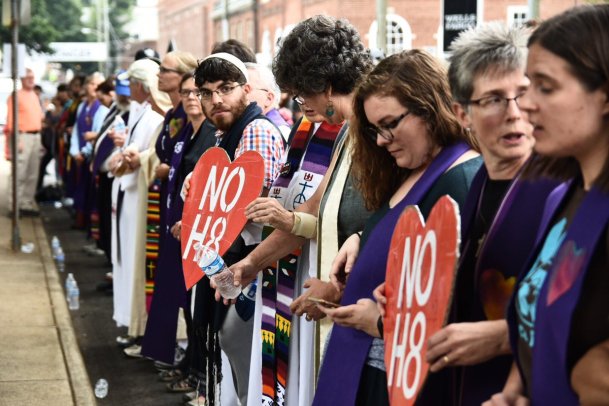
I turned my attention, though, to the events in Charlottesville, and it was not long before an image shook me to my core. It was that of a human wall populated by men and women in clerical robes, priest collars, and prayer shawls. They stand shoulder to shoulder. Some clutch Bibles against their hips, while a few feet away the blue-jeaned and camouflaged-adorned “alt-right” scream about the need to return America to “its Christian roots.”

clergy

What?!

And I realize that whether I like it or not, we must not only adjust our sermons and Bible studies this morning because of an astonishing outbreak of insolence and rage in our country; we have to change them because tangled up in the back-and-forth arguments of both sides is the Kingdom of God. Both sides believe they are standing up for its principles, and to the millions of outside observers it is almost impossible to distinguish if one side is completely right and the other completely wrong, or if the Christian faith is just another malleable philosophical system that can be manipulated into bearing all manner of social views, however alternative or fringe.

A Prayer for Clarity

This past week, I sent an e-mail welcoming a recent visitor to the church, but it turned out I had the wrong address. I received a snarky response from an obvious atheist who attributed the Christian faith to nothing more than 2000-years worth of mass hysteria. I’m not the kind of person who can leave such a parting shot alone, so in addition to apologizing for confusing his address, I added a short plea for civility rather than rudeness. He responded curtly, “Get off your high horse, Bo. Your religion is responsible for more intolerance and injustice than rude assholes like myself could ever aspire to.”

Now, I probably shouldn’t have written back in the first place. I probably should have allowed this apparently militant atheist to insult my beliefs without response. However, what bothered me most was not the insult. It was that this man had learned a completely false concept of God’s Kingdom. When he thinks of Christianity, what he sees is the catalyst for suffering, not the remedy for it. When he encounters a Christian, he doesn’t see someone who’s life has been radically redefined by a relationship with God’s son, but rather someone who has applied for membership in an oppressive, power-hungry regime of moralistic bigotry. And that’s as much the fault of actual Christians not denouncing such behavior as it is his for accepting such fraudulent expressions of faith.

So, this morning, what I pray for from my fellow preachers and teachers regarding the events in Charlottesville is clarity. I hope that we will denounce what is clearly not Christianity – in this particular instance the hate-filled, violent tantrums of the “alt-right” – because avoidance or ambiguity of this situation will only muddle society’s comprehension of Christianity. In this case, the truth is that a Christian who steps into the fray can do so only with those who stand against the cries for subjugation, exclusion, and regressive entitlement. If he steps in on the other side, he has effectively stepped out of God’s Kingdom.

Jesus often spoke of the Kingdom of God as if it were a real place – a true reality that was slowly unfolding, day-by-day, beneath the surface of our worldly events, however mundane or chaotic. He did not shy away from pinpointing where certain people – or, at least, certain behaviors – were located in proximity to this coming Kingdom. To a lawyer who agreed with him that the greatest commandments were not ceremonial directives but rather wholehearted love of God and neighbors, Jesus responded, “You are not far from the Kingdom of God.” When his disciples tried to prevent children from crawling onto his lap, Jesus rebuked them, saying that the Kingdom is populated with people who do just that. And he taught that the poor, the peacemakers, and the persecuted were the ones who would “inherit the Kingdom of God.”

But Jesus also told a story about a man who missed out on God’s Kingdom when, after receiving unexpected forgiveness for an astonishing amount of debt, threw one of his own debtors into prison, having failed to let that forgiveness permeate and transform his life. Then there was the time Jesus watched a wealthy man walk away from his counsel and remarked, “It is exceedingly difficult for a rich person to enter God’s Kingdom.” In contrast to the poor, the peacemakers, and the persecuted, he also lamented the self-centered perspectives of the rich, the prideful, and the self-actualized, which would inevitably lead only to ruin.

The Folk Religion of the Alt-Right

White Supremacists March with Torches in Charlottesville

The main reason white supremacists have historically been able to claim Christianity as a banner is that society long ago replaced a life lived according to the radical truths of Christianity with cultural concepts like decency, propriety, and “know-your-role/know-your-place” classism. For many people, the Kingdom of God became intertwined with the idolatrous City of Man, where conduct, appearance, and status reign supreme.

I do not doubt that many of those who support views espoused by the alt-right, and perhaps even some who marched on Charlottesville, believe they are on the side of a good, fair, and moral citizenry. I accept their earnestness and their passion. I recognize that they truly believe they are stemming the tide of a great injustice. In their minds, they are heroes, not villains. However, what they are actually standing up for is not Christianity but the ideology of a particular brand of folk religion.

In his book, Questions to All Your Answers, Roger Olson provides a helpful description of what exactly folk religion is. He writes, “[it] is practiced mostly by individuals although they may network with each other. A folk religion spawns little or no research or focused thought. Theology is anathema to folk religion; it lives by word of mouth and internet circulation. It cares only about feelings and experiences and hardly at all about doctrine or critical reflection.”

Indeed, so much of the Christianity we have encountered over last year’s election season, as well as the way some particular evangelical leaders have contorted Scripture to support our current administration’s policies (including this one), is not Christianity at all. It is folk religion. It is molding and shaping a faith system that fits neatly into our particular opinions, ambitions, and carefully curated prejudices. Sadly, some of the most successful pastors in our country are mere folk Christians, not true citizens of God Kingdom. Of course, we must remember that the same can be said for some individuals on the opposite side of the present issues, who can become so focused on “progress” that they speed right past the Kingdom in search of a utopia of their own design.

So, I pray for clarity, because folk religion dupes a lot of people. Contrary to what my short-lived e-mail pen-pal believes, the actual culprit behind all the intolerance and injustice in the world is folk religion – a ghastly legacy of ruthless selfishness perpetrated by person after person donning a Jesus mask utterly stripped of its true colors and features, like the unnatural Shatner mask from Halloween. And in whatever venue we have at our disposals – pulpits, classrooms, blogs – we need to call it what it is. We need to re-establish exactly how far such people are from the Kingdom of God, if only to clarify what the Kingdom of God really is. 

Giving an Answer

both sides

Just a few minutes ago I heard a church member remark how much wiser it would have been for those who oppose alt-right ideologies to have simply turned their backs on this group’s torch-lit march through Charlottesville. No counter-protesters. No news agencies. No photographers. I have to admit, I started chuckling at the thought of a bunch of indignant white nationalists assembling on an empty university lawn, their only audience the summer crickets chirping indifferently. They look around curiously, holding signs that no one will read. They shrug their shoulders impotently. “Should we just go home?”

If only.

The truth is that our society will not – cannot – ignore such people. It’s going to give them its attention, and its going to comment on them and react to them and formulate ideas in response to them. And because of this, those who unequivocally offer their allegiance to the eternal Kingdom of God cannot ignore them either. We cannot turn our backs on the issues at stake. We must not pretend like everything will eventually settle down and revert to life as usual.

“In your hearts revere Christ,” writes the Apostle Peter to the churches of the first century. “Always be prepared to make a defense to anyone who calls your beliefs into account. Only do so with gentleness and respect, keeping a clear conscience, so that those who slander your good deeds in Christ end up ashamed” (1 Pet. 3:15-17).

Whether it knows it or not, this world is calling us to account. Let’s not be afraid to give a clear answer.

A Need to Disconnect

This is part two of a two-part essay. The first part, which you can read HERE, focused on the problem. This week, I do my best to offer a solution.

It seemed like a good idea at the time. Desperate times called for desperate measures. Even if someone could have foreseen the dangers that lay far ahead, what other choice was there. They could not concern themselves with future generations. If they didn’t do something now, there would be no future generations.

So Joseph bought all the land in Egypt for Pharaoh. The Egyptians, one and all, sold their fields, because the famine was too severe for them. The land became Pharaoh’s, and Joseph reduced the people to servitude, from one end of Egypt to the other. …  Joseph said to the people, “Now that I have bought you and your land today for Pharaoh, here is seed for you so you can plant the ground. But when the crop comes in, give a fifth of it to Pharaoh. The other four-fifths you may keep as seed for the fields and as food for yourselves and your households and your children.” 

“You have saved our lives,” they said. “May we find favor in the eyes of our lord; we will be in bondage to Pharaoh.”  (Genesis 47:20-21, 23-25)

This is how the Bible records the origin of Hebrew enslavement to Egypt. It starts in the midst of a terrible famine. It’s the socioeconomic backdrop that we don’t often notice raging behind the drama of Joseph and his brothers. Year by year, the peoples of Canaan and the other surrounding regions find themselves unable to grow crops, unable to raise animals, unable to hunt or forage. And Joseph, who has ascended all the way to Pharaoh’s cabinet, responds to the suffering of a lot more people than his remorseful siblings.

skywalker 2

Joseph’s family are the Skywalkers within a Universe full of other compelling stories.

Of course, by establishing a system of civil servitude and taxation based on the productivity of Egypt’s subjects, Joseph has also opened the door to oppression. Though he is essentially the first taskmaster the Israelites will know, at least he is kind. He understands their plight. He strives to create a system that maintains balance.

But Joseph cannot live forever.

Then a new king, to whom Joseph meant nothing, came to power in Egypt. “Look,” he said to his people, “the Israelites have become far too numerous for us.”…

So they put slave masters over them to oppress them with forced labor, and they built Pithom and Rameses as store cities for Pharaoh. But the more they were oppressed, the more they multiplied and spread; so the Egyptians came to dread the Israelites and worked them ruthlessly. They made their lives bitter with harsh labor in brick and mortar and with all kinds of work in the fields; in all their harsh labor the Egyptians worked them ruthlessly.  (Exodus 1:8, 11-14)

More often than not, oppression is the go-to tool of an empire. To keep a heavy hand upon the common rabble is not simply a way to exert power. It is a way to prevent the people from considering any other power but yours.

Still, in the story of the Israelites’ toil in Egypt, we see more than just a picture of oppression. We see the ingeniously cruel amalgamation of oppression and productivity, of enslavement and efficiency. Despite such persecutory suffering, Pharaoh’s demand for endless toil somehow still breeds blind allegiance! Consider what the Israelite elders say to Moses and Aaron after their royal court disruptions, which only serve to enrage Pharaoh who turns around and accuses the Israelites of laziness – laziness! – and ups the ante on their brick-and-mortar production quotas.

…they found Moses and Aaron waiting to meet them,  and they said, “May the Lord look on you and judge you! You have made us obnoxious to Pharaoh and his officials and have put a sword in their hand to kill us.”  (Exodus 5:20-21)

Today, when we read this story, we shake our heads at the infamous Israelite stubbornness, how they lash out at the very people working for their deliverance! We fail to recognize that systems of endless productivity and efficiency make us oblivious to what real freedom looks like when it actually presents itself.

phone

This sermon is a little long for our taste. Glad we brought something to pass the time.

In my previous post, I ranted about addressed this same oppressive reality in our society today. We may not struggle under the thumb of a tyrannical Pharaoh, but we are fools to deny that numerous, present-day taskmasters aren’t woven into our own cultural fabric. They hide behind so much of what we have come to accept as modern-day realities, often whispering even behind simple phrases like “normal society,” “status quo,” “tech-savvy,” “bonus check,” or “Sorry but I’ve got to take this call.”

I also wrote about a new law that took effect in France this year, which places restrictions on large companies regarding their employee’s connectivity to work e-mails and messages; it is a small yet significant step in trying to give people back some semblance of rest, a portion of their existence not wholly defined by occupational pursuits. And it is the very thing that so frightened and enraged Pharaoh.

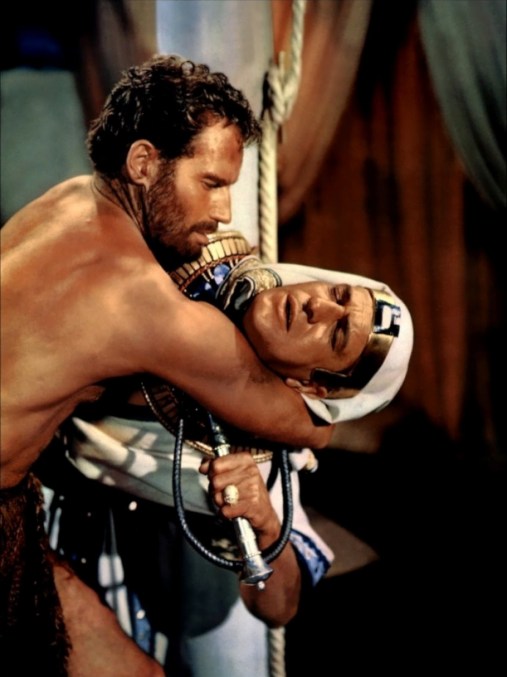
Cecil B. DeMille’s epic The Ten Commandments is an iconic piece of cinema, but it doesn’t get everything right about the Exodus story. The most memorable of all its lines – “Let my people go!” – is deceptively inaccurate. Moses and Aaron did not swagger into the royal court as tenacious liberators, brazenly offering Pharaoh a lose-lose deal. No, their request was much tamer. “Let my people take a break” would be a more accurate line. All they asked for, at least at first, was a spiritual retreat – essentially a three-day weekend – in which the Israelites could pilgrimage into the wilderness and offer sacrifices to their God.

Ten Commandments

Also, Ridley Scott wasn’t the only one to envision Egyptian and Semitic peoples as slightly tanned Caucasians.

Pharaoh refuses not because a three-day retreat would mean three days of limited brick and mortar production. Remember, the productivity quotas imposed on the Israelites were designed to oppress, to weary, to strip away every defining aspect of who they were, except hopeless slaves. This almost impossible workload was instituted so they would have no time whatsoever to indulge in their own sociocultural identity. After all, awakening to the reality of who you truly are – and what you were made for – poses the greatest threat to the powers of oppression.

Why? Because you start to realize you may not actually need them anymore. That there might be another way of life. One that liberates rather than subjugates. One that frees rather than abuses.

This, by the way, is the Rosetta Stone of interpretation we should apply to the Law, which is given to the Israelites on the other side of the Sea of Reeds after the waters effectively annul Joseph’s citizen-slave system. Consider how the Book of Exodus introduces the Ten Commandments:

And God spoke all these words: “I am the Lord your God, who brought you out of Egypt, out of the land of slavery…”  (Exodus 20:1)

Every single law and ordinance and regulation flows from this foundational identity, and should be understood as pointing back to the principles of the Lawgiver, rather than arbitrary codes of conduct for a fledgling nation. God is the Deliverer. He is the breaker of chains. He is the new taskmaster that, in stark contrast to Pharaoh, desires his servants to live in peace and prosperity, to live free from the wearying, life-sapping bonds of endless productivity and efficiency.

Game of Thrones Season 3 Review

Copycat.

For any who may not be convinced by this, consider what the fourth commandment is, and the way both Exodus 20 and Deuteronomy 5 describe it. “For in six days the Lord made the heavens and the earth, the sea, and all that is in them, but he rested on the seventh day.” If the greatest Ruler/Creator/Designer/Builder dedicated a day to complete rest (the Hebrew word, menuha, literally means “to cease”), and, what is more, if out of every single piece of creation it was this day of complete rest that He chose to call “holy” (qadash), you can be certain He wants His subjects to do far more than honor it. He wants them to experience it.

Let’s consider that fact for an additional moment. In the Creation poem that opens our Bibles, only one thing is explicitly deemed “holy.” It’s not the vast Pacific. It’s not the majestic Rockies. It’s not even the man and the woman, made in God’s own image. Sure, they’re called “good,” but only the seventh day – the Sabbath – is actually called holy. This day in which God ceases from extraordinary, glorious productivity – this is what must be declared most excellent, set apart, and preserved.

The French legislation is known as the “right to disconnect law.” But God’s law already has one. It is a “need to disconnect law.”

Sabbath, at its core, is about disconnecting from the cultural obligations and expectations to produce, to want, to crave, to be stimulated and insubstantially satisfied by the world’s systems. As Jesus corrected the Pharisees, the Sabbath was made for man. It should never be defined by deprivation or a list of don’t-do-and-can’t-do’s; instead, we should see it as a happy return to the freedom and peace we have already been given by our Great Deliverer. It is a day we devote to face-to-face connection with our families, cultivating deeper relationships with friends, celebrating the extraordinary beauty of this short life, and worshipping the One who made the world and called it very, very good.

France’s passing of a “disconnect” law should give us pause. It should remind us that insatiable productivity is an ever-present threat, and the assumption that everyone should always be connected – dialed in to the Matrix – is not a passing fad. Even in a society that prides itself on individualism and personal freedom, Pharaoh’s identity-sapping edicts are alive and well.

And just like in Egypt, it thrives off our wearied acquiescence to the system. It feeds off a culture that spinelessly shrugs its shoulders and says, “I can’t afford not to check my e-mails, answer my phone, come in on a Saturday. I can’t afford not to check my Facebook feed, respond to these texts, be one of the 300,000,000 people who viewed this video…”

rest

What are you talking about? I’m quietly sitting still in a mostly dark room. How is this not restful?”

What would it look like if not just a negligible minority of us but rather a whole country full of Christians (not to mention Jews) decided to truly observe the Sabbath for what it was always intended to be? What would happen if, for a single day each week, we turned our backs on all the professional obligations and nagging responsibilities that incessantly demand our time and energy, and also set aside all the tools and gadgets that sneakily tether us to unquenchable compulsions? What would happen if, instead, we pursued the things that gave us true rest? The things that restored our awareness of freedom, intimacy, joy, and celebration.

While the stresses of daily life and work would remain, I suspect our weariness of them would lessen. I don’t think we would so often lament how busy we are. Maybe we wouldn’t be so quick to consult our phone screens when we’re in the company of other people. Maybe we’d even become a little kinder. A little more patient. A little more peaceful.

Because that’s what deliverance does. It changes your life.

When They Just Don’t Get It

This week’s post is a rerun, originally published on June 24, 2013. Next week, look for Part 2 of “A Right to Disconnect.” 

Yesterday, I received an unwelcome glimpse into the future of my vocation.

While the interim senior pastor at my church has been traveling, I’ve had the privilege to deliver the sermons in the morning and evening worship services. I don’t take these invitations lightly.

I love preaching. I love the preparation – choosing the text, meticulous researching, jotting down good lines turned in captivating ways. I enjoy writing the manuscript. And, despite the unavoidable pain that comes from revising and cutting it down to size, I relish the way slashing paragraphs and removing unnecessary repetition seems to grant freedom to the whole enterprise.

I even enjoy practicing the manuscript out loud, contending with it until I’m able to leave it behind without losing point or pace.

cheater

Cheater.

Preaching is an art form. It is as much a specialist’s craft as poetry, painting, playing an instrument or writing a short story. I know I still have a long way to go before I can consider myself an accomplished craftsman, but each opportunity afforded me is practice I need and practice I crave.

But yesterday, following the worship service, I came face-to-face with one of the biggest drawbacks to making this art form part of a ministerial career.

It wasn’t criticism. By now, I’ve preached enough sermons and taught enough Bible studies to receive my fair share of negative responses. A few disparagements have been called for. A few have not. And a few of the “have nots” remain, without a doubt, the most selfish, insensitive and tactless attacks I’ve ever heard leveled against another human being. (That last group usually comes by way of e-mail, one of the many ways the Internet allows us to wage bloody trench wars against people we disagree with.)

It’s true that criticism can be acutely discouraging. I have had my sense of accomplishment and my confidence behind the pulpit sapped more than once by the homiletic equivalent of “haters.” Ultimately, though, negative criticism only makes the preacher work harder and pay more attention to the words and illustrations he chooses.

writing-sermon

Okay, so how can I keep this point from sounding like “the vapid, ignorant utterings of a pea-brained, liberal jackass with all the common sense of a monkey throwing its feces?”

No, what left me so disconcerted with the preaching life yesterday was not criticism. Rather, it was some of the conversations I had with parishioners at the close of the service (no more than ten minutes after I’d finished delivering my sermon). I should say that most of the people who greeted me had only kind and encouraging things to say. However, there was a small minority of people who expressed their enjoyment of the sermon, but then lingered to tell me why. The reasons they gave flowed directly from a point-of-view I had spent the last half hour arguing against!

In a nutshell, yesterday’s sermon intimated that the gospel of Jesus Christ erases all manner of distinction between a person and others. Orbiting the life-altering words of Galatians 3:28 (“There is no longer Jew or Greek, there is no longer slave or free, there is no longer male and female; for all of you are one in Christ Jesus.”), my main premise was that the truth of the gospel abolishes all lines of contrast we humans so often draw around ourselves or our communities, be they cultural, political, racial, or socioeconomic. I insisted that if followers of Jesus want to live as authentic Christians rather than by the weak and maligned societal definition of the word “Christian,” then we must submit to this radical new way of thinking and speaking and doing. There can be no argument. The gospel of Jesus robs us of the permission to figure our identity by worldly standards.

Somehow, despite so carefully preparing this message and painstakingly practicing its delivery, it seems that a few people nevertheless heard the exact opposite message than I intended. When they praised the sermon, they did so based on a particular cultural, political, or social perspective, and seemed brazenly unaware that bad-mouthing or lamenting people whom they considered different from them was the very thing I had spoken against.

What bothered me most, though, was the presumptuousness. Each of these point-missers simply assumed I shared their point-of-view, when, in reality, all I could think was, “Well, that’s not what I meant at all,” and “Did you even listen to the part where I said ________?”

plugging-ears

Aah! He’s saying something that sounds impactful. Quick, plug your ears!

Look, I’m no fool. I understand it is unrealistic to expect one sermon to completely change every heart and mind, no matter how much preparation I give to it. And I also realize that God is patient, and that he calls his children to be patient as well. Changing minds takes time. As a matter of fact, that happened to be one of the main points of the sermon – that sanctification is a struggle because we are constantly pulled backwards into our old ways of life, into cold legalism and the convenience of social distinctions.

And yet, there is something deeply disconcerting when the words you speak are not only heard incorrectly, but the people who most need to hear a message of deliverance interpret what you say as encouragement to keep on living the way they’ve been living. It made me wonder if this is always going to be an unwelcome aspect of the preaching life. Will anything ever break through to such people? Will the Spirit ever be able to convict them?

Furthermore, how exactly do I respond to such misinterpreted praise? Granted, I was a substitute – a guest preacher. Communicating the truth of God’s Word comes as one-shot opportunities right now. I’m not sure it’s my place to stop the well-meaning commenters in the middle of what they’re telling me and say, “Wow, you just didn’t get it at all, did you?”

Spiritual Life Week

“C’mon, be honest. You were just doodling in the bulletin the whole time, weren’t you?”

As I ponder the next step and whether or not I’m really up for this kind of life, I realize that maybe there is no significant difference between receiving negative criticism and receiving misinterpreted praise. It still just makes me want to work harder – to meticulously pour over that next message (whenever the opportunity to preach comes my way again), and consider even more deliberately the audience to whom I speak.

I realize something else, too. It occurs to me that it’s one thing to stand up on a stage or behind a pulpit and preach a good sermon. It’s a whole other thing, in the midst of post-sermon conversations, to live as that very model of grace and Christ-filled patience.

God have mercy! There’s no greater art form than that.

Playing Jesus

I spent hours last week pretending to be Jesus.

If you grew up in an evangelical tradition of the Church like I did, particularly one that unfolded in or around the so-called “Bible Belt,” you probably remember a little thing called Vacation Bible School. Granted, it is an understatement to call this old standard of summer children’s ministry a little thing; anyone who has worked the VBS of even a small-to-moderate-sized church knows it often commands the attention of dozens, if not hundreds, of church members. Even before the actual event arrives, it’s all-hands-on-deck. There are materials to organize, rosters to assemble, costumes to distribute, sets to build, and a plethora of decorations to plaster in every nook and cranny of the church campus.

I was volunteering with Vacation Bible Schools  – whether willingly or compulsorily – well before I ever chose to enter the ministry. Over the years, I’ve contributed in a variety of areas: registration clerk, recreation leader, classroom helper, recreation leader, drama team member, recreation leader, and storyteller. Oh, and recreation leader. If you work in VBS long enough, you will find yourself donning a variety of hats. I mean that literally. You will end up sporting some of the most ridiculous and unnecessary headgear you’ve ever seen, all in service of the event’s exuberant, almost manic atmosphere.

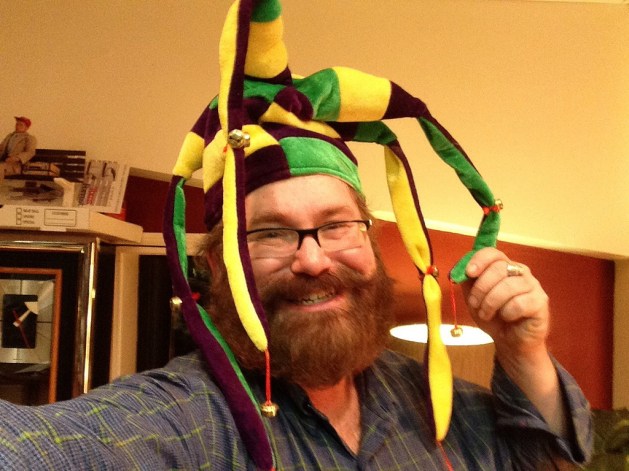
jester's hat

VBS: the only week of the year a senior pastor can wear shorts, sandals, and a jester’s hat and nobody complains.

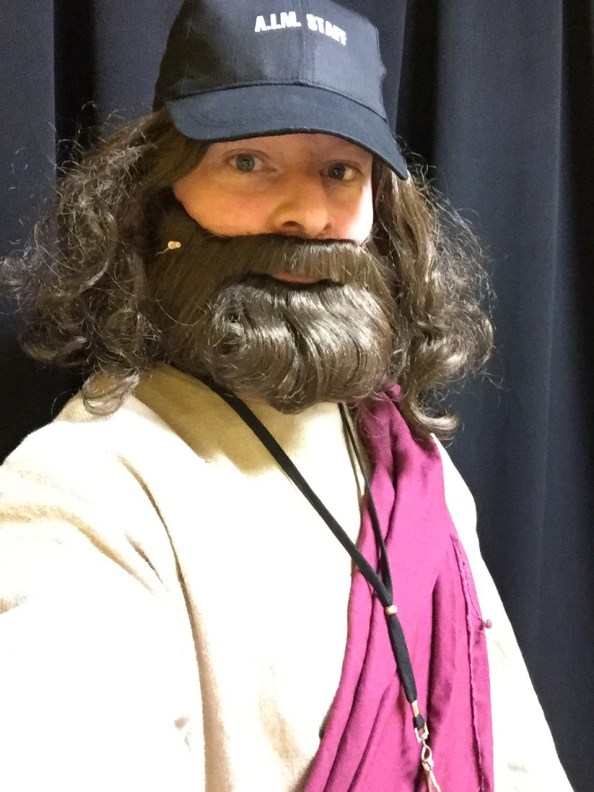
This year, though, it was determined my headgear should emulate none other than Jesus of Nazareth, or as stereotyped a version of our risen Savior one might expect to find within a suburban Baptist church’s Vacation Bible School. Now, having spent years in silly period costumes – playing everybody from Noah to St. Peter to a Roman centurion to a wise, old Bedouin shepherd I ignorantly named Apu Nihasapiddananajada – I wasn’t immediately phased by the thought of putting on a fake beard and long-haired wig and, four times each day, portraying Jesus to an auditorium full of elementary-aged children. After all, I hammed my way through countless Bible dramas throughout high school and college, and, as a twenty-something youth pastor, directed just as many groan-worthy yet well-intentioned productions. So, I was no stranger to playing the Son of God.

bedouin

Seriously, guys, I really do apologize for that name. I was 25, lazy, and I’d never traveled anywhere farther than southern Québec.

It wasn’t until I’d struggled through the first day of VBS that I realized I may have finally taken on a role that was over my head. I had never portrayed Jesus to children, let alone in such a wide-eyed, jovial, and interactive manner. I’d never had to go sans script and improvise my way through an entire performance, all the while happily acknowledging eagerly raised hands and the astonishingly perceptive questions that followed.

Why do your sandals look like my daddy’s flip-flops?

How did you get here from heaven? Did you fly?

If you were nailed to a cross, why aren’t there holes in your hands?

Do you know my grandmother? She lives in heaven, too.

I never thought I would envy the people who wrap themselves in long underwear and furry red and white coats every December to play Santa Claus. At least the people portraying Kris Kringle are working with an easily malleable mythology; when your backstory includes a fabled home at the North Pole and a perpetually efficient labor force of elves, what harm is there in adding the occasional fabrication?

Elf_039Pyxurz

Like the fact that, for some reason, the guy who knows every address in the world doesn’t even attempt to find baby Will Ferrell’s correct residence…

But when you’re playing Jesus to children (and you also hold a masters degree in biblical theology), the last thing you want to do is stretch the truth about God’s Son, or satiate them with a spurious answer. I didn’t want some unbiblical exagerration imbedding itself in their brains for years to come. By the same token, I didn’t want to be dismissive of their questions, either. I knew these kids weren’t asking merely to humor me. They weren’t simply playing along. Each concern was genuine; each child expected an answer.

I remember having several conversations during my years in seminary regarding the alleged “age of accountability.” The essential question went like this: At what age is it appropriate to encourage a personal response to the gospel message? Few of my fellow grad students debated whether it was all right to teach kids the story of Jesus, even the grisly and mysterious details of his death, burial, and resurrection. After all, most of them had heard the story themselves since before they were even out of diapers. However, plenty of them differed on what age children must reach before they can genuinely respond to the inherent truth of that story – when they can be expected to actually understand what it really means to “admit, believe, and confess.” Five years old? Seven? Ten? How about a wise-beyond-their-years six? How about an eight-year-old who always makes the Honor Roll?

I had my own opinions. When I became a father, those ideas didn’t change all at once, but the older my children get, the more sheepish I feel about how uncompromising I used to be. I used to answer decisively to the age of accountability question.

Lately? Not so much.

Plenty of people who reject the teachings of Christianity are quick to label things like Vacation Bible School nothing more than manipulative indoctrination of the young. And I will abashedly acknowledge there is plenty of misguided and even damaging manipulation alive and well in our churches today (and not just with the young). However, as I struggled through four days of Good Shepherd performances, inundated each day with questions upon questions, one thing became clear to me. It is a fool’s errand to definitively apply, across the board, an age of accountability for children hearing, and reacting to, the gospel.

While Christians may disagree on what exact moment in a person’s salvation experience the Holy Spirit spurs his insight, even more mysterious is the vast array of ages that receive his prodding. It can take a lifetime for the truth part of The Way and The Truth and The Life to resonate in some folk’s minds. And yet, sometimes the Spirit will choose to illumine the path of salvation to a child who hasn’t yet mastered the “loop-it-swoop-it-pull” method on their sneakers.

shoes-for-kids-930176_960_720

Who’s got time for laces when you could be reading the collected works of Kierkegaard?

Throughout this past week, I was regularly reminded of the moment I awkwardly stepped onto the trailhead of my own spiritual journey. I was only eight years old when, one dark night beneath the bed covers, I whispered the Sinner’s Prayer. My sister had died less than a year earlier, in a freak accident on a church youth group outing. Prior to that moment, I hadn’t given much thought to death – the how or the why of it – or what exactly the afterlife might be, if there even was such a thing. I was just a kid who liked marshmallow cereal, Saturday morning cartoons, and Voltron. My acquaintance with Jesus was through the handsome, white-robed depictions on Sunday School room posters and storybook Bible covers. I knew he was the guy all that Sunday morning stuff revolved around, and that he somehow related to the Sandy Patti and Amy Grant songs my mother listened to on our car’s cassette player, but I couldn’t have articulated that connection in any coherent way. Still, I believed in God because I was told he was real, and because we bowed our heads before every meal, and because there were at least a dozen churches in my tiny, bucolic town and how could every single one of them be wrong? It just made sense to believe in God.

But after Katy died, it stopped being enough for me that God’s existence made sense, that Jesus was a nice guy who wanted you and me to be nice, too. In the void left by the passing of my only sibling, I was curious for more than logic. I didn’t realize it until much later, but what I was really interested in was hope. So, I responded to the gospel because, alone in the dark beneath the dubiously protective shroud of my covers, I decided there must be more to Jesus than niceness. Something about the combination of his cross and his empty tomb offered possibility, a semblance of hope beyond the dark finality of death. I didn’t have the whole equation worked out yet, but what I did have was the memory of a simple prayer our pastor had taught a sanctuary full of wiggling grade-schoolers a few weeks earlier at the annual Vacation Bible School.

That patchwork prayer was the first meager offering I brought before the God of the Universe.

There are some who could no doubt point to that moment as yet another example of indoctrination – the actions of a child who had been subtly brainwashed to interpret a recent tragedy, and his own connection to that tragedy, all according to something that amounted, ultimately, to little more than a fairy tale. If I consider things from their perspective, I can understand where they’re coming from.

Bernie_Sanders_2014

I don’t blame you, Bernie. If I were you, I’d probably think it sounded crazy, too.

And, of course, there is much more to salvation than the articulation of a prayer. More than human cognition and abstract thinking. Because just like the kids at last week’s VBS who prayed such a prayer to God for the first time, eight-year-old me didn’t understand everything about what I was praying. I couldn’t fully comprehend the ramifications of what I was saying to God. But, oftentimes, understanding comes later. If we Christians are honest, and we certainly should be, we will admit that genuine understanding takes longer than even a lifetime allows. As Rich Mullins once said, “We never understand what we’re praying, but God, in his mercy, does not answer our prayers according to our understanding of them, but according to his wisdom.”

All I know is what I have become. All I know is that from time to time I have found another couple of crumbs scattered along this path. Not every day, of course, but every season. If I keep my eyes peeled, eventually I spy yet another modest clue that leads me onward. Perhaps one day I’ll discover that they were all incidental, and this path I have chosen has lead me only to a dead-end. Or, perhaps I’ll come to the termination point, push back the undergrowth of weeds, and behold a wide and magnificent river.

Several times during their handful of years spent together, Jesus’ disciples would ask him what it really took to be considered “great” in the heavenly kingdom. On one of those occasions, Scripture says Jesus called a little child over and had him stand in front of the disciples. “Unless you become like this little guy,” he told them, “you’ll never even get a look at the kingdom. And whomever makes room in his life for children just like this one is the one who makes room for me.”

I don’t know if the children who encountered this freckled, fake-bearded Caucasian Jesus last week received from him any great truth. Then again, maybe they weren’t the only ones the Spirit was interested in teaching.

coach jesus

I know, I know. Look, it was a sports theme, OK. So, yes, I was “Coach” Jesus, and, yes, I wore a whistle and I had … oh, never mind.

On Rest (Lenten Reflections, Week 7)

I write this early in the morning on Good Friday, at the welcome desk in the lobby of the chapel. To my left is a simple, black and white sign indicating the starting point for my church’s Stations of the Cross prayer exercise. A little c.d. player spills gentle, acoustic ballads into the solemn atmosphere. In each of eight classrooms behind me, there is a small table bearing the name of each station, a corresponding Scripture text, and an artistic, black and white photograph imagining eight individual seconds of an event that unfolded in the early morning hours of the first Good Friday 1,990 years ago, give or take a couple of years.

My mind is not in this… yet. I am still imbibing my first cup of coffee, still going over in my head the setup for today’s prayer exercise to make sure I haven’t forgotten anything, still wondering if the air conditioning is going to cut on. (Oh, there it goes. That’s good.)

But my mind is also toeing the high-cliff edges above a reservoir of doubt. In the past couple of days, my soul has been bombarded by troubling news and dark truths. News stories have flashed across my little smartphone screen, informing me of chemical warfare and subsequent retaliation; of a massive bomb dropped in Afghanistan (Oh, not a nuclear bomb. That’s… good?); of North Korea threatening to test an actual nuclear bomb; of the president of Turkey actively pursuing despotism. To top it off, I just finished a podcast all about super volcanoes. Did you know that when the super volcano residing beneath Yellowstone Park finally explodes, it will release 580 cubic miles of molten rock and dust up to 16 miles into the atmosphere, inevitably triggering a nuclear winter that will almost certainly bring human life to screeching halt?

Well, now you do.

I behold a world of chaos, of natural and man-made disasters roiling just beneath the surface of quotidian life. Then I step into the pre-dawn dark of this chapel lobby, and I click on the little spotlights that illuminate eight simple images of a first-century Jewish peasant scalded to death by a brief steam vent of that chaos. And I am reminded that a Christian is one who is supposed to believe this betrayed and beaten and brutally assassinated Jewish peasant is, somehow, in control of everything else. That there is no measure of chaos, momentary or catastrophic, to which he cannot speak a pacifying word – that he cannot, if he would choose, remove entirely from reality itself.

No wonder so few people in this world truly believe, let alone truly follow, this Savior. It does not merely seem as if the scales are tipped in the other direction; it seems like a joke to believe some massacred miracle-worker from an utterly insignificant blip of a town within a long-lost empire could possibly hold power over a gentle spring breeze, let alone all the world and all its contentious inhabitants.

It is a difficult thing to apply ourselves to the disciplines of which I wrote in my last post. But it is a far more difficult thing to rest in the Master who guides us in his discipline. To accept that what I am doing with my life – these commitments I am making and striving to keep – holds any consequence, makes any difference. Because, in the scheme of things…

But things don’t have schemes, it turns out. World powers serve a lie that one violent act can end violence, rather than naturally necessitate another. World leaders falsely believe that the pinnacle of achievement is asserting their authority, even though millennia have proved all authority is fleeting. And the world itself simply spins and shifts and rumbles along, a slave to chemistry and physics. There is no scheme – no rhyme, no reason – to what it does.

The only scheme belongs to God alone. The only efficacious plan is the one of a Heavenly Father who sends his Son to model true humanity to misguided humans, and to surrender to that misguidedness to the extreme point of blood and nails and death.

It makes no sense… to me. To us. But, then again, I’m a misguided human. When false schemes frustratedly vent their steam, I quake in my boots. I cannot comprehend the mind of the Lord; I cannot fathom his divine logic.

All I can do is rest.

Rest in his power. In his authority. In his order.

If this season of Lent has taught me anything, it is that discipline without rest is just a lot of sound and fury, signifying nothing. Repentance without reassurance is pointless. Purgation without peace is worthless. Confession without joy, meditation without stillness… it is all for naught if we cannot lay our myriad fears and doubts and disbelief at the feet of our Savior and say, “Please cast these shackles so far away they cannot be remembered. And defend me, because this world loves to jangle about in its carefully fashioned chains. It loves to rattle sabres and hear the cruel and pretty sounds they make. Guard my eyes. Preserve my ears. Still the anxious beating of my heart. Help me, glorious God, holy Other, to rest in you.”

On Discipline (Lenten Reflections, Week 6)

My father is a disciplinarian. Or, at least, he was when I was under his care. Corporeal punishment was commonplace in our home growing up. Not overly so. I do not believe in any way this was abuse. On the contrary, it was well-earned punishment. If a spanking was deserved, a spanking would be given. End of story.

Growing up, when I heard the word “discipline,” I thought of pre-adolescent spankings. I thought of sitting in my room waiting for what I knew was coming. I thought of mouthing off and getting a quick, sharp swat of medicine. Discipline was something that was doled out by a disciplinarian, an authority figure.

Then I began working in churches, and pursuing a call to ministry, and soon perceived discipline in an entirely different light. First of all, I recognized that the root of the word is “disciple,” which I had always equated with a student or a learner of some kind. Next, I became acquainted with sets of practices known as “spiritual disciplines,” and absent from every single one I learned about was an objective to punish. The further I studied, and the more I sought experiences in these so-called “disciplines,” the more I realized that they had one thing in common with my childish understanding of the word. That is, discipline is intended for correction, and no one ever really explained that to me.

When I was younger, discipline meant a spanking, and spanking was punishment, and punishment was what you got when you got caught doing something wrong. Later, I learned that spiritual discipline is not about retribution. It’s about remedy. To engage in discipline is to submit oneself for correction in order to put away false narratives and destructive habits that lead to “bad behavior.” But it is also the practice of good behaviors that turn into positive habits that eventually imbed true, healthy narratives deep in our souls. Discipline is the method by which God transforms his children.

As a child and a teenager in church, I learned a lot about the Bible. There were several very good and generous people who sacrificed their personal time in order that I would learn the truth about God and his plan of redemption. But one thing I was rarely taught was how I was supposed to live based on my belief in him. What specific actions – besides the standard “you should pray and read your Bible” – would help firmly establish this truth in me? What were the corrections that needed to be made in my life, and the remedies in which I could partake so that I would not just believe in Jesus, but actually, tangibly follow him? And so, like my false understanding that spankings were just retributive punishment, my grasp of Christianity devolved into a white-knuckled resistance of as much temptation as possible. It was a hold-on-for-dear-life, try-not-to-piss-God-off kind of faith.

And it was exhausting.

Undisciplined faith is like that.

When we avoid engaging in specific spiritual disciplines like fasting, solitude, stewardship, retreat, hospitality, or simplicity, our normal excuses is that they all seem too hard. But it turns out it is a lot harder to live the undisciplined life of faith than the disciplined one. Those who truly desire intimacy with God will submit to his correction, knowing we do not serve the stereotypical God the world makes its ignorant assumptions about – the capricious disciplinarian in the clouds. Rather, we serve a God who uses discipline to repair us, renovate us – to return us to his glorious image.

My son, do not despise the Lord’s discipline,
    and do not resent his rebuke,
because the Lord disciplines those he loves,
    as a father the son he delights in.

Proverbs 3:11-12, NIV

So, may you not be afraid to take your medicine. May you submit to the discipline of our holy God, knowing he has put away your misdeeds long before you put them away yourself. May you allow his gentle and gracious Spirit to show you the well trod ways of obedience, and may you experience the same delight in him that he has in you.

On Meditation (Lenten Reflections, Week 5)

Meditation has fallen out of fashion in Christianity these days. Sure, there are segments of Christendom that still practice this ages-old discipline, but when it comes to the evangelical tradition of the Church in America, practicing meditation makes Christians uncomfortable. To a lot of well-intentioned disciples, meditation has become synonymous with Eastern mysticism, New Age spirituality, and other religious traditions like Hinduism and Buddhism. A lot of evangelicals would be at a loss to understand its place within the Christian faith.

That is not merely disappointing. It is profoundly tragic.

If you have been following along with these “reflections” throughout the season of Lent, you know that what I have been endeavoring to describe is the internal metamorphosis that a follower of Jesus experiences when he or she submits to the soul-restoring work of the Holy Spirit. The metaphor I have been using to loosely explain this process of transformation is that of renovating an old, rundown house. Taking something that has fallen into disrepair from both seasons of suffering interior neglect and weathering exterior storms, and returning it to something even more beautiful than it was in its earliest, most innocent years.

So, imagine you began all the dirty work of ths renovation: evaluating the broken places, cleaning out the junk, and tearing out the shabby, damaged remnants of old construction, and then, before you set to work restoring and rebuilding this old house, you blacked over all the windows and sealed up all the doorways, never to uncover them again. It’s absurd, not only because any beautification of a home demands the influence of natural light from repaired and cleaned windows, but because you would essentially be going about your renovation work in a cave.

This is what spiritual formation looks like devoid of meditation. Or, to put it simpler, when we remove the practice of meditation from our prayers for transformation, we end up stumbling around in the dark. We fail to see the extent of decrepitude in our souls because we have shut out the Light that illumines these dark places, that reveals them to us so that we might either tear them away or restore them. And we fail to find joy and freedom in the removal of our selfish narratives because we are not considering them according to God’s redeeming wisdom.

In my previous post, I wrote about the process of katharsis, the willingness to delve into the dusty corners and shadowy spaces of our souls in order to get to the root of the problem, to address not simply our sinful acts, but rather the sinful conditions, or habits, that cause these behaviors. To find and treat the deep-seated wounds that influence our self-destructive narratives. But katharsis done with our backs turned to God’s searchlight will never be effective in transforming us, and will only be a miserable experience of identifying the many core failures and doubts that have burrowed too deep for us to reach.

Many Christians fear the concept of meditation because its fundamental aspect is shutting up and being still. It is willingly opening up our dark, dilapidated houses to the Spirit’s sweeping, comprehensive evaluation of our condition, and He doesn’t miss anything – any cracks in the drywall, any warping of the floor, any unswept chimneys. As the Apostle Paul writes about the perfect wisdom of God’s Spirit:

The Spirit searches all things, even the deep things of God. For who knows a person’s thoughts except their own spirit within them? In the same way no one knows the thoughts of God except the Spirit of God… The person without the Spirit does not accept the things that come from the Spirit of God but considers them foolishness, and cannot understand them because they are discerned only through the Spirit. The person with the Spirit makes judgments about all things…

1 Corinthians 2:10-11, 14-15, NIV

While meditation in other traditions of spirituality may be more concerned with emptying one’s mind and contemplating some innocuous, external concept of truth, Christian meditation is about looking inward, following the Spirit of God as he advances through the corridors of your soul, shining God’s steadfast light of wisdom and truth – the truth of His unconditional love and desire for you to be made whole – into every space.

“Be still and know that I am God,” insists Psalm 46; “I will be exalted among the nations, I will be exalted in all the earth.” This is a call for meditation not on some innocuous, external truth, but on an intimately powerful truth that doesn’t empty us of our personalities and individual passions, but refines them according to God’s perfect purposes. But we will never experience this refinement, or comprehend His purposes, if we don’t allow the Spirit in – if we don’t cease our own strivings and allow the home inspector into our spaces to further illuminate what must be done.

In meditation, we momentarily stop praying about what we think our problems are and how they should be fixed. We fall silent. We breathe deeply. We remain still, and with inwardly turned eyes we consider what lies at the root of these issues. We wait on the Spirit to stimulate our minds, revealing just how deep our rebellion goes. We do not fear this revelation because it is done in the light of a great love. And in the strength of His mercy, we begin to address these deeper blights on our souls. We do not wallow or mope in guilt; instead, we celebrate that God’s light is reaching deeper and deeper into the core of who we are. Through it all, we remember the Great Truth:

For God so loved the world that he gave his one and only Son, that whoever believes in him shall not perish but have eternal life. For God did not send his Son into the world to condemn the world, but to save the world through him. Whoever believes in him is not condemned, but whoever does not believe stands condemned already because they have not believed in the name of God’s one and only Son. This is the verdict: Light has come into the world, but people loved darkness instead of light because their deeds were evil. Everyone who does evil hates the light, and will not come into the light for fear that their deeds will be exposed. But whoever lives by the truth comes into the light, so that it may be seen plainly that what they have done has been done in the sight of God.

John 3:16-21, NIV

So, may you not misunderstand meditation, and may you not neglect it. May you experience the excitement and abiding peace that comes when you allow God’s Spirit to walk through the many rooms of your life, loving each one, seeing in them a beauty you have never permitted yourself to see before. May you bid farewell to the roots of selfishness and celebrate the planting of holiness, and may you bask in the golden light that fills a soul made new.

On Confession (Lenten Reflections, Week 4)

Now pride and hate, they live inside me
I need your love enough to guide me
Help me walk across these borders
I’m a pilgrim in deep waters

Faithful God, like faithful sunrise
Help me break from all these old ties
Lead me all to that is holy
Break these chains, but break them slowly

from “Mansions” by Burlap to Cashmere
from the album, Anybody Out There?

Confession is both an instinctual mode of prayer – what I like to call a posture – and also a spiritual discipline.

A mode, or posture, of prayer refers to what a follower of Jesus prays about. Confession is part of an “inward” posture. It is the kind of prayer that gazes not upward at God’s majesty, nor outward at the needs of others, but into the depths of our individual selves – and into the darkening residue of grime that accumulates the longer we tarry in this present world. It is a means of katharsis, the essential first step in spiritual transformation that I wrote about in last week’s post. Confessional prayer is the way we gather up and expel the junk that piles up in our souls. Prayer by prayer, we identify the rust and rot of self-centeredness and we tear it out, clearing our houses, preparing them for further renovations courtesy of the Holy Spirit.

But confession is not simply a type of prayer. It is also a spiritual discipline – that is, something we apply ourselves to. Something we work at. Something we strive to improve in, even master, in our pursuit of purity and blamelessness (a pursuit that often takes a lifetime for a devoted follower to experience, as Paul infers in Philippians 1:9-11).

There is a reason why Catholic churches include confessional booths, and why their spiritual leaders insist parishioners visit them regularly. Despite the way pop culture treats these little closets as either priestly power plays, impromptu counseling centers, or ineffectual shrines to narcissism, very early in to this whole Christianity thing the Church recognized that the act of confession is not simply a one time statement of belief in the sufficiency of Christ’s sacrifice. Rather, it is a necessary practice of prayer – something anyone who desires to follow the Savior’s way must make room for in his or her life.

In the evangelical tradition – which is, sadly, becoming much more scattershot and tangled in the poison of partisanship and nationalism – we don’t always do a good job of teaching confession as a discipline of prayer. (Truth be told, we don’t do a good job of teaching the disciplines much at all anymore.) We tend to refer to prayer in primarily general terms, I think because, deep down, we feel like going into detail about its many, many different methods and disciplines and techniques will end up confusing people. There may be some truth to that inclination, but the problem that inevitably arises from generalizing prayer is that generations of believers grow up within a faith tradition that fails to train people how to pray.

As such, when a run-of-the-mill evangelical believer hears the word “confession,” he will usually think of one of two things. One, the stereotype of a confession booth, or, two, the moment a person professes Jesus as Savior. “If you confess with your mouth that Jesus is Lord,” the Apostle Paul writes to the believers in Rome, “and believe in your heart that God raised him from the dead, you will be saved” (Romans 10:9).

But that is only the start of the discipline of confession. It is an extraordinarily powerful first confession, for sure, but it is certainly not meant to be the last. Not because forgiveness is contingent upon our actual naming of each sin we have committed, but rather because it is through confession that we continue to identify not merely our sinful acts but even more the selfish inclinations and lingering weaknesses weighing down our souls. In other words, when you “invite Jesus into your heart as your personal Lord and Savior” as the saying goes, this act breaks the stranglehold of sin on your life; it does not, however, eradicate your selfish nature altogether. You are just as susceptible to act selfishly as you were before you first confessed Christ as Savior.

Confession, then, is the discipline that teaches us just how far God’s forgiveness reaches. As we seek to live as renewed, repurposed children of our heavenly Father, we engage in the process of katharsis, and, by confession, we continue to clean house of all those old, imbedded wounds and the deep-set tendencies to assert our own will over the will of the Great Architect.

When we pray our prayers of confession, we are not informing God of our wrongdoing and wrongbeing. What we are actually doing is agreeing with him that, yes, our flesh is indeed corrupted by worldly obsessions. We are not telling God anything he doesn’t know, but just because God knows it all doesn’t mean there isn’t profound power in naming these things before him. Confession has always been more for us than it is for God.

Lastly, it is important to remember that there is more to the discipline of confession than merely through listing off our individual sinful deeds, as if we are simply taking a depressing, masochistic inventory of all our bad behaviors at day’s end. On the contrary, time spent in confession should leave a follower of Jesus rejuvenated rather than drained. Filled with a sense of freedom and peace rather than sorrow and guilt. Confession begins heavy, but it ends light. In confession, we identify healthy practices that must replace our sinful habits. We take comfort in God’s mercy, and find confidence in his grace to commit again to obedience and purity. We marvel at the endless reach of his perfect, healing love.

So, may you not shy away from the act of confession. May you make it one of the good habits that replaces the self-centered clutter littering your soul. May you run desperately into your moments of confession, eager for the cleansing that it brings, and the peace that sweeps through you like a cool wind in the heat of the day. May you confess your brokenness in such a way that you cannot help but lift up praises to the One who holds the power to put all things back together again.

On Purgation (Lenten Reflections, Week 3)

In last week’s post, I compared repentance and the process of transformation that follows to the demolition and renovation of a house. I told you that spiritual maturity doesn’t come all at once, and that there is much work for us to do in order to experience the qualities of transformation.

So, exactly what kind of work am I talking about?

Early in the fourth century C.E., a Roman general named Constantine won a series of decisive battles against his political opponents, and for whatever reason, he felt that the God of the Christians somehow had a hand in this success. In his ascension to the throne, Constantine legalized and rapidly legitimized Christianity throughout the empire. And even if he didn’t end up professing the faith until he was on his death-bed, this was nothing short of a watershed moment not just for the Christian faith, but for religious history in general. Suddenly, it was perfectly legal to profess Jesus Christ as Lord and Savior of the world. It was completely above-board to gather regularly in order to praise “the one true God.” From that moment on, being a Christian wasn’t just harmless – it was the gold standard of Roman citizenship.

In response to this whiplash-like shift in Christianity’s relationship with culture, devoted followers of the Risen One realized that what once had been the ideal expression of faithfulness was no longer possible. Before Constantine, Christians who lived out their love for Jesus without compromise were often martyred – burned alive on stakes or pyres, tortured before gathered crowds, and, of course, crucified. And yet, as horrific an event as martyrdom was, the persecuted Church came to see it as the ultimate act of fidelity to God. Now, however, with the complete decriminalization of the Christian faith, martyrdom was off the table as a means of expressing one’s matchless devotion to God.

In response to “imperial Christianity,” many Christians who found this new, cultural faith suspect chose a new ideal expression of faithfulness. They withdrew from society and all of its creature comforts. They exiled themselves to remote deserts and harsh wilderness environments where culture could not tempt and taint them. And they began teaching a new method of spiritual practice – the way of asceticism. Granted, ascetics were nothing new, but joining fierce simplicity and the pursuit of suffering with Christian devotion had never been the norm. However, these “Desert Fathers” insisted not only on the need to remove oneself from the worldly trappings of civilization, but also to purge the carnal accumulations that affix themselves to our souls.

They spoke of something known as katharsis, the willingness to search our souls and identify the selfishness and weaknesses bedded down in the dark, hidden places within us. In order to rid ourselves of the earthly debris and spiritual rot pervading our inner beings, we must first recognize the extent of it. The standard practices of the ascetics – silence, solitude, fasting, even flagellation – puts the believer in a position for this deep “soul-searching,” and leads them to cry out for God’s divine, inside-out renovation.

As a pastor, while I don’t advocate full-blown asceticism, I do recommend believers learn about and attempt most of the ascetic practices (self-flagellation not being one of them). These ancient spiritual disciplines are incredibly powerful experiences, and accomplish much more than katharsis. However, the process of purgation is certainly one of their primary benefits.

Jesus himself seemed to support the concept of katharsis. A large portion of his famous “Sermon on the Mount” focuses on the inner catalysts for sinful behaviors. Consider the following statements from Matthew 5:

“You have heard that it was said to the people long ago, ‘You shall not murder, and anyone who murders will be subject to judgment.’ But I tell you that anyone who is angry with a brother or sister will be subject to judgment.” (21-22)

“You have heard that it was said, ‘You shall not commit adultery.’ But I tell you that anyone who looks at a woman lustfully has already committed adultery with her in his heart.” (27-28)

“You have heard that it was said, ‘Eye for eye, and tooth for tooth.’ But I tell you, do not resist an evil person. If anyone slaps you on the right cheek, turn to them the other cheek also.” (38-39)

The worst thing we can do in our interpretations of Jesus’ sermon is to chalk these statements up to hyperbole. While the Savior does indeed make use of exaggeration in his rhetoric, none of the above statements are wholly hyperbolic. Rather, they are indicative of his understanding that sin is not simply something that is done, but also something that invades us like a parasite, festers, and methodically corrupts us. It is both a contagion and a cancer.

Concurrently, the other dangerous thing modern-day Christians can do is consider personal holiness to be an unattainable ideal – a pipe dream no normal person will ever experience. As a pastor, I am deeply committed to proclaiming the gospel of God’s grace – of unconditional, divine love that knows no bounds. However, just because believers live under God’s extraordinary grace does not mean we should be okay with our sin and weakness. While not necessarily biblical, the old adage, “God loves you as you are, but he loves you too much to let you stay that way” is a truth we must accept if we ever want to enter intentionally into the process of spiritual transformation.

These days, while we may get a rush out of shaming those we disagree with, when it comes to our own, individual sense of shame, we don’t like to spend a lot of time thinking about it. If we pray about our sin, we are quick to name what we did wrong, ask for Christ’s covering of those actions, and move on. And while there is nothing incorrect about such prayers, they rarely reach the full, purgative experience they should – the kind of exercise in prayer and meditation that not only names our sins, but allows the Holy Spirit to point his searchlight into the dank recesses of a soul that has housed a capacity for such evil habits. We must not wallow in our sin, but we must not ignore its far-reaching roots either.

It is no easy thing to let the Spirit of God shine his light into the shadows of our souls. But it is an essential part of transformation. To return to the renovation metaphor, it is the moment we enter inside our decrepit houses and begin identifying all the things that must be purged, swept up, and stripped away before the work of renewal can begin. Sometimes, this cleansing is easy – shoving excess clutter into trash bags, or pulling down old screens caked with dust. Other times, however, we find cracked beams, rotting floorboards, and purposeless walls, all of which must be torn away, piece by piece, if this old house will ever be made beautiful again.

So, may you not shy away from katharsis, no matter how uncomfortable those first forays into the cobwebbed cellar of your life may be. This is dirty work – no one ever said it wouldn’t be. But you have a co-laborer with you every step of the way. He holds a bright light from which no dirt or decay can hide. He is here to show you everything this old, rundown soul can be. Trust him. He’s been doing this kind of work for thousands of years.