The Problem with First World Problems

“First world problems.”

It was a funny categorization at first, but that phrase has begun to wear thin, don’t you think? It’s one thing to recognize that my problems aren’t as significant as other points of suffering in the world. Rarely, though, was this sobering realization followed up by action on behalf of those who are suffering with greater significance.

After all, few of us appreciate suffering. We don’t want to experience it, we get uncomfortable when we witness others go through it, and more often than not it is our guilt and our pity, rather than our compassion, that is aroused when we hear of global atrocities near and far. And, save for a bold few, it would seem that over time Christians in the West have lost their stomach for suffering.

Which is odd.

Because suffering is intimately connected to what Christians are taught to look to as the source and the power of our faith.

Pictured: suffering.

Pictured: suffering.

The ultimate activity of following Christ is to be made like him. It is the journey of sanctification – by the movement of the Spirit within us, we are slowly, day after day, made holy.

Our culture, however, encourages us to have our desires, needs, and aspirations met as quickly as possible. This selfishness is found in a slick-suit preacher who says, “Come to Jesus and he will make your life one joy after another.” While it is true that Jesus promised abundant life to those who would follow him, as the pioneer of that life, he set his “face like flint” (Isaiah 50:7) and walked faithfully on into a violent, fallen world.

Thus the question comes, what is more tragic: the poor and needy who have experienced suffering, or the proud and naïve who have no stomach for it?

If we are to become like Christ, suffering is necessary, and faithful perseverance is the goal. In his influential work, The Orthodox Way, Bishop Kallistos Ware writes, “The Son of God suffered ‘unto death’ not that we might be exempt from suffering, but that our suffering might be like his. Christ offers us, not a way round suffering, but a way through it; not substitution, but saving companionship.”

When we pray for God to reveal to us his glory, we should remember this. It was only after the visibly heartbroken Jesus washed his betrayer’s feet, broke bread for him, and bid him leave to fulfill his treachery that he was able to proclaim, “Now the Son of Man has been glorified, and God has been glorified in him.”

To identify something as a “first world problem” may be to communicate perspective on hardship, but may we never forget that suffering is not something to always be on our guard against. May we be open to whatever comes our way, trusting in the provision and the compassion of a God who truly has seen it all.

Confessions of a Car Thief

The first sin I remember committing was stealing a car. I was four years old at the time.

That's the way life is out here in da 'burbs.

Yo, dat’s the way life is out here in da ‘burbs.

I should probably clarify. I stole the car from my neighbor’s garage. And the car I stole looked exactly like this.

"Yee-haw."

“Yee-haw.”

Swiping that Matchbox car from my neighbor’s house is the first memory I have of knowingly doing the wrong thing. I can remember feeling both exhilaration and immediate guilt. I realized that if I kept this toy car (which I’m pretty sure I did), I could never tell anyone where I had gotten it. Thankfully, I had about a dozen other General Lees, so I figured my parents wouldn’t notice a new addition to the collection. But that makes my first act of wrongdoing all the more puzzling. I didn’t need that car. I’m not even sure why I wanted it. I had twelve others back in my bedroom!

This is the mystery of selfishness, which I am convinced is at the heart of all wrongdoing – what Christians call “sin”: that our self-serving deeds seem completely logical but, when unraveled and examined, show themselves to be illogical.

We can understand the reason for our selfish impulses. From a sociological perspective, we recognize that people are wired to preserve their lives and protect their interests. This is as much instinct as anything else. And from a Christian perspective, we understand that the divine creation was corrupted by this. The original intent for human beings was to be wholly dependent upon God’s provision and order, but in our free will, we chose instead to depend on our own desires, judgments and innovations. This is the heart of Genesis 3, and even people who find it difficult to take that story literally would, in their most honest moments, be apt to agree that this is the tendency with all people. More often than not, we rely on our own way rather than on the way of another.

I mean, c'mon, who doesn't get a feeling of superiority when you ignore these things?

I mean, c’mon, who doesn’t get a feeling of superiority when you ignore these things?

It seems logical, doesn’t it? If our instincts are geared for self-preservation, then our acts of selfishness make perfect sense. Sure, every once in a while I make choices for the betterment of others (sometimes I’ll even make personal sacrifices in order to help someone else), but the more deeply I examine my day-to-day activities and decisions, the more convinced I am that the majority of these things conform to an attitude of self-service.

What’s the illogical part?

Well, if we return to the Christian perspective, one of the truths we recognize is that no matter how many careful acts of self-preservation we commit, we are incapable of fully preserving our lives. Selfishness can delay trouble, but it will never defeat it. And what is more, we also believe that the man who completely shuts out the world – who does everything on a “me-first” basis while forgoing nothing and making no acts of personal sacrifice – becomes a pretzel of a man. He is twisted inward so dramatically that he has tied himself into a knot of uselessness. He could even be a wealthy man who invented something found in every household, but when it comes to basic human interaction, he has made himself worthless. And he has revealed the illogical nature of selfishness.

I'm looking at you, Ettore Staccone, inventor of the shower squeegee.

I’m looking at you, Ettore Staccone, inventor of the shower squeegee.

Consider this famous excerpt from the C.S. Lewis classic, The Four Loves:

To love at all is to be vulnerable. Love anything and your heart will be wrung and possibly broken. If you want to make sure of keeping it intact you must give it to no one, not even an animal. Wrap it carefully round with hobbies and little luxuries; avoid all entanglements. Lock it up safe in the casket or coffin of your selfishness. But in that casket, safe, dark, motionless, airless, it will change. It will not be broken; it will become unbreakable, impenetrable, irredeemable. To love is to be vulnerable.

Ever wonder why acts of love and devotion are such a pervasive theme in movies today, especially Disney and Pixar films? Because while we’re getting tired of Hollywood remaking and rebooting and reimagining stories we have already seen, what we haven’t tired of (and never will tire of) is the age-old theme of sacrificial love. Rick tells Ilsa to get on the plane to Lisbon. Atticus Finch jeopardizes his reputation to defend Tom Robinson. Kyle Reese gives his life to protect Sarah Connor. William Wallace does the same for the sake of his countrymen. Captain Miller leads a dangerous mission into Nazi-occupied France solely to locate and rescue a single soldier. With her last bit of energy, Anna steps between her sister and the man with the sword. We love these films because they celebrate triumph while acknowledging that we are at our very best when we have chosen vulnerability over personal comfort or safety.

For the antithesis of this, go watch The Wolf of Wall Street. Only, you know, please don't go watch The Wolf of Wall Street.

For the antithesis of this, go watch The Wolf of Wall Street. Only, you know, please don’t go watch The Wolf of Wall Street.

What’s the point of all this? What does it have to do with stealing a Matchbox car when I was four? Simply that whether you are four years old or thirty-four years old or sixty-four years old, you can’t escape the addiction of selfishness. This side of the heavenly kingdom, it is the opponent in the ring of our hearts and minds, knocking its gloves together, itching for the next round to begin. It’s a natural thing to want to serve ourselves, and yet, oddly enough, it is a natural impulse to appreciate acts of kindness and stories of sacrifice.

May you come to see that living a good life is less about self-concern and more about concern for others. May you perceive new opportunities to turn away from me-first decisions, and may that act fill you with a greater peace than self-serving decisions could ever produce. And may you learn to love sacrificially, for, as the Prayer of St. Francis reminds us, “It is in giving that we receive; it is in pardoning that we are pardoned; and it is in dying that we are born again to eternal life.”

A Great Wind is Blowing

I’ve been thinking about what it’s like to be guided by the Holy Spirit, and a one-word answer keeps shoving its way into the forefront of my mind.

Windblown.

It took me a while to figure out why that particular word should mean anything. But the other day I got one of those questions pastors often get from church members:

“What’s your favorite story in the Bible?”

Now, most of the time, these questions are posed by the younger members of the church – those in VBS classes or, when they’re not preoccupied with shaving cream shenanigans, the church youth group. I have to say, I appreciate this question more than some related ones like, “What’s your favorite Bible verse?” or “What’s your favorite Psalm?” Here’s the deal: I’ve been going to church all my life, and I’ve been a minister for thirteen years, but, in all honesty, I have never been able to arrive at a favorite verse or Psalm. The former requires selecting one statement out of over 31,100 statements, and anyone who thinks he or she can pull that off with confidence probably hasn’t given equal time to all 31,100 of them. The latter involves ranking incredibly personal and historically poignant prayers that will only hold up until Chris Tomlin or Matt Redman finds a catchy new hook for one you hadn’t cared about up until that point, and then your whole echelon crumbles.

Soundtracking your quiet times since the mid-90's.

Soundtracking your quiet times since the mid-90’s.

But I’m confident in naming my favorite Bible story. Unlike the others, my preference for it seems to endure.

It’s John 20:19-23. You probably know the story. The disciples (most likely referring to the Ten, culled by an absent Thomas and a dead Judas) are back in the upper room featured in chapter 13, and they’ve got the door locked “for fear of the Jews.” In other words, they believe they’re next on the Temple Guard’s list. Now that the Sabbath has ended, perhaps the High Priest will be gunning for them. Perhaps they were also part of Judas’s treacherous deal. Perhaps the reports that the tomb has been robbed will bring centurions to their door. They are disorganized, inhibited, and terrified. Whatever confidence and strength they once possessed was lost in the woods outside Gethsemane.

Into this anxiety-filled room, however, steps Jesus. He is just… there. As flesh and blood as his followers, but somehow no longer bound by pesky hindrances like deadbolts or walls. “Shalom,” he says to them, and then he allows them to inspect him – to climb out from underneath the weight of their doubts and fears and behold that, yes, what the woman from Magdala had told them was indeed true. Their Master is alive!

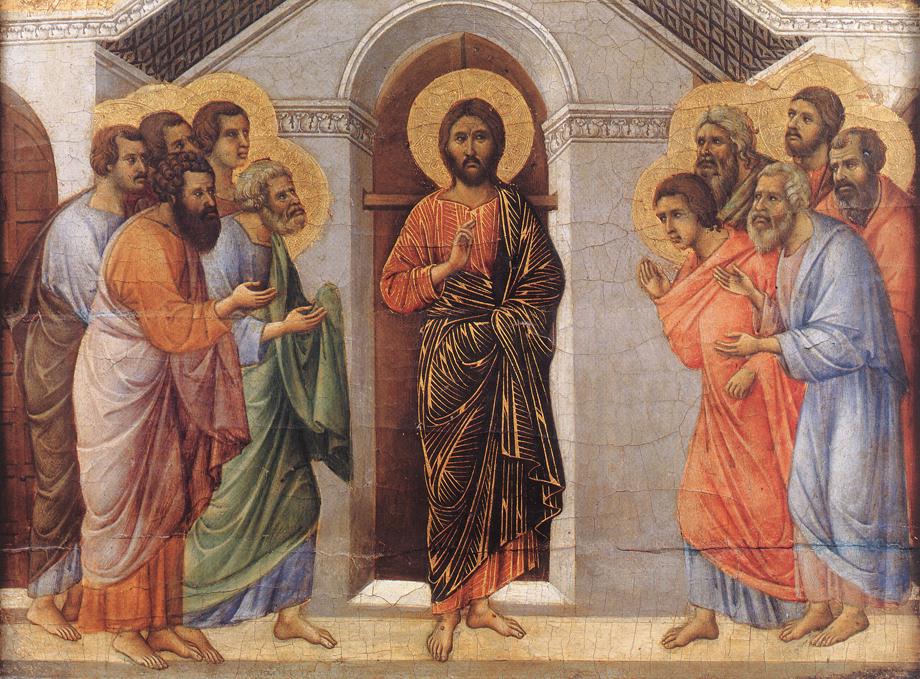
Pictured here. The disciples' expressions suggest Jesus may not be pulling off the stripes as well as he thought.

Pictured here. However, the disciples’ expressions suggest Jesus may not be pulling off the stripes as well as he thought.

But it is in this moment that the high drama of the scene takes an odd turn, and John includes a detail that at first, second and even third glance does not always stand out to readers.

Again Jesus said, “Peace be with you! As the Father has sent me, I am sending you.” And with that, he breathed on them and said, “Receive the Holy Spirit.”

He breathed on them? Was that… um… customary? A Jewish thing? Something you did when you blessed someone?

It took me a while to grasp the deeper meaning here, but the mystery started to come together when I looked up “breathed” and discovered that the word in Greek – emphysao – shows up nowhere else in the entire New Testament. However, it is the exact word used by the translators of the Septuagint (the Hebrew-to-Greek translation of the Old Testament by Jewish scholars in the second century BC) when they rendered Genesis 2:7: “And the Lord God formed man of the dust of the ground, and breathed into his nostrils the breath of life; and man became a living soul.”
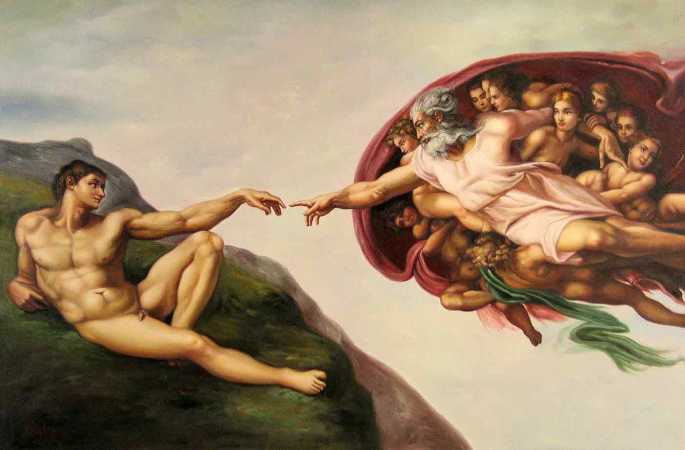
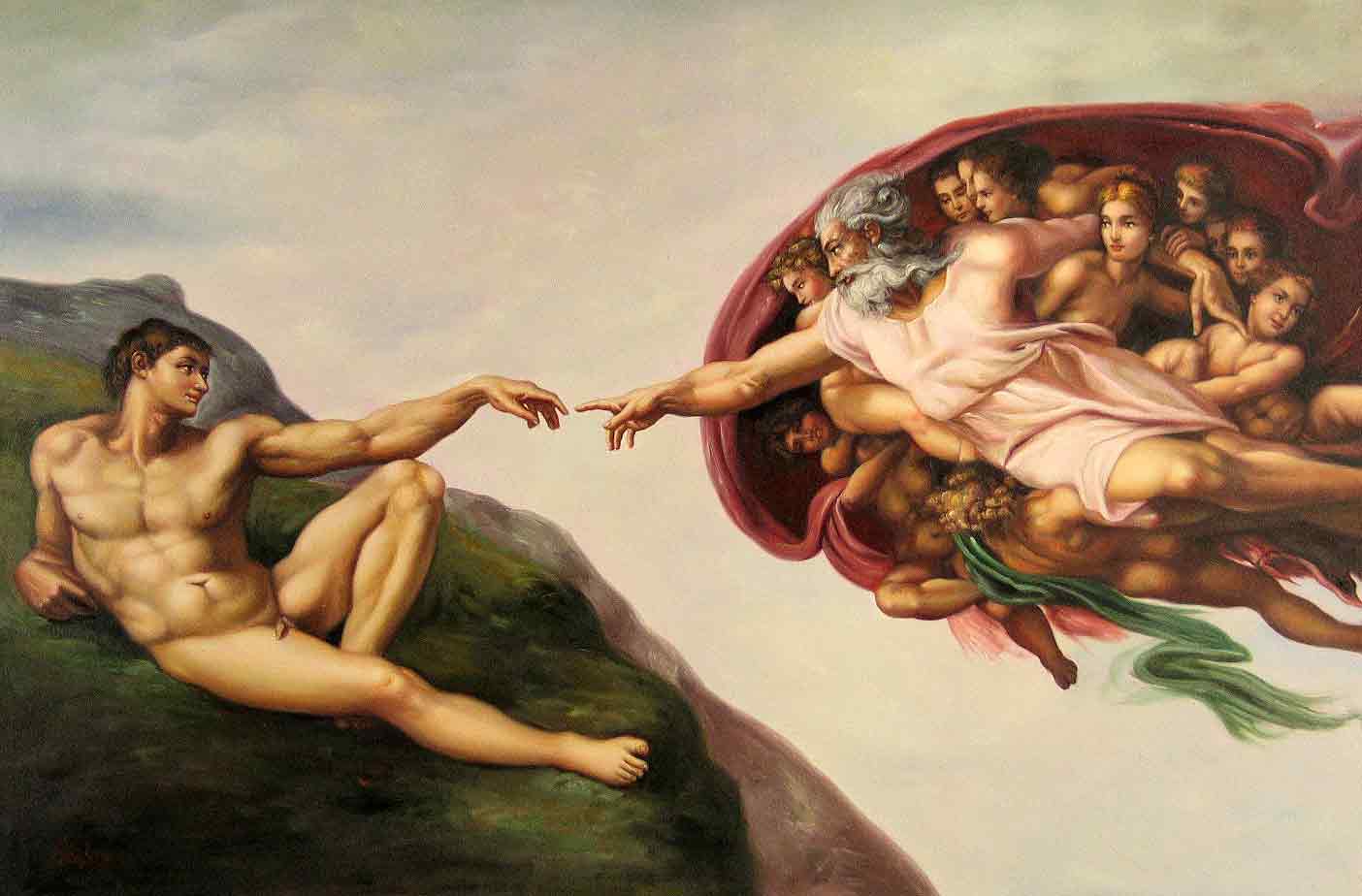
Michelangelo, however, preferred a less intimate, "phone home" interpretation.

Michelangelo, however, preferred a less intimate, “phone home” interpretation.

There’s something deeper than the drama going on in John 20. John – whose narrative resonates on many different levels – isn’t just describing a resurrection appearance and proclaiming the peace that Jesus brings. He is insinuating that what went on in the upper room that day was none other than the beginning of the new creation. The original creation was completed by the breath of God placed into Adam, making him more than what he was – more than an ineffectual clod of dirt. And on the day of his resurrection, Jesus spoke words of peace to his friends and then he breathed on them and said, quite intentionally, “Receive the Holy Spirit.” It was his way of inaugurating a new age – and a new covenant – in which faith in the Risen Savior changes everything.

Funny thing about the word spirit – pneuma in Greek. It can also mean “breath” as well as “wind.” Even funnier thing, so can its Hebrew equivalent, ruach. The Old and New Testament writers, by the way, have all kinds of fun with this wordplay.

For instance, think about the other famous story of the gift of the Holy Spirit, found in Acts 2. How does Luke describe the coming of the Spirit? With the sound of…

Google Image search would like to offer this picture of a person's face being met by "a violent wind."

Google Image search would like to offer this picture of a person’s face being met by “a violent wind.”

According to both the end of John and the entire book of Acts, the mark of a Christian is the indwelling of the Holy Spirit – the Counselor and Teacher Jesus describes earlier in John’s Gospel. The One that would guide the disciples into all truth. It comes to us as if on a breath, unseen, but filling us with a purpose and a conviction we could never produce on our own. Like Adam, we are made more than what we are. Like the disciples, we are transformed from fearful doubters into bold witnesses.

What is it like to be guided by the Holy Spirit? What is John trying to communicate to the Church? What does this mean for us?

Simply that there is a great wind blowing. It is the wind of God, the pneuma of transformation. It cannot be contained, it cannot be stopped, and it brings with it the glory of the new creation.

The Spirit prompts us like a stiff wind at our backs. It is as close to us as the breath we take into our lungs. To be guided by the Spirit is to be transformed into something a little less like ourselves, and little more like the One who created both.

In the Details

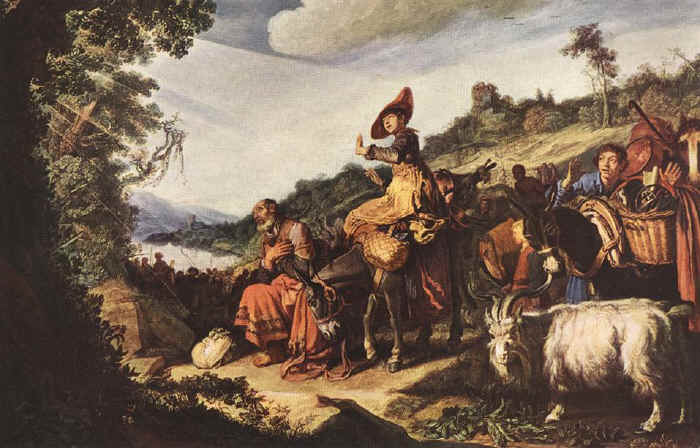
Now the LORD said to Abram, “Go from your country and your kindred and your father’s house to the land that I will show you. I will make you a great nation, and I will bless you…” – Genesis 12:1-2a

When I was growing up, my father often told me that I had trouble “seeing the big picture.”

When we would talk about something – my homework or my extracurricular activities or my household chores – I would often fixate on specific details of the subject in question. I would make arguments about the little things, and it was not uncommon to hear my father interrupt me by saying, “Son, you’re not seeing the big picture.” He would tell me that I was focused on one little corner of the picture, his thumb and index finger raised to indicate just how small a detail it was. He said what I needed to do was step back and see the whole thing.

As a teenager, I usually disagreed. I didn’t think I was overly fixated on the details. I just thought my father’s diagnosis was nothing more than his way of asserting his own opinion over mine. However, twenty years later, I realize that maybe the old man was on to something.

When it came to eating vegetables, though, he was totally unreasonable.

When it came to making me eat vegetables, though, he was totally unreasonable.

We are detail-oriented people in many, many ways. Even in an instant-gratification, product-obsessed society, we still place a lot of importance on process. Even the more impulsive of personalities are not immune to the comfort that comes from knowing how something is going to work out – how the product is going to be produced. A movie is praised not merely for its opening and closing sequences, but even more for the quality of its content – its effects, its writing, its characters, and the enduring power of its themes. Video games are judged as much for the intricacy of their graphics as for their overall concepts. Politicians can hardly make an off-the-cuff statement to their constituents without it being analyzed, dissected, and conjectured on 24-hour cable news.

We are detail-oriented people, and therein lies the problem. It is not so much the problem my father identified in me, though. It has more to do with our capacity for trust. It is becoming harder and harder to exhibit trust – to act without full knowledge, to make a decision without first hedging our bets. When it comes to our motivations in this life, the well-known idiom, “The devil is in the details,” is not far from true. We want to know how its going to work out for us before we even agree to the it. In this day and age, faith may sound noble, but there is little actual room made for it.

The devil is also in a lot of 80's metal music, but they play that stuff on Oldies stations now, so...

The devil is also in a lot of 80’s metal music, but they play that stuff on Oldies stations now, so…

Twenty years since my father diagnosed me with detail-obsession, I finally realize how indicative the problem is in my own life. For instance, I recently accepted a staff position at Dunwoody Baptist Church in Dunwoody, Georgia, the offer for which came on the heels of a five-month interview process. And even though I was eager to take the position, I found it terribly difficult to put away the anxiety of how it was all going to work out. Most of all, I was hung up on discerning whether or not God was really “calling” me to serve in this church, and, if so, why would he call me away from my previous church after only two short years? What was God thinking? What could his reasons possibly be?

In short, I got lost in the details. It didn’t occur to me until after I’d devoted a healthy heaping of brain cells to this dilemma that a big part of faith is trusting God’s plan without having to know the ins and outs. There are plenty of examples in both Testaments that remind us of this fact, none so profound as the life of Abram (a.k.a. Abraham). In chapter 12 of Genesis, God’s call completely uproots Abram from what was certainly a comfortable, sensible life. The most unsettling thing about that call, though, is that it didn’t come with a ten-point plan attached. There was no explicit, bullet-pointed directive on how God was going to fulfill his promise and make Abram a “great nation” – how he was going to bless him apart from the very things the people of that time looked upon as blessings: homeland, ancestry, and reputation of family.

"Leave the silly hats, too. 'The land I will show you' has a certain dress code."

“Leave the silly hats, too. ‘The land I will show you’ has a dress code.” – God

If I struggled with accepting that God was calling me from one job in a Baptist church to another job in a different Baptist church, then I can’t fathom the kind of turmoil going on in Abram’s heart and mind as he sought to discern the call of the Creator who, unlike the gods of his father’s house, was active and boundless and interested in an establishing an intimate, interactive relationship with a mortal.

And yet…

Abram went.

We are detail-oriented people because, if we can, we want to exert control over those details. We are detail-oriented people because we cannot shake the self-serving desire to manipulate and control our situations in order to preserve our lives in the best way we know how. It’s hard to trust someone else with the details if I am unwilling to place faith in anyone but myself. The same is true for my relationship with God.

Le bon Dieu est dans le détail,” wrote Gustave Flaubert. The good God is in the detail. The aforementioned idiom is but a cynical adaptation of a life-defining truth.

It turns out, God wants us to trust him with the details. He wants us to see him as trustworthy. It’s why he had a habit of reminding the people of Israel, time and time and time again, of all the ways he had come through for them over the years. “God is our refuge and strength,” proclaims the psalmist, “a well proved help in trouble” (Ps. 46).

It’s no easy thing to respond to the call of God without getting a look at his blueprints. But the faith that makes us able to hear his call is the same faith that should remind us that God is in the details – that he’s always been remarkably careful with them – and we would do well to trust in the goodness of that.

Maybe the old man was right. Maybe seeing the big picture is what’s important. Maybe it’s time to take step back and see the whole thing.