Imagining the Divine: A Response to Tim Challies

Recently, author and blogger Tim Challies, whose articles and book reviews I read on occasion, wrote a preemptive review of the upcoming film, The Shack, which itself is based on the 2007 novel of the same name by William P. Young.

fb-share-img

Prepare to be Hallmark movie-ed!

Preemptive review may not be the best term. Challies’s piece, entitled “Why I Won’t Be Seeing (or Reviewing) The Shack,” is a critical review of the core conceit around which the story revolves – a grieving, guilt-stricken man meets and is counseled by the Triune God (i.e., Father, Son, and Holy Spirit) who manifests in different human forms. Challies contends that such a representation of God is iniquitous, if not heretical, and his choice not to watch the film is a way of escaping an act of sin.

Of course, Challies can make whatever decision he likes regarding whether or not to see, or review, a feature film. He’s a grown man, a devoted Christian, and I do not deny that his choice may stem from deeply personal issues in his own spiritual development.

However, I believe Tim Challies has made a fundamental error in labeling the film The Shack “dangerous” simply because it casts human actors in parts that are meant to represent the divine persons of the Holy Trinity. And, taken to its logical conclusion, this error is actually an unwitting assault on imagination and creativity, two incredibly valuable faculties gifted us by our Creator.

Allow me to explain…

What is Lacking?

Tim Challies puts forth one particular passage of Old Testament scripture that he believes explains why a film version of The Shack, in which human actors will visibly and audibly portray the three persons of the Trinity on giant movie screens, is hazardous to one’s true understanding of God.

I take this to be a clear, serious violation of the second commandment: “You shall not make for yourself a carved image, or any likeness of anything that is in heaven above, or that is in the earth beneath, or that is in the water under the earth. You shall not bow down to them or serve them, for I the LORD your God am a jealous God, visiting the iniquity of the fathers on the children to the third and the fourth generation of those who hate me, but showing steadfast love to thousands of those who love me and keep my commandments” (Exodus 20:4-6). I will not see the film, even to review it, because I will not and cannot watch humans pretend to be God.

I have to hand it to Challies. He has conviction. But you know who else had conviction? The Pharisees.

67101969

Now, comparing someone to a Pharisee in this day and age is usually assumed to mean that someone has become so concerned with religious legalism that he or she has lost sight of the gospel of Jesus. But this is not what I mean when I compare Tim Challies’s staunch rejection of The Shack to pharisaical behavior. What most Christians often forget about the Pharisees – or never learn in the first place – is how incredibly devout they were, how deeply they committed themselves to personal physical purity, and how exceedingly inquisitive they were of the Scriptures. In almost every case within Greco-Roman history of the Jewish world, the Pharisees are the spiritual heroes. They insisted on faithfulness to God’s Word. They sought to interpret and explain every single word and verse of the Torah in order to more deeply commune with the Creator. They continually clashed with Roman and Jewish authorities alike out of an insistence that Jewish religious expression should maintain purity and ethicality. Thus, ninety-nine times out of one hundred, the attitude and behavior of a Pharisee was directly in keeping with what modern Christians would consider a righteous person. As such, the Pharisees really only lacked one thing.

Imagination.

Time and again, when the Pharisees clashed with the teachings of Jesus, it was not because his teaching style was suspect, or because he was openly rejecting the Torah. Rather, what the Pharisees disliked about Jesus was his way of portraying God, and, by association, the purpose of various aspects of the Law that God gave to Moses. Regularly, Jesus told parables that fleshed out certain characteristics of God, or certain actions of a faithful disciple, and usually these stories scandalized the Pharisees’ painstakingly assembled understandings of theology and spirituality. And it is also worth noting that, in these parables, God is often portrayed through human characters: a bridegroom, a gracious king, a searching shepherd, a celebrating woman, a wounded father.

the-expulsion-from-the-temple-1

Thank God first century Jerusalem didn’t have a film industry. Imagine the carnage!

But the topper – the assertion that really drove a wedge between Jesus and the majority of the Pharisees – is when Jesus himself claimed to be divine. To their eyes, this was a poor, upstart rabbi from a suspect town, possessing a suspect education, and he had the gall to say to them, “I tell you truly, before Abraham was, I AM!” (Jn. 8:58). If Jesus was nothing more than a poor, upstart rabbi, his utterance of these words was an offense deserving of public stoning. And since the Pharisees lacked the imagination – the creativity of mind and the expectancy of heart – to see Jesus as anything more than what his physical appearance revealed, they went on seeing him as such, and their pious conviction endured that what Jesus needed was a good, public execution.

What’s the Purpose?

Tim Challies is concerned that the physical, visible portrayal of any member of the Trinity – except perhaps the Son (since Jesus was also fully human) – is tantamount to blasphemy. He argues that it is impossible to accurately depict the holy Other-ness of a divine God through any kind of human guise. He even cites the second of the Ten Commandments to further his point. All of these arguments seem pretty solid.

And yet, integral to the Christian faith is our understanding that God chose not simply to command and direct humanity from his position of Other-ness, but instead chose to become flesh and blood and live in our midst (Jn. 1:14). Even though the historical person of Jesus of Nazareth is not made out of stone, it would seem that God violates, or at least sidesteps, his own commandment in order to help his chosen people grasp his true purpose for them.

bale

Though, if movies are to be believed, he was most certainly chiseled.

After positing the commandment as his reasoning for not viewing the film, Challies admits, “I will grant that the primary concern of the second commandment is worship. It forbids creating any image of God in order to worship God through that image. Yet the commandment first forbids any visual representation for any reason. Whether that image is used to better worship God or better understand God, the commandment covers it.” He goes on to insist that while Jesus might get a pass, it is sinful to portray the other two Persons of the Trinity, the Father and the Holy Spirit (even though the commandment of course makes no such distinction).

Really, Tim? So, did you seek forgiveness that time you looked up at the ceiling of the Sistine Chapel (or viewed a photograph of it)? Did you shut your eyes whenever one of your history textbooks included an artistic rendering of God visiting Abraham at Mamre, or the Holy Spirit coming like fire at Pentecost? Did you run away screaming at the sight of Far Side cartoons or the trailer for Bruce Almighty when Morgan Freeman had the audacity to dress in a white suit and pretend to be God? Just how far does this self-righteous conviction, currently directed at a book you obviously don’t like, extend?

You are correct in your assessment that the commandment was chiefly concerned with worship. But like a Pharisee, you stretch it across as many specific cases as possible in a nervous effort to obey it.

2814154115_8f5cec9be5_b

I hope this benefits your team, cuz you’re gonna burn for it!

It doesn’t take a Bible scholar to recognize that when you differentiate the application of the Ten Commandments based on the different Persons of the Trinity, you steer your boat into murky theological waters. Refusing to look upon any human portrayal of God the Father or the Holy Spirit is not simply imposing limitations on theological investigation – it is spurning human capacity for imagination and creative cognition which was given to us by our Creator! Nowhere in the entire Bible is there the stipulation that portraying the human form of Jesus is acceptable while any other representation is verboten. Why not? Because God understands there is a big difference between seeking to understand more about him by envisioning him in more familiar contexts, and actually fashioning an idol for the purpose of bowing down and invoking its power and authority for our lives. I mean, c’mon, Tim. Surely you can see this difference.

Look, I’m not a huge fan of The Shack either. I read it. I appreciated some parts, disagreed with others. I am a pastor, so, yes, some of the things the three God-characters tell the main character rubbed me the wrong way. But I understood that it’s a story. A work of imagination. It is as unlikely to be worshipped as this blog post is. So, at no point did I break out into an anxious sweat because William P. Young was tempting me to picture God in human form.

And if you don’t think there’s anything sinful about that act of imagination, as long as we don’t “flesh out” those characters on a movie screen, then the thin-ice semantics by which you are applying the commandment is astounding. Because, for all its little flaws (yes, little flaws), the purpose of The Shack is to spur people’s imaginations about what God is like. It is meant to challenge our theology not with blatant falsehoods but by asking us to consider whether we have unintentionally adopted a culturally acceptable view of our Creator, and, in so doing, collapsed into a lazy, shallow faith.

Does it get everything correct? Absolutely not. I wouldn’t expect it to. But I got to have some great conversations with church members and seekers about the nature of God when the book came out back in 2007. If the movie is at all similar in its impact, then this is all the more reason why a writer/reviewer as intelligent as Tim Challies should not refuse to review it. Perhaps his insights and corrections of what is portrayed on-screen could help people better process their own grasp of theology and soteriology.

Too bad Tim’s obedience to God’s command prevents him from offering such help.

Embracing Imagination

Again, I do not deny that Tim Challies’s decision is based on a desire to maintain faithfulness and obedience to the God he loves, and believes loves him.

But it is a dangerous thing to cite Scripture as a reason not to engage in theological exploration, even if it comes in the form of the movie version of a mediocre book. The commandments are not a leash. Rather, they are meant to set God’s people apart from a lawless, morally relative world. To obey God’s commandments is to live in such a way that people see the characteristics of God in you – love, goodness, forbearance, honesty, integrity, purity.
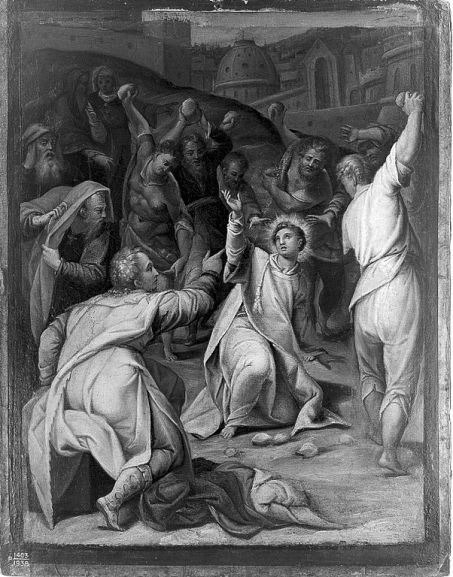
the_stoning_of_st_stephen-_oil_painting_attributed_to_orazio_wellcome_l0010582

Oddly enough, though, they shouldn’t lead you to do this.

In his “Sermon on the Mount,” God himself reminds us that true obedience is dependent upon the internalizing of each commandment. Thus, “You shall not murder” is as much about holding grudges and nursing hatred as it is spilling another person’s blood. “Remember the Sabbath day and keep it holy” is not simply a compulsory day-off as it is a directive that resting and relishing the rejuvenating presence of God is the only thing that will sustain us in this mad, mad world. And “You will not make for yourself a carved image” is an insistence that the creation should never attempt to comprehensively define its Creator.

In an essay entitled “Invisible Things,” the great songwriter-poet Rich Mullins writes:

He is the image of the invisible God. He is incomprehensible to our Western minds – as He was to Eastern ones. He came from that great beyond that no human mind has visited. When we true to squeeze Him into our systems of thought, He vanishes – He slips through our grasp and then reappears and (in so many words) says, “No man takes My life from Me.  No man forces his will on Me. I am not yours to handle and cheapen. You are Mine to love and make holy.”

Perhaps Tim Challies will read words such as this and think, “Exactly! Human actors should never portray God!”

But my understanding of God’s command is a bit more nuanced. No, I will not carve his image out of stone (or wood or sand or Lego bricks or George Burns’s face) and offer my worship to it. But I will keep seeking a deeper understanding of who my Savior is. Christianity is about a relationship with God, and I want to know the One to whom I am engaged. I want to think about Him more, and in more profound ways, and whatever medium will help enhance and mature my worship of Him, then I say, “Bring it on.”

May you not be afraid to imagine the divine. May you believe in a God who insists not on cold allegiance to law but rather ardent worship that flows freely from your heart, soul, strength and mind. And from your eyes, ears, nose, mouths, hands, and feet…

Thoughts at 37

One of my favorite comedians, Louis C.K., had a bit about how being forty years old isn’t very impressive – that what it essentially means is you’re half-dead. And another favorite comedian, Patton Oswalt, on one of his albums, scolds the crowd for cheering when he mentions turning thirty-seven, and goes on to explain how most birthdays are completely insignificant after a person turns 21.

Well, today I turn thirty-seven years of age, and I can’t help but sense the truth of both of those bits. I feel that I’m just about half-dead (if I’m even fortunate enough to make it to my mid-seventies), and that the sweetness of one’s birthday does indeed pale considerably upon the addition of more candles. If I was trying to craft my own comedic bit on the subject, I would start by suggesting that the day in which your regular-sized cake cannot adequately accommodate the number of candles signifying your age, you should forego a birthday celebration. But it occurs to me that most people my age probably haven’t had a regular-sized cake baked for them in several years, what with all the unhealthy sugar and gluten.

I digress.

But digression is the point of this post, actually. If only to document this mostly insignificant moment in my life, I felt it a worthwhile use of my time today to jot down some random notions and half-formed thoughts that have been fluttering about my mind as I approached, and woke up within, this day. Some are introspective. Others are melancholic. A couple are even happy.

So, here they are, in no intentional order…

  • If your concept of what genuine beauty is doesn’t change as you age, I think this might well be a sign of personal immaturity. The same goes for your ability to relate kindly to people who hold different viewpoints than your own.
  •  People’s perspectives are the hardest things to alter. Because of this great difficulty, compassion is one of the most elusive and poorly understood virtues in the world.
  • Culturally speaking, at thirty-seven I am simultaneously too old to be viewed as relevant by the younger generations and too young to be viewed as an authority figure by older generations. This doesn’t mean I can’t earn those qualities, but both endeavors are uphill battles.
  • Chick Fil A’s mobile ordering app is incredibly convenient, and that makes it physically and financially dangerous.
  • I’ve been a “full-time minister” in the Church for sixteen years. (See point #3 for why that warrants little validation.)
  • My wife really does know best an incredibly high percentage of the time. Probably something like 96.7 percent.
  • Divorce is truly an ugly, heartbreaking thing. So is cancer.
  • Some Church-goers can be the sweetest, most generous and humble people in the world. Others can be unbelievably stubborn, insensitive, and exceedingly selfish. So, you know, just like the people you find wherever you go in the world.
  • Deepening the relationships we have with a small group of friends is vital to the quality of our lives, but more and more of our relationships have become thin, stagnant, and technologically dependent. This is perhaps the most frightening and damning reality of our present time.
  • On the whole, television is currently telling more genuine, compelling and engrossing stories than movies ever have.
  • I am now fully convinced that 2 Timothy 4:3-4 is indeed referring to the Church itself, not secular culture. Local churches, pastors, and Bible teachers have become like items for consumption spread upon a vast buffet, so that no one must ever again listen to teaching or advice that corrects or irritates them. As a result, more and more people are building their individual Christian faith according to their own image, rather than the Imago Dei.
  • One of the most inspirational life stories I recently heard belonged to Billy Crystal. That man has led a remarkable life! I hope any retelling of my own life is even a quarter as compelling as his.
  • No matter how tragically human beings are currently trashing the planet – and, yes, it’s certainly true that we’re significantly affecting the climate – it remains extraordinarily beautiful. Here I find a correlation in the unwavering sovereignty of God despite how many intelligent people have completely rejected his existence.
  • I want to preach more often. (Not just “want.” I think I need to, not only to improve the skill, but to continue in obedience to God.)
  • I feel sorry for the Baylor students who were victims of sexual assault. I feel equally sorry for the student-athletes who have been vilified-by-association with those few players and administrators who actually perpetrated the crimes. And I feel guilty for feeling “equally sorry” for the latter.
  • I want more people to learn about spiritual disciplines and take the practice of them seriously. I am convinced this is why so many people in the Church lack maturity, because my own years of immaturity as a Christian was the result of ignoring the disciplines.
  • More and more often, I miss living close to the kinds of friends I could talk to about anything, and in whatever way I needed to do that talking.
  • I still have a long way to go in bearing the fruits of the Holy Spirit, most notably self-control.

Okay, that’s enough for someone turning thirty-seven.

Why Evangelicalism Isn’t to Blame

In the wake of the presidential election, a lot of insinuations regarding who is responsible for electing Donald Trump have been tossed around by news sources, pundits, dissatisfied voters, and many a social media post. As far as I have noticed, the culprits receiving perhaps the most blame in news articles, blogs, and social media have been a group of Americans categorized as “white evangelicals.”

If this political demographic had not drawn its fair share of ire leading up to the election, it is receiving a cascade of vitriol now. On Twitter, in particular, I have read the incensed statements of friends and strangers alike denigrating this group as, at best, duped patsies, and, at worst, homophobic-racist-bigots by association. Most troubling to me has been how these allegations are coming as much from Christians as they are non-Christians and atheists.

For instance:

screen-shot-2016-11-09-at-10-15-00-am

screen-shot-2016-11-09-at-10-16-31-am

screen-shot-2016-11-09-at-10-15-56-am

screen-shot-2016-11-09-at-10-16-45-am

screen-shot-2016-11-09-at-10-17-31-am

screen-shot-2016-11-09-at-10-19-31-amimg_5565

It did not take long for my anxiety over the election of Donald Trump to be overshadowed by full-on despair at the unmitigated acrimony leveled against evangelicalism. More than I am worried about a Trump White House – and, believe me, I am still pretty worried about a Trump White House – I have been much more hurt by this reactionary fallout toward evangelicalism.

Why?

Because, last Tuesday, I cast a vote in the presidential election. And it was not for Donald Trump. For over a year, I was deeply disturbed at the idea of him becoming Commander-in-Chief, not simply because of his past and present moral debasement, but also because, having researched many of the policies he touted throughout his campaign, I could see in them no ultimate viability. In other words, my vote was not cast for Trump not only because of the lack of personal temperance and honor I saw in him, but also because I chose to be an informed voter who, despite the perceived character of a candidate, nonetheless weighs the practicality of his or her platforms.

And yet, I am an evangelical, and a white evangelical at that. Thus, according to a large group of Americans, many of whom are infuriated at the result of this election, I am responsible for a President Donald J. Trump.

From the tweets of those Christians above, it now seems the only good and right course of action for me is to renounce evangelicalism as a corrupt and profane group. Otherwise, I must accept the indignation of my more enlightened brothers and sisters in the faith, and live under the guilt of my association. Even if, technically, I belong to the mere 19% of white evangelicals whose votes were not cast for Trump, I will certainly find myself haunted by my inability to persuade my demographic’s majority not to vote for a monster. That, or I must wallow in shame because I was not bold or courageous enough to speak against him and those who planned to vote for him.

According to the first Tweet featured above, from spiritual director and author Richard Rohr, whom I deeply respect, the evangelical movement has irrevocably defiled itself. Real Christians should extricate themselves from it as soon as possible, as if it doing so were truly the quick and simple adjustment some think it is. As if all it takes is for a Baptist to start attending a Catholic parish instead, or an Assemblies of God Republican to re-register as a card-carrying member of the Democratic Party and transfer his membership to an Episcopal church.

The truth is, every single Christian whose tweets are shown above have not slipped the bounds of evangelicalism as wholly as they may think. Many of them may disparage both the word and the social demographic it categorizes, but were you to press them for an honest answer on whether they have truly rejected the core principles of evangelicalism, you would find almost all of them remain squarely in the center of evangelicalism whether they like it to not.

Back in seminary, I had a friend who was outspoken about his rejection of the term “Christian.” To him, the word had been so drastically watered-down and misapplied that he had completely lost use of it (or, rather, he feared he would be associated with people with whom he did not share particular political or spiritual beliefs). He preferred, instead, the title “marked by X,” (X representing the Greek letter, chi, the first letter in the word “Christ.”). “I am not a Christian,” he would say to us. “I am marked by X.”

Meaning he was a Christian; he just didn’t like the word.

My friend despised the many false connotations the word “Christian” had picked up over the years, like dirt and cockleburs that stick to a hiker’s clothing as he journeys along a wooded trail. In the minds of many people today, the word “evangelical” is in very nearly the same situation. The question, then, is whether or not Christians should “divorce” themselves from the word or persist in using it?

What would we gain if we rejected evangelicalism as a term? Clarity, maybe. Or at least a slightly clearer conscience.

What would we lose? Only a word describing the very heart of Christianity itself. Not to mention associating ourselves with a more than 500-year-old movement of individual and communal liberation.

The term “evangelicalism” comes from the Koine Greek word euangelion, a combination of eû (“good”) and ángelos (“messenger”). The word is found all over the New Testament, commonly translated “good news” or “gospel.” In the Church, it refers exclusively to “the way, the truth, and the life” provided us by Jesus Christ. To be an evangelical is to stake your entire existence on the belief that atonement for sin, salvation of the soul, and redemption of the body is found in Jesus alone. It means pursuing transformation by the Holy Spirit through the practice of spiritual disciplines modeled for us by the Savior, including befriending rich and poor alike, showing endless compassion to the oppressed, responding to all conflict and confrontation with grace and non-violence, and accepting the expectation that your obedience to the Law must surpass that of even the religious (and political) elite. Throughout history, the evangelical movement has continually challenged the Church to find its identity in this Gospel, and to, in turn, proclaim and practice its principles unto all humankind.

Historically, the evangelical movement has boldly stood up to corrupt, idolatrous men of power who selfishly and opportunistically entangled the Church with the State, and who used its influence to oppress millions and withhold dignity and basic rights from the masses. It preached that forgiveness of sin comes from God alone, and that no mere human being may wield power over another’s soul. It insisted that all people have a divine right to read the Scriptures in their own common languages. It contended time and again that salvation is for everyone, regardless of age, race, gender, or socioeconomic status.

Are we sure we want to separate ourselves from so extraordinary a movement, and the incredibly fitting word that describes it, simply because a handful of one country’s population (categorized “evangelicals” by secular news agencies and pollsters ) have made what many would say is a bad political choice out of the very real temptation for personal prosperity and security?

The simple fact is, even if a person is a committed Christian, they are not exempted from national concerns. The inclination to chase after individual liberties, sustainable employment, general safety at home and lasting security abroad is as common to us as it is to every other American. No matter what some Christians may claim, these desires do not always present themselves as black-and-white choices, even when we consider them in light of the Gospel. Certainly many of these “white evangelicals” are considered Christians simply because they live in heavily “Christianized” areas, not because the principles of the Gospel populate the top of their personal priority lists. In other words, the only way the term “evangelical” describes them is in its false, sociopolitical context.

And yet, I am also well aware that there are plenty of people within the 81% of white evangelical Trump voters who have indeed been cleansed of their sins – past, present, and future – and are being transformed by the Holy Spirit. Personally, I could not reconcile a Gospel-centered life with a vote for Trump. Some of my brothers and sisters in Christ would disagree. And many others either were not considering the principles of the Gospel, or considered a vote for any official candidate to be a compromise of those values in one way or another. And so many “evangelicals” voted for a guy who promised (however dubious such promises may be) that he would fight to protect their morals and way of life. They are afraid the country is turning its back on many important things, including at least some of the principles of the Gospel they believe in, and so they cast their vote for the person who convinced them he would do the most to stem the tide, and perhaps even reverse it.

In other words, the true meaning of evangelicalism, nor the tradition of the movement, is not responsible for the result of the election. National sentiment is, and whether or not it is easy to describe this sentiment as “evangelical,” it is ahistorical and pseudo-theological to do so.

I realize that my argument is primarily semantic. It mostly revolves around the definition of a word. But no matter how many times I read the indignant statements of Christians who have turned their noses up at “evangelicals” and have joined with the masses in equating the movement with racism, homophobia, bigotry, and regressive conservatism, I cannot bring myself to disassociate with a concept that stands at the heart of our faith.

The evening after the election, I was teaching a class on the inspiration and translation of Scripture. I reminded the class that one of the hallmarks of the evangelical movement was fully evident in the room: every person had their own copy of the Bible, not only in their own language, but even in a style of that language they most preferred to read! (I am willing to bet a large sum of money that every single person whose tweets are shown above take advantage of that same privilege.)

One man asked, “What’s the difference between a Christian and an ‘evangelical Christian’?”

In the aftermath of the 2016 Presidential Election, there are many people who would have you believe the answer to this man’s question is, “A lot!”

But if Christians – be they Trump protestors or Trump supporters – will resist the temptation to treat politics as that which brings justification, security, and ultimate happiness, then maybe we can restore the original meaning of evangelicalism. Maybe we can even be united by it, even as we continue to differ on specific ethical or denominational issues. Maybe we can humbly admit that no one is so enlightened in the faith that they cannot be led astray by Gospel-less perspectives and opinions.

Maybe we can come to see the nonsensical redundancy of the term “evangelical Christian,” because we know a true Christian is evangelical, and a true evangelical is a Christian. Maybe we can look that man in the eye when he asks his question, and reply, “Actually, there is no difference at all.”

This article has been updated since its original publication in order to correct language, primarily in the 19th paragraph, that unintentionally insinuated those who voted for Donald Trump do not truly believe in, or understand, the Gospel. This, of course, is the opposite of the point I was endeavoring to make. My sincerest apologies to any who may have been offended in their initial reading.

It Shakes You

Earlier today a man called the church. He claimed he had viewed our website and was interested in joining our community and finding out if the people here would be his brothers and sisters. But first he wanted to pose a question.

“What does it mean to bear your cross and follow Jesus?”

As a pastor, I’ve had many opportunities to explain the meaning of Jesus’ well known statement, but I have never before been asked what it means by someone who, it seems, already knows the answer. In this case, I quickly learned that the man on the phone did not consider my response completely satisfactory.

My response to his question was something along these lines: “To take up one’s cross is to live sacrificially – to surrender my own will in favor of the will of God. And to follow Jesus is to recognize him not only as the example of how to live for God, but also as the atoning sacrifice that makes it possible for me to experience a relationship with God.”

The man seemed pleased with my answer initially. However, before I could really respond again, he began to accuse me, and by extension the entire church leadership, of forsaking the true meaning of “bearing the cross.” Apparently, this man interprets that passage as the relinquishment of all worldly possessions, everything from houses to material items to, as he said, “everything you got up there in that bank.” This man believes Jesus was promoting complete asceticism when he said his followers must take up their crosses. (I’m not sure where the use of a phone, or the Internet, falls in that extreme expectation.)

There was little I could say at that point. It was clear this man’s mind was made up, that he had a predetermined agenda and this question was just a setup – a test for me to fail so I could receive his rebuke. What is more, as his correction quickly morphed into impassioned rant and then into fever-pitch screaming, he would not have been able to hear me even if I had wanted to repent right then and there.

“Sir,” I said beneath his tirade, “I cannot talk with you if you won’t listen to anything I say. I’m going to have to hang up.”

The last words I heard as I placed the phone back into its cradle was, “You see, you’re running! That’s all you people do when I call, just run away from-”

Click.

In the silence that followed, I could feel my beating heart, quickened with the adrenaline that washes over you when you’re being screamed at. I could hear my shuddering exhale under stress. And I could feel the rush of my racing mind, immediately turning inward, awakening the inevitable personal reflection that comes from any kind of rebuke, whether unwarranted or wholly deserved.

Have I interpreted that verse of Scripture incorrectly? Was the man on the phone right? Have I strayed from the true meaning of discipleship?

I do not believe so. However, this man unknowingly exposed the scars I bear from my own upbringing. For years, I worried I was getting it all wrong. During my adolescence, I walked many a confessional aisle, prayed many salvation prayers (which we so often referred to as “prayers of rededication”), made many recommitments to Jesus, most of which basically boiled down to a white-knuckled, teeth-clenched, self-actualizing vow that this time I would get things right. This time I would really be a Christian.

I have come to accept and even embrace the ambiguity of biblical interpretation. I realize that I have many brothers and sisters in Christ who understand and apply certain passages and verses differently than I do, and unlike the man who called me, I do not think all of them are wrong and I am right. I believe God is bigger than our finite understanding of him. I believe he is bigger than our interpretive capacities. I believe he is bigger even than this testimony about him that we call the Bible.

I believe that I will never be able to get it all right, and that is essentially the reason God sent his son to die on a cross. And I believe that what brings the Son of God glory is when I try to get it right – when I make a genuine, honest effort. As Thomas Merton famously wrote, “The fact that I think that I am following your will doesn’t mean that I am actually doing so. But I believe that the desire to please you does in fact please you.”

Nevertheless, a confrontation such as the one I had with this man may cut more deeply than you expect it will. It halts you. It shakes you. It gives you the kind of uncomfortable, self-searching pause that few of us ever seek out on our own.

Holy Spirit, sustain me. Abide in me, and teach me your ways. When I am wrong, rebuke me with gentleness and wisdom. When I am right, bless me with humble assurance. Holy Lord, I thank you that, ultimately, I must answer to no one else but you. Amen.

Lauds

A period of silence may follow.

The prayer book prompts me to be silent, and so I take a breath and close my eyes and go to where the silence is. Outside is the click of the ice maker, the low hum of the refrigerator, the faint gush of air through the ducts of this aging house. The baby monitor elicits the sound of an artificial womb, the volume raised just enough to perceive a pre-dawn cry. Beyond the window in the darkness, a morning bird too eager for the break of morning decides to test its call.

Outside, there is a beating heart, a yawn, a subtle pop within the stiffened neck of this aging body. The shift of the couch cushion. The gurgle of an empty stomach accepting hot coffee.

I go inside. Inside is the soul, and thus, the silence. Inside is where the Spirit of God has made His dwelling place. Some mornings, He seems a next-door neighbor; other mornings, it is a long journey to His abode, down the narrow path of sluggish contemplation that winds through the wild interior woods where if I turn to look I will see the watchful eyes of dark shapes surveilling me from the shadows. The path empties into a clearing, in the center of which is a quaint cottage. A thin line of smoke whispers from the little chimney – He always has the fire kindled in His hearth – and the morning light spills across the garden plots that surround the cottage.

Some mornings I find the Spirit tending these gardens: aerating the soil, assessing the strength of the stalks, inspecting the budding fruit. He greets me with a smile and a kind word, and there is always a look of pleasure on His face. He is proud of His gardens, of the fruit that has been born and is slowly growing. On other visits, I have found Him relaxing on the little front porch. He rocks back and forth slowly, and as I approach He gestures to the other chair next to Him. “Sit for a moment,” He says. “Enjoy the view with me.”

Once, I found Him inside by the fire, and I asked Him why He was not tending the gardens, and He told me that He was, that resting is also part of gardening, and the fruit He has planted responds as much to this as any other act of cultivation.

I feel safe in the clearing. I am aware that eyes remain on me, that there are dangerous things in the woods, but the Spirit says He is unafraid of these wild things and I should be as well. Standing there next to Him, it is hard not to feel safe. Still, I tell Him that the things in the shadows want to ravage His gardens, and He nods His head as if this isn’t news to Him. He tilts His gardener’s hat back, letting the first rays of the morning splash His face. “Of course they do. This used to be their territory, like the rest of your soul. A completely lawless place. But then you invited Me to live here, and together We have tilled gardens for My fruit – good soil beneath warm sunlight – where before had been only overgrown wilderness, brambles and thorns.”

“But what if they get in?”

He looks at me. “That’s up to you. But I can assure you that they won’t run me off. I will go on tending these gardens, and if you will keep visiting Me, day after day, they will stay in the shadows. And, eventually, you will not only see the fruit; you’ll get to taste it, too.”

The clearing fades away. I surface from the silent depths. I come out from within my soul.

A period of silence may follow, the prayer book says, and I wonder if what I have seen… or imagined (what’s the difference, really?)… will suffice for practicing the discipline of silence. I move on in the prayer book: I read from the Psalter, then the Gospels, and then I offer prayers for myself and others, and it is within these free-form supplications that I often find myself saying, “Holy Spirit, cultivate the gardens of my heart. Let the harvest of Your fruit be bountiful.” In my mind’s eye I see the Gardener standing by the garden plots. He tilts the brim of His hat. I pray to know love, to experience joy, to feel peace, to have patience, to show kindness, to exemplify goodness, to learn faithfulness, to exude gentleness, to practice self-control. I pray the same fruits would be tended by the same Gardener in the souls of others.

Then I pray the way the Savior taught His disciples, and, at the end, as the black of night gives way to the gray of dawn, and the lone birdsong becomes a chorus, and the baby mutters and shifts against the weakening grip of sleep, I conclude with the Collect: Lord God, almighty and everlasting Father, you have brought me in safety to this new day…

Cross

cross 2

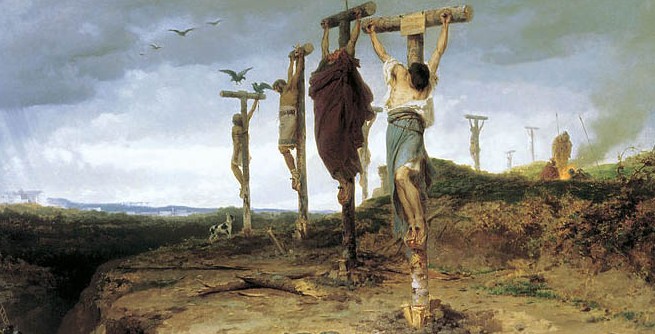
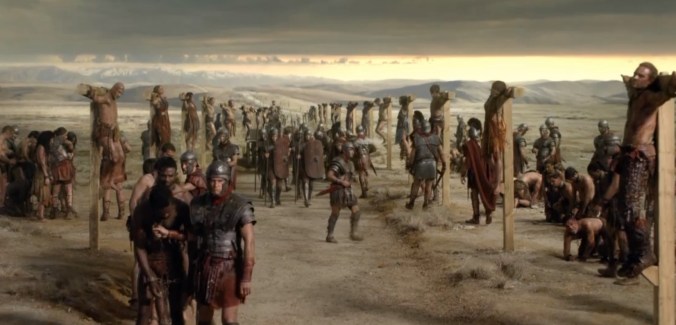
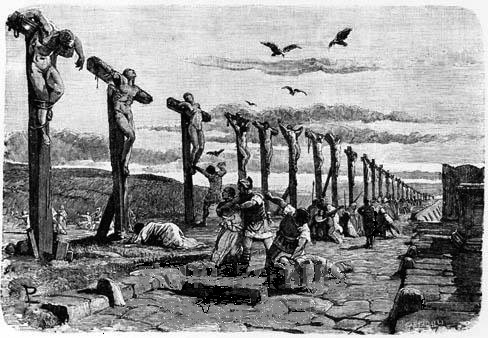
A professor of New Testament once told me about a little known historical event that took place in the very early years of the Common Era (which we even more commonly abbreviate A.D.) in which the Roman army crucified a large group of criminals along a major Galilean road. From what we know about the Roman practice of crucifixion, most people who were hung on crosses were left there to wither and rot over a period of days, possibly weeks.

cross 1

If indeed this event took place, there is nothing odd about it. Despite the ghastly nature of it, crucifixion was commonplace in the provinces of the Roman Empire. It was appalling enough to promote fear among the populace, and public enough to be a cogent display of imperial dominance. While back in Rome the practice was frowned upon, considered far too cruel and inhumane a punishment for a Roman citizen, away in the far reaches of Caesar’s realm it kept the riffraff and the rebels, the subjugated and the slaves, in line.

The event this professor described would have taken place in the days of Jesus’ youth, perhaps a decade or more before he began his earthly ministry at the Jordan River. The Galilean road where this alleged mass execution took place ran close to Nazareth and other nearby villages. It was well traveled – that was the point of the Roman army erecting such a horrifying display. What good was a criminal on a cross if nobody came round to behold it and tremble?

And so, I’m left to wonder if Jesus was familiar with this crucifixion road just beyond his city’s limits. Some scholars have suggested that as a carpenter’s apprentice, he would have assisted with various building projects, and in those days many Galilean tradesmen would have been commissioned in the ongoing renovation work of nearby Caesarea Philippi. Perhaps Jesus traveled the very road along which these enemies of the Empire were hung.

cross 4

Perhaps he made his way back and forth along this road several times, walking by his father Joseph’s side, lunch pails in hand, tool belts hanging loosely around their wastes, a handful of other local craftsmen in their company. The sun is just over the mountains, casting long shadows of the poles and crossbars upon the road. The smell of old blood and rotting flesh hangs heavy in the air. Scavenging birds circle, perch, peck, and cackle at one another.

“Someone oughta take ’em down,” mumbles one of the tradesmen, a Nazarene neighbor. “It goes against Torah.”

Jesus, who knew the Scriptures better than most young apprentices who had left school behind to learn the family craft, recalls the Book of Deuteronomy. In it, the teachings of Moses are recorded, including a statement that those who are hung on poles are under God’s curse, and should be taken down by sunset. The neighbor is right. They should be removed. But not only would touching a cursed, dead man require a whole process of washing and atonement, but these tradesmen have lived long enough to know that if the Roman oppressors want their countrymen to hang until they rot, anyone caught removing the corpses without approval would likely join them on a cross of his own. So Jesus does not blame the men for doing nothing, for continuing to travel this road in service of the pagans, for trying their best to ignore these grisly adornments on the sides of the road. After all, what is a band of poor, simpleminded Galileans to do against such monstrous tyranny?

But as they near their destination – a city coming into view in the distance through the dust of the road and the glare of the morning sun – Jesus hears something that causes him to turn aside. It is the sound ragged breathing and the faintest of whimpers. At the end of the line of crosses, he comes to a living corpse. He can tell the man is only minutes from death.

He pauses at the foot of this cross and gazes up curiously into the criminal’s face. The man’s body is severely bruised, the skin of his chest, back, shoulders, neck, arms, and legs is torn by what must have been repeated, merciless blows of a reed cane. As was the usual practice of Roman executioners, this man had been flogged prior to being executed. The Romans knew the importance of ruining a man before affixing him to a cross; that way the criminal would have no strength left to endure, to struggle, perhaps even slowly work the impaling instruments from his body. Indeed, this is the case for the man hanging above Jesus’ head.

There is a rasping sound that Jesus cannot make out. He steps even closer, so that the man’s scarred and bloated feet are only inches from his face. There are long, jagged nails pierced through the man’s ankles, affixing his feet to each side of the pole. The man’s upper body is caked with blood, smells rancid, and hangs limp. His head is bowed low. Again, the rasp, and Jesus thinks the man is trying to speak a word.

“Thirst.”

Quickly, from his shoulder he swings a leather strap at the end of which is sewn a skin filled with water. He stands on his tip-toes, awkward and unbalanced, and reaches as high as he can to place the opening of the skin to the dying man’s lips. Cool water from a Nazarene well trickles out. Most of it drips back down Jesus’ arms, but a few precious drops find the man’s thick, dry tongue. He moves it around sluggishly, relishing the momentary coolness. Then he grimaces deeply and breathes a pitiful, guttural moan.

Jesus stares up into the man’s face, and for the briefest of moments the criminal’s glazed-over eyes meet his. The man blinks slowly. If Jesus didn’t know any better, he might think the man recognizes him. But it is clear he has been hanging for several days – his mind must be scrambled by the heat of the sun. And, almost as quickly as those eyes found him, the man’s gaze shifts back to the nothingness of the middle distance.

“Yeshua!”

Jesus turns to see Joseph hurrying back up the road. The company of workers is already far ahead, blurred shapes amid waves of high desert heat. Joseph advances upon him with a nervous expression on his face. Jesus knows he must not linger any longer. But as he turns away from the dying man, another bit of Torah echoes in his mind. It is prophecy, lines he has thought about often since he first heard them as a boy.

He is despised and rejected by men; a man of sorrows, and acquainted with suffering; and we hid as it were our faces from him; he was despised, and we esteemed him not. Surely he hath borne our sufferings, and carried our sorrows; yet we did esteem him stricken, smitten of God, and afflicted…

Joseph places his strong, caring arm around Jesus’ shoulders and leads him away from the cross. But Jesus realizes in that moment it is impossible, in a world such as this, to be fully protected from such terror. He supposes that these will not be the only crosses he encounters in his life. He understands that safety from experiencing such an end is an illusion. And he knows that, despite what the oppressors intend with this grim display, he must not be afraid.

He does not look back. There is no need. He enters the city in the company of his father, and goes to work.

Slave

It must have been incredibly shocking.

I have to wonder if at first they even noticed what exactly was happening. The way people dined back then, there is at least a chance these men were used to not paying attention to whomever was behind them performing this task. The way they sat – reclining on their elbows, their legs stretched out behind them, focused on the food in front of them, holding conversation, seeing only the other faces at the table – it could very well have been that their master had made it halfway around the table before anyone even noticed he was the one washing their feet.

When Jesus got up from the table, perhaps they didn’t pay him much mind. Maybe they thought he was just excusing himself to the privy. Maybe in their periphery they noticed him messing with the wash basin and assumed he was performing a thorough wash before the main course began. And since the act of foot-washing was typically performed by the lowest of slaves – Gentiles, girls, or Gentile girls – it probably wasn’t customary to pay much attention to the one cleaning the dust of Judaea roads from your feet.

John doesn’t record who first noticed what Jesus was up to. He does, however, put the audible reaction in Peter’s mouth, one of the more outspoken members of the group (a trait that would soon bring him to his lowest point, and not long after raise him to his highest). The way Peter speaks when a stripped-down Jesus draws near to him with the water basin and soiled towel, you would think he is not merely scandalized by this role-reversal but is going so far as to swear an oath; he insists he will never permit his esteemed rabbi to persist in the humiliation of touching another man’s dirt-ridden feet. Granted, Peter had a habit of refusing Jesus of things, though his intentions were usually noble.

“I have to do this,” Jesus tells him. “Otherwise, you will have no share in what is coming.” It’s a puzzling statement to our modern ears, but not to a first-century Jew following a man they believe to be the promised Messiah. Being included in Jesus’ “share” no doubt evoked images of glory and affluence, of being a part of the newly crowned king’s inner circle. Peter wasn’t the only one interested in this future. The Gospel writers occasionally point out that debates regarding rank and status came up now and again. James and John thought about it often. It is very likely Judas Iscariot was just as interested in this outcome, and when he didn’t see it going the way he envisioned, he either sold-out to the establishment, or he arranged a plan with the establishment in hopes of provoking his master to finally, at long last, take the bull by the horns. One way or another, to have a “share” with Jesus was a chief concern of the Twelve.

“Then wash everything!” says Peter. “Do my head and hands. Do it all.” Translation: I want a share more than anybody else; I’d like a share greater than everyone else; include me in your plans more integrally than anyone else.

You have to wonder if Jesus smiled at that point. Or maybe he even laughed. It was a night in which he was no doubt experiencing a creeping melancholy because of what he had perceived was coming, but this moment of intimacy among men with which he had spent so much time over the past several years was something he had been looking forward to for a long while. Maybe he chuckled before he said to Peter, “That won’t be necessary. Now give me the other foot.”

And so the disciples watched their rabbi – the one they called Messiah, Savior, Lord, etc., and the one who called himself the eschatological “Son of Man,” divinely related to the one true God, whom he called Father – wipe away the gunk and grime from their well-traveled feet. They felt his hands guide the towel between their toes, scraping them clean. They saw beads of sweat form on his forehead and temples because he was not pretending to wash their feet, he was actually washing them, scrubbing them back to a presentable, hygienic purity.

James and John watched him, and they thought about how Jesus had responded to one of their recent arguments: “Whoever wishes to be the best among the group must act as the slave of everyone else.”

Peter watched him, and thought about the time Jesus had spoken about being watchful for the master’s return: “Blessed are the slaves the master finds still waiting up for him; the master will be so happy that he’ll cook dinner for them.

Judas watched him and struggled. He remembered the day Jesus had sat down on the hilltop and taught a gathered throng: “No one can be a slave of two different masters. It’s only natural that he’ll refuse one and obey the other.”

They all struggled. It was a shocking illustration, and even though they were used to their rabbi shirking propriety for the sake of making his point, to feel his hands on their feet – hands that had touched unseeing eyes, held leprous hands, lifted up lame bodies – was a sensation difficult to appreciate. It was also, of course, a sensation that would remain vividly in memory for many years to come.

So there they sat, around the table, feeling their master wash their feet.

Watching him do the work of a slave on their behalf.

Letting the Son of Man serve them.


The Greatest Danger We’ll Face in 2016

If you walked the streets of your neighborhood, or even the aisles of your local Target store, and asked the people you encountered what they believed to be the greatest threat to humanity’s development, what do you suppose they might say? Who or what would be the potential culprits?

No doubt some would toe the current media line and answer “gun violence” or “gun control.” Some might consider our country’s deeply divided views on immigration. Others might nod toward ISIS or other Islamic extremists. The most cynical might blame religion in general. A few germaphobes might point the finger at Ebola or some new flu you can get from armadillos or Canadian geese or something. There would probably be a handful who say, “Hillary,” while hopefully at least some reasonable people answering, “Trump.”

Donald-trump

Please, America. Please… just… just… no.

Here’s what I don’t think many people, if any, would say. I don’t think they would respond to the very problem studies show affects more people than terrorism or gun violence or immigrants takin’ our jobs. More people even than are affected by anxiety, depression, heart disease or cancer combined.

I don’t think anyone would say, “Excess.”

Our society is fanatical about speed and afflicted with the need for more. Year after year, we take great strides in productivity and efficiency, and while we may marvel at the industrial and technological advancements of the past two hundred years, we have ignored the tragically adverse effects such progress has wreaked on humanity.

The Inescapable Illness

“At first sight there is something surprising in this strange unrest of so many happy men, restless in the midst of abundance,” wrote the 19th-century French historian, Alexis de Tocqueville, as he described the bewildering social changes in America resulting from the Industrial Revolution. He observed men chasing after more money, more possessions, more abilities, while simultaneously less and less content despite everything they had acquired. “The spectacle itself, however, is as old as the world,” acknowledges de Tocqueville. True. Industrial America was only the latest victim of what many now refer to as “hurry sickness.”

I have no doubt felt the effects of such an illness. It surely no less than an epidemic in our country. We have becomes slaves to productivity and efficiency; we are incapable of ignoring the ticking of the clock. The comedian Louis C.K. makes us all laugh when he profanely fusses at human beings for being impatient for a picture to load on the technological wonders that are our smartphones, but the joke is that this is no exaggeration. We are all in a rush, and, if pressed to give a reason why, the only explanation we can really offer is, “So I can move on to the next thing I need to do.” Even if that next thing is a much-needed nap, rest itself as been tightly wedged into our congested and overcrowded daily schedules.

When you or I lament that there is never enough time in the day to accomplish everything we have to do, truer words were never spoken . If you’ve ever made that remark, guess what? You are afflicted with hurry sickness.

De Tocqueville goes on: “He who has set his heart exclusively upon the pursuit of worldly welfare is always in a hurry, for he has but a limited time at his disposal to reach, to grasp, and to enjoy it.” As a result, what happens to us? If we evaluate our attitudes and behaviors honestly, we find that this pace of life quite often makes us anxious, irritable, non-present. He who suffers from hurry sickness finds he spins less and less time with other people without an agenda unfurled between them. Our relationships are weakened because they plummet from the priority list. Without realizing it, we isolate ourselves from others – few if any really know the real us. Even when we do kick back and have a beer with a friend, we find much of our conversation dominated by our respective job responsibilities and family problems in need of solutions.

A Costly Cure

And here’s the rub. The cure for hurry sickness is actually quite simple, but it is stubbornly rejected time and time again. Why? Because this cure is not like other cures. It isn’t adaptable to our current, normal lifestyles. There is no pill to pop, no energy shake to grab on-the-go so we may continue flitting from one meeting to the next and multitasking only so we can multiply our productivity. No, the cure for hurry sickness is to slow down. To step out of the rat race. Not just two-week’s vacation from it – that’s nothing more than a Band-Aid. To be cured of this addiction to productivity and efficiency is to no longer bow to the power it exerts over us.

rat

Is it even possible to escape such a thing?

As a minister, I am nonetheless susceptible to the great temptation of our modern culture. I, too, want to accomplish just as much as everyone else as quickly as possible. I, too, complain there is never enough time in the day. I, too, have found myself snapping at people who hold up my progress by raising questions or disagreeing with me. And I, too, have given in to anger and uncharacteristically “gone off” on someone about an unsolved problem. All of this is indicative of hurry sickness – of a soul under stress, not at peace.

But I’m trying. I’m attempting to slow down this year. To resist the ever-present urge to rush, to accomplish or complete a large number of tasks every day, to produce results quickly, to cook dinner as quickly as I can, to ferry my children off to bed with as little lethargy as possible. I’m trying to avoid feeling like I never take any time for myself – for reading, writing, praying. There are more important things than feeling productive. Of course there are.

Slowing down and doing less doesn’t mean I shirk all my responsibilities. It doesn’t mean I show up late to meetings and tell the people I’ve put out, “Deal with it.” It doesn’t mean I indulge procrastination.

bedtime

But it also means this shouldn’t be my go-to bedtime book for my kids.

No, it simply means that I renounce the aggressiveness and stress that so often controls my days. Instead, I practice stillness, receptiveness, patience. I take time to reflect. By doing less, I create space in my day, and by slowing down, I do not surrender to the temptation to immediately fill those gaps. And I evaluate my progress in this not by how much I have produced and how quickly I get things done, but by how many meaningful conversations I’ve had in the past week, how many meals I recall savoring, how many times I’ve stopped to observe something beautiful. It is the very essence of “quality over quantity.”

The Root of All Sickness

This won’t be easy. The siren songs of our society can be terribly mesmerizing. I still have deadlines. I still work with people who need my timely input. I still carry a smartphone, and I still get “push” notifications from CNN.

cnn

So, North Korea has an H-Bomb. Thanks, CNN, for that late-night notification. I’m sure I’ll get a good night’s sleep now.

But I have finally come to see our hurry-obsessed culture for what it is. Idolatry.

I have listened to many a Christian offer that same “not enough time in the day” lament as an explanation for why they don’t spend more time reading their Bible, praying, or simply enjoying solitude with God. And I very often commiserated because their struggle was also mine. I would always agree: “Spiritual disciplines can be hard.” But deep down, whether I wanted to acknowledge it or not, I’ve always known that how a person spends his time reflects what he values most. It isn’t that there isn’t enough time in the day. It’s that there is not enough time after we have scheduled and done what we most value. Maybe it’s work, maybe it’s shopping, maybe it’s Facebook, maybe it’s our child’s soccer practice, maybe it’s another Law and Order marathon on USA.


Law & Order SVU home invasions ice-t

“Yo, you tellin’ me thisth dude wasth s’posthed to be a wapper back in tha day? That’sth ridiculousth!”  

Our idol is whatever we value most, and whatever we value most determines how we spend our time. This doesn’t mean that if we work a long-hour job or we spend our days taking care of our children that these things have necessarily become idols. That happens only if we allow these important, time-consuming things to control and direct our days – if we surrender to the assumption that everything else must revolve around these things. Just because you spend 9 hours at work and only 45 minutes praying and reading Scripture doesn’t mean your job is the most important thing in your life. That would be elevating quantity over quality. Rather, when you strive to protect your job within your schedule but fail to protect that 45 minutes you spend with God, that’s when you know which one you truly value more. That’s when idolatry rears its all too familiar head.

That’s the irony of this whole thing for me; a common assumption is that the minister would never make such a mistake. But I must confess I have often valued my job as a minister over my relationship with the God I am supposed to be pointing people to. I have put off meeting with a church member in order to complete a planned task. I have lingered at the office longer than I should have, subtracting time I could be at home with my family. And there have been many days when I have scheduled early meetings that caused me to neglect my own personal time of prayer and reflection.

That’s idolatry.

When you stop to think about this in light of the Ten Commandments, hurry sickness puts a believer at least two in the hole. We have essentially placed another god – our schedule – before our heavenly Father, and if we’ve done that, it’s probably been years since we’ve remembered the Sabbath day and kept it holy.

worship

What, you mean sitting in the semi-dark listening to music and a spiritual TED talk for an hour and the  rushing off to lunch before the Methodist church lets out doesn’t constitute keeping the Sabbath?

Trusting the Healer

And all the while, the God who saves us – who sent His Son that we might know peace – watches us run from one task to next, one consumeristic pleasure to another, wondering when we’ll realize that it will never satisfy us – we will never achieve this good life that society promises us is right there for the taking if we would just reach a little bit more

“Peace I leave with you; my peace I give to you. I do not give as the world gives,” said Jesus. The Greek word is eirene, the Hebrew is shalom. It isn’t a passive thing – the absence of strife. It is a powerful, active experience. It means fullness, wholeness, to live well. Or, as Frederick Buchner puts it, shalom means “having everything you need to be wholly and happily yourself.”

To know the genuine, abiding peace of the Son of God, we must live as he did. He was certainly tempted by hurry and progress and efficiency and success, but he never bowed to those influences no matter how insistently they grabbed for his allegiance. And if we are to live as Jesus did, then we must make him the highest authority – the one, true God – of our life, and protect our time and pace with him at all costs.

This is what I am trying to do in 2016. I will no doubt produce less, become a bit more limited in my availability to others, have less acquisitions and professional attainments to show for the year, but all the while I will have gained something far beyond the cumulative value of hurry-driven accomplishments.

I will have gained fullness. I will be more wholly and happily myself than ever before.

What about you?

A Phone Call from Mack

feature_remembering-mack

I didn’t know Mack Hannah very long. He was only in my life for less than two years, and a significant portion of that time was via e-mail and phone calls before I finally joined his staff at Dunwoody Baptist Church.

It was, in fact, a phone call that started it all.

On October 31, 2013, my cell phone lit up with an unfamiliar number hailing from Dunwoody, Georgia. I drew a blank on the city, and assumed this was some manner of telemarketing call. However, because at the time I was assisting in the tedious task of crafting a cardboard box maze in a church gym (standard preparation for the annual “Harvest Hoedown”), even taking a telemarketer’s call was a welcome break, so I excused myself. As it turned out, the voice on the other end of the line sounded as if it was either the friendliest telemarketer in the history of the sport, or my long-lost best friend.

“Bo, it’s Mack Hannah. How are you?”

“Um… fine.” What followed was that awkward moment when you encounter someone who knows you, but you have no clue how. Thankfully, Mack cleared things up quickly.

“I’m the pastor at Dunwoody Baptist Church. I’m sitting here looking at your resume. You know, I lived in Waco for a while…”

The call stretched on for over an hour. We even got disconnected once when, after realizing I was talking to another church about another job, I retreated into the attic of the church to maintain secrecy and ended up losing the signal. In all that time, though, what Mack talked about was other people. Despite having led his own extraordinary life, Mack rarely told stories in which he was the main subject or active agent. When he spoke of the ministries of Dunwoody Baptist, or other churches and organizations he had led, he always portrayed himself more like a bystander witnessing other great people doing extraordinary things. This was not a calculated decision to effect a more humble attitude; what makes Mack Hannah so endearing, and what made me want to work for him (or “with him” as Mack would always insist) was this very way of seeing ministry. For Mack, everything was a team effort. Even when he was front and center – and, as a pastor, he often was – Mack was mindful that the success of any endeavor was not due to his strengths alone. Often when he preached, you were apt to hear him pray, “Holy Spirit, you are the teacher in the room.”

During that initial phone call, when Mack spoke of his own ministry experience, he would sing the praises of others – of fellow ministers, neighbor churches, and the many, many people he had encountered and worked “alongside.” The way Mack often spoke of himself, he seemed like the Forrest Gump of the evangelical Church. Amazing things just seemed to happen around him and to him – things for which he refused to take credit or admit responsibility. He pastored a small congregation in a farming town outside of Nashville that just happened to attract the membership of Amy Grant and her family, who became close friends. He focused on caring for people of every stripe, and Belmont University just happened to create a student-care position solely for him. He lent his time and energy to the Fellowship of Christian Athletes, and just happened to find himself ministering to the NCAA tournament-bound Georgia State basketball team, or offering a prayer for the Atlanta Falcons. And yet…

And yet Mack Hannah is an extraordinary man. He is one of the most genuine Christians I have ever known. That is to say that every faithful word he spoke did not sound forced or planned or regurgitated from some other pastor’s book. Even when he would quote other writers, pastors or theologians, the words always made more sense coming from his mouth. When I finally arrived on staff at Dunwoody Baptist Church, I realized this was because Mack didn’t speak in a way that was disconnected from the life he lived. No, every word he spoke was steeped in life experience. He lived the words he spoke first. To put it in a more colloquial way, Mack only talked the talk after he had walked the walk.

This, among many other things, has been a continual inspiration to me. Typically, when I teach or preach, the messages I prepare are as much for me as for anyone else. When I speak, I am often testing out a lifestyle concept – a spiritual exercise or a specific act of service – rather than reporting on how I have actually experienced this concept unfolding in my life. I teach about how I want to live, and I try to live up to the words I speak. But Mack Hannah simply described the life he lived every day. This is his legacy. He was a pastor, a teacher, an evangelist, a coach and a friend. Perhaps, one day, I might learn to be the same, and to then speak from those places.

I am where I am – and, partly at least, I am who I am – because of Mack Hannah. Of course, he would never claim such an influence was his own, but simply the Spirit at work through him. But it was that phone call that made me realize how much I wanted to serve with Mack, and my initial face-to-face meetings that had me excited to learn from him how to be an effective pastor who remained genuine throughout. It was those stories he told, which always seemed like only a hint of even greater stories, that instilled an eagerness to sit beside him and listen to his grand narrative of a life charged with God’s goodness, mercy, and abiding peace.

So it was that the last phone call we shared before I moved to Dunwoody was such a disappointment. It was a few days after Easter, the beginning of the season of Resurrection, that Mack phoned me.

“How are things going for you?”

I proceeded to recount a number of little stresses that come from offering one’s resignation, finishing up ministry at a church, and moving one’s family halfway across the country. To his credit, Mack patiently listened to all of this.

After I finally closed my mouth, he said, “Well, listen, let me tell you what’s going on with me. I’ve told you before how I was diagnosed with cancer a couple of years ago, right? Well, I recently found out that it’s come back.”

*

My family and I came to Dunwoody anyway. Of course we did. As much as it pained me to know that my future plans for service alongside Mack Hannah were tenuous at best, even in the six months we had communicated primarily via phone and e-mail, Mack had taught me that you don’t follow after a person; you follow after the Spirit that works in and through that person. And while a person may die, the Spirit that dwells in each and every one of the faithful never dies, but carries on the good work to which we have all been called. And so, I came to Dunwoody with the understanding that even if Mack ceased to be the senior pastor at the church (which, eventually, he did), and even if this time he didn’t go into remission (which he didn’t), and even if he passed before I got the chance to hear all those wonderful stories brimming within him (thankfully, I was blessed to hear a few more before the end), I would nonetheless continue following the leading of God’s Spirit. I would continue to, as Mack has always said, “do the next right thing.”

Today is Mack Hannah’s memorial service. It is most definitely a celebration of life. A life of honesty. A life of joy. A life that clearly reflected the transformation promised to us in a relationship with our glorious, good God.

I’ve only known Mack Hannah for a short amount of time. But what I know I like, and what I like, I celebrate and I will hold close for as long as the Spirit gives me. Thank you, Mack, for making that first phone call. I am a better man because of it.

5 Reminders for Christians Worried About Same-Sex Marriage

In my last post, I wrote about the inherent tension that comes from pursuing a holy life. I believe this tension has become as evident as ever within American churches in light of the recent Supreme Court decision. Many, many Christians are struggling to reconcile orthopraxy with orthodoxy – that is, correct conduct with correct belief.

protest-sign

How are Christians supposed to maintain genuine attitudes of hospitality and compassion to people they believe are openly engaging in sinful practices? And, now that same-sex marriage has been federally legalized, does this mark the beginning of the end for any form of biblical morality within government legislation?

If we are going to adequately and correctly address questions such as these, there are several important truths Christians in this country need to bear in mind…

#1 – Christians in America still enjoy unprecedented levels of religious liberty.

When it comes to our place in American society, it is difficult for the modern-day Church to find any similarities to the Christian Church of the first century. For hundreds of years, followers of the Way (Acts 9:2, 22:4) were the weird and suspicious cult members of the neighborhood. Their worship practices were misunderstood, and their theology was considered heretical by some and ludicrous by others. In those first few centuries, persecution was an integral part of their reality; sometimes it was localized to a particular region because a local governor didn’t like them, and other times the Roman Emperor himself sanctioned the oppression empire-wide. And so we’re clear, the Church didn’t define persecution merely as unkind words or unfair stereotyping of their faith. That, they believed, was just the nature of a worldly society desiring to malign them. No, persecution was more significant than that. It was shocking, often violent. From vicious slander to the stripping of business ownership. From treatment as social pariahs to imprisonment, forced apostasy and even execution.

Kind of puts our fussing about the

Kind of puts our fussing about the “rights” of florists and caterers in perspective.

When we stop and consider the social conditions within which the first and second-century Church operated, believers in America should be thoroughly humbled by how good we’ve got it. We should also be embarrassed that while recent Pew Research reports indicate a decline in church membership today, in contrast the early Church grew at an extraordinary rate despite being seen as much more counter-cultural. We may lament the recent decision by the Supreme Court, but we should also remember that both the judge writing for the majority and the President of the United States himself included statements acknowledging and calling for respect of those in the country who hold dissenting views due to religious reasons in particular. This, along with the First Amendment itself, would have bewildered Christians in the first century.

And, concurrently, they certainly would have reminded us that…

#2 – Christians are not called to infringe on another person’s civil rights.

Some Christians may refuse to admit it, but there is simply no basis in Scripture for preventing a citizen of a democratic country from enjoying his or her civil rights. What is more, Christians were never called to enforce their belief system – or the behavioral standards incumbent – on the public at large. Sure, they could and did argue for the value of it. Boldly even. But when the powers that be rejected their theological, moral and ethical viewpoints, neither did the Christians take their dolls and go home to pout. They recognized that what they believed in – the new reality to which they had sworn allegiance – was much bigger than mere civic responsibility. Jesus did not spend his last hours accusing the Sanhedrin of corruption and unfair treatment, but rather looked into the eyes of skeptical Pilate and said, “My kingdom is not of this world” (John 18:36).

Of course, there are many Christians who would argue that America was founded as a Christian nation and that means it should uphold Christian morality. The problem with this, besides the fact that the foundation of the United States was more a product of Enlightenment principles than biblical ones, is that it assumes the measure of a good society is found in its laws rather than the ideas that inspired them. But what does it mean to be American? Is it to be a biblically moral person, or to be a person liberated from tyranny and oppression? This Saturday is Independence Day. What will that celebration look like: Reveling in the satisfaction that comes from being law-abiding citizens, or gratefully extolling our country’s commitment to equality and personal freedom? At some point, Christians must recognize that for other people to live unto the standards we hold ourselves to, they must be inspired toward them, not forced into them. In the meantime, we mustn’t degrade people who fail to uphold a standard they don’t even believe in.

throwing-bible-gifgifw700

And speaking of forcing people into something, we should remember that…

#3 – A Christian is called to live a holy life, not to legislate for one.

The fallout from the Supreme Court’s decision on same-sex marriage reveals that a lot of Christians are deeply confused about the inherent difference between an authentic life of faith and civil responsibility. The Bible never claims that trusting in God will bring about a socially comfortable life. The story of Scripture finds true believers constantly at odds with the world around them, with no legislation to ease that antagonism. Those who seek to live a righteous life according to the will of God will, at some point, find themselves in conflict with the prevailing moral and ethical standards of the day. As that point, the committed follower must choose whether he or she will continue to think, speak or act contrary to that worldly standard, or assimilate to it.

The Book of Leviticus was an incredibly progressive work, defining a sacrificial system and a code of moral/ethical conduct far more advanced than any of the prevailing polytheistic societies that surrounded the ancient Israelites. Thus, we read time and again phrases like, “be holy,” “consecrate yourselves,” and “I am the Lord.” It is clear that the purpose of the book was not simply to establish a detailed code of law for the Israelites to live by. No, it was first and foremost a call to live a holy life – to be different, distinct from all the other neighboring cultures and their hazardous influences. To be a people set apart and belonging to a loving, almighty God.

Yeah, I tried to read that one. I really did, but then my eyelids got all heavy...

Yeah, I really tried to read that one, but then my eyelids got all heavy…

In the New Testament, we find Jesus upholding this same call despite living under a different law – the Law of Rome – which had politically subjugated the Jewish code. But for Jesus, holiness need not be government sanctioned. It was a question of open-handed devotion to God, not fist-clenched obedience to the law. He embraced the moral and ethical code, claiming in his most famous sermon that he had not come to abolish this call but to fulfill it (Matthew 5:17-20), but he continually pointed to inner motivation as the key to outward behavior. Christians today need to understand that even if we are unsuccessful in passing legislation that upholds our behavioral ideals, that failure in no way affects our unique call to live a holy life unto the Lord within this country.

Which brings us to the biggest spot of tension, namely that…

#4 – Christians are called to resist idolatry, not simply to uphold biblical morality.

Historically, Christians have been called not to pull back from a society that contains unbiblical laws, but rather to abide within it. Peter’s first letter acknowledged the tension of living in a culture that rejected what they saw as an unpatriotic, upstart Messiah cult. Nonetheless, while encouraging Christians to pursue holy living, he also instructed them to submit to, and even honor, human authorities. Any Christian who would seek to justify his or her disrespectful or ill talk against the government or its leaders would do well to contemplate 1 Peter 2:11-17. Those words pull no punches.

The New Testament never assumes society would affirm the principles and standards of God’s kingdom, or even that it could. Rather, Christians are expected to resist the spiritual, political or social idols that offered only false identity and fleeting provision. The problem is, we often forget what idolatry really is. When we place our trust in a worldly institution or individual (for security, provision, identity, recognition, and/or pleasure), that is idolatry. It has always come in many forms, from natural elements to graven images to political figures. And we find a variety of manifestations of idolatry in our world today, but one Christians often overlook is American individualism. A side-effect to living in a country founded on Enlightenment ideals and upholding democratic principles is that we place quite a bit of importance on individual freedom – that “pursuit of happiness” part of our Declaration of Independence. Thus, when some Christians rage against American courts that choose not to uphold their moral standards, they are reacting less from a commitment to spiritual holiness and more from an innate sense that their personal liberties are being challenged. In reality, they have made idols out of state and federal laws. They have placed in them their sense of security and personal worth, and when that law changes, they feel vulnerable, insecure, and threatened.

And what of same-sex marriage itself? In our time, one of the most deceptive idols has turned out to be human sexuality. Our conditioning within American individualism only furthers the misguided belief that sexual expression is key to defining oneself. More and more people, whether they are heterosexual, homosexual, transgender, etc., have been fed his lie. And so, the search for individual identity trumps submission to divine relationship, let alone biblical morality. However, even committed Christians have just as often fallen prey to this particular form of idolatry. For instance, young Christians who believe that a “true-love-waiting” soul mate will finally complete their existence are just as misguided as homosexual couples who believe they will find true fulfillment through government-sanctioned marriage.

Because of course God wants me to get married.

Because of course God wants me to get married.

So, given the above four truths, how do we as Christians move forward, particularly in relationship with those who do not share our commitment to holy living?

#5 – Christians should be ever-mindful of their approach as much as their attitude.

The whole story of Scripture – Old Testament and New – is of God calling people to anticipate and participate in His work of redemption and restoration. The first two chapters of Genesis paint us a vivid picture of God’s perfect intentions, and it is immediately followed by a story of how the whole thing was thrown out of sorts by our selfishness. (Adam and Eve’s response to the serpent’s lie that they could become “like gods” is indicative of the idolatrous thinking discussed above.) Everything after that is the account of God seeking to restore what has been broken. And at the exact right time, God’s son appeared to not only provide atonement for that inherent selfishness, but also to show us what it looks like when we truly live within God’s redemptive plan.

One of the most impressive things about Jesus’ life is how he was able to uphold a moral standard while simultaneously showing sincere empathy and genuine compassion to people whose lives had become idolatrous messes. Jesus’ attitude about sin never faltered. He was both grieved and angered by it, particularly the way it prevented people from recognizing what God was up to in their midst. Nevertheless, he also maintained an intimate and understanding approach toward sinful people. He did not keep people at arm’s length, but instead showed them incredible patience. And he never once complained that the government should better regulate faithful living. As one writer has put it, his position on sin never overshadowed his posture toward those lost in it. So, when it came to instructing his disciples in holy living, he did not say, “Let your light be so legislated among all people that they may be legally held to your moral standards and glorify your Father in heaven.” Nope. He wasn’t interested in seeing a world that knew nothing of holiness forced to conform to that standard.

“Listen, before I take off, did everyone add their names to the petition that was passed around?”

Instead, Jesus asked his followers to live in such a way that here and there in a lost and bewildered world, we might stand out as those rare individuals who know where true identity comes from. That we might be those peculiar folks who, as it turns out, have learned what real freedom is all about.