5 Reminders for Christians Worried About Same-Sex Marriage

In my last post, I wrote about the inherent tension that comes from pursuing a holy life. I believe this tension has become as evident as ever within American churches in light of the recent Supreme Court decision. Many, many Christians are struggling to reconcile orthopraxy with orthodoxy – that is, correct conduct with correct belief.

protest-sign

How are Christians supposed to maintain genuine attitudes of hospitality and compassion to people they believe are openly engaging in sinful practices? And, now that same-sex marriage has been federally legalized, does this mark the beginning of the end for any form of biblical morality within government legislation?

If we are going to adequately and correctly address questions such as these, there are several important truths Christians in this country need to bear in mind…

#1 – Christians in America still enjoy unprecedented levels of religious liberty.

When it comes to our place in American society, it is difficult for the modern-day Church to find any similarities to the Christian Church of the first century. For hundreds of years, followers of the Way (Acts 9:2, 22:4) were the weird and suspicious cult members of the neighborhood. Their worship practices were misunderstood, and their theology was considered heretical by some and ludicrous by others. In those first few centuries, persecution was an integral part of their reality; sometimes it was localized to a particular region because a local governor didn’t like them, and other times the Roman Emperor himself sanctioned the oppression empire-wide. And so we’re clear, the Church didn’t define persecution merely as unkind words or unfair stereotyping of their faith. That, they believed, was just the nature of a worldly society desiring to malign them. No, persecution was more significant than that. It was shocking, often violent. From vicious slander to the stripping of business ownership. From treatment as social pariahs to imprisonment, forced apostasy and even execution.

Kind of puts our fussing about the

Kind of puts our fussing about the “rights” of florists and caterers in perspective.

When we stop and consider the social conditions within which the first and second-century Church operated, believers in America should be thoroughly humbled by how good we’ve got it. We should also be embarrassed that while recent Pew Research reports indicate a decline in church membership today, in contrast the early Church grew at an extraordinary rate despite being seen as much more counter-cultural. We may lament the recent decision by the Supreme Court, but we should also remember that both the judge writing for the majority and the President of the United States himself included statements acknowledging and calling for respect of those in the country who hold dissenting views due to religious reasons in particular. This, along with the First Amendment itself, would have bewildered Christians in the first century.

And, concurrently, they certainly would have reminded us that…

#2 – Christians are not called to infringe on another person’s civil rights.

Some Christians may refuse to admit it, but there is simply no basis in Scripture for preventing a citizen of a democratic country from enjoying his or her civil rights. What is more, Christians were never called to enforce their belief system – or the behavioral standards incumbent – on the public at large. Sure, they could and did argue for the value of it. Boldly even. But when the powers that be rejected their theological, moral and ethical viewpoints, neither did the Christians take their dolls and go home to pout. They recognized that what they believed in – the new reality to which they had sworn allegiance – was much bigger than mere civic responsibility. Jesus did not spend his last hours accusing the Sanhedrin of corruption and unfair treatment, but rather looked into the eyes of skeptical Pilate and said, “My kingdom is not of this world” (John 18:36).

Of course, there are many Christians who would argue that America was founded as a Christian nation and that means it should uphold Christian morality. The problem with this, besides the fact that the foundation of the United States was more a product of Enlightenment principles than biblical ones, is that it assumes the measure of a good society is found in its laws rather than the ideas that inspired them. But what does it mean to be American? Is it to be a biblically moral person, or to be a person liberated from tyranny and oppression? This Saturday is Independence Day. What will that celebration look like: Reveling in the satisfaction that comes from being law-abiding citizens, or gratefully extolling our country’s commitment to equality and personal freedom? At some point, Christians must recognize that for other people to live unto the standards we hold ourselves to, they must be inspired toward them, not forced into them. In the meantime, we mustn’t degrade people who fail to uphold a standard they don’t even believe in.

throwing-bible-gifgifw700

And speaking of forcing people into something, we should remember that…

#3 – A Christian is called to live a holy life, not to legislate for one.

The fallout from the Supreme Court’s decision on same-sex marriage reveals that a lot of Christians are deeply confused about the inherent difference between an authentic life of faith and civil responsibility. The Bible never claims that trusting in God will bring about a socially comfortable life. The story of Scripture finds true believers constantly at odds with the world around them, with no legislation to ease that antagonism. Those who seek to live a righteous life according to the will of God will, at some point, find themselves in conflict with the prevailing moral and ethical standards of the day. As that point, the committed follower must choose whether he or she will continue to think, speak or act contrary to that worldly standard, or assimilate to it.

The Book of Leviticus was an incredibly progressive work, defining a sacrificial system and a code of moral/ethical conduct far more advanced than any of the prevailing polytheistic societies that surrounded the ancient Israelites. Thus, we read time and again phrases like, “be holy,” “consecrate yourselves,” and “I am the Lord.” It is clear that the purpose of the book was not simply to establish a detailed code of law for the Israelites to live by. No, it was first and foremost a call to live a holy life – to be different, distinct from all the other neighboring cultures and their hazardous influences. To be a people set apart and belonging to a loving, almighty God.

Yeah, I tried to read that one. I really did, but then my eyelids got all heavy...

Yeah, I really tried to read that one, but then my eyelids got all heavy…

In the New Testament, we find Jesus upholding this same call despite living under a different law – the Law of Rome – which had politically subjugated the Jewish code. But for Jesus, holiness need not be government sanctioned. It was a question of open-handed devotion to God, not fist-clenched obedience to the law. He embraced the moral and ethical code, claiming in his most famous sermon that he had not come to abolish this call but to fulfill it (Matthew 5:17-20), but he continually pointed to inner motivation as the key to outward behavior. Christians today need to understand that even if we are unsuccessful in passing legislation that upholds our behavioral ideals, that failure in no way affects our unique call to live a holy life unto the Lord within this country.

Which brings us to the biggest spot of tension, namely that…

#4 – Christians are called to resist idolatry, not simply to uphold biblical morality.

Historically, Christians have been called not to pull back from a society that contains unbiblical laws, but rather to abide within it. Peter’s first letter acknowledged the tension of living in a culture that rejected what they saw as an unpatriotic, upstart Messiah cult. Nonetheless, while encouraging Christians to pursue holy living, he also instructed them to submit to, and even honor, human authorities. Any Christian who would seek to justify his or her disrespectful or ill talk against the government or its leaders would do well to contemplate 1 Peter 2:11-17. Those words pull no punches.

The New Testament never assumes society would affirm the principles and standards of God’s kingdom, or even that it could. Rather, Christians are expected to resist the spiritual, political or social idols that offered only false identity and fleeting provision. The problem is, we often forget what idolatry really is. When we place our trust in a worldly institution or individual (for security, provision, identity, recognition, and/or pleasure), that is idolatry. It has always come in many forms, from natural elements to graven images to political figures. And we find a variety of manifestations of idolatry in our world today, but one Christians often overlook is American individualism. A side-effect to living in a country founded on Enlightenment ideals and upholding democratic principles is that we place quite a bit of importance on individual freedom – that “pursuit of happiness” part of our Declaration of Independence. Thus, when some Christians rage against American courts that choose not to uphold their moral standards, they are reacting less from a commitment to spiritual holiness and more from an innate sense that their personal liberties are being challenged. In reality, they have made idols out of state and federal laws. They have placed in them their sense of security and personal worth, and when that law changes, they feel vulnerable, insecure, and threatened.

And what of same-sex marriage itself? In our time, one of the most deceptive idols has turned out to be human sexuality. Our conditioning within American individualism only furthers the misguided belief that sexual expression is key to defining oneself. More and more people, whether they are heterosexual, homosexual, transgender, etc., have been fed his lie. And so, the search for individual identity trumps submission to divine relationship, let alone biblical morality. However, even committed Christians have just as often fallen prey to this particular form of idolatry. For instance, young Christians who believe that a “true-love-waiting” soul mate will finally complete their existence are just as misguided as homosexual couples who believe they will find true fulfillment through government-sanctioned marriage.

Because of course God wants me to get married.

Because of course God wants me to get married.

So, given the above four truths, how do we as Christians move forward, particularly in relationship with those who do not share our commitment to holy living?

#5 – Christians should be ever-mindful of their approach as much as their attitude.

The whole story of Scripture – Old Testament and New – is of God calling people to anticipate and participate in His work of redemption and restoration. The first two chapters of Genesis paint us a vivid picture of God’s perfect intentions, and it is immediately followed by a story of how the whole thing was thrown out of sorts by our selfishness. (Adam and Eve’s response to the serpent’s lie that they could become “like gods” is indicative of the idolatrous thinking discussed above.) Everything after that is the account of God seeking to restore what has been broken. And at the exact right time, God’s son appeared to not only provide atonement for that inherent selfishness, but also to show us what it looks like when we truly live within God’s redemptive plan.

One of the most impressive things about Jesus’ life is how he was able to uphold a moral standard while simultaneously showing sincere empathy and genuine compassion to people whose lives had become idolatrous messes. Jesus’ attitude about sin never faltered. He was both grieved and angered by it, particularly the way it prevented people from recognizing what God was up to in their midst. Nevertheless, he also maintained an intimate and understanding approach toward sinful people. He did not keep people at arm’s length, but instead showed them incredible patience. And he never once complained that the government should better regulate faithful living. As one writer has put it, his position on sin never overshadowed his posture toward those lost in it. So, when it came to instructing his disciples in holy living, he did not say, “Let your light be so legislated among all people that they may be legally held to your moral standards and glorify your Father in heaven.” Nope. He wasn’t interested in seeing a world that knew nothing of holiness forced to conform to that standard.

“Listen, before I take off, did everyone add their names to the petition that was passed around?”

Instead, Jesus asked his followers to live in such a way that here and there in a lost and bewildered world, we might stand out as those rare individuals who know where true identity comes from. That we might be those peculiar folks who, as it turns out, have learned what real freedom is all about.


The Suit Maker

For Bayo, my friend

bayo

“Just you wait,” my pastor told me. “Pretty soon, he’ll make you one, too.”

In addition to being an expert couturier of incredible skill, the person in question was a faithful deacon and usher in the church, not to mention the director of a nearby community outreach ministry. And just as predicted, only two weeks later, this man walked up to me with a smile on his face and, in his thick Nigerian accent, said, “I would like to make you a suit.” As always, he was impeccably dressed that morning, wearing one of his own handmade suits – a light gray set accented with a beautiful scarf of magenta and scarlet. “Would that be all right with you?”

“Oh,” I said, surprised only by how soon my pastor’s prediction had come true. “That’s very kind.”

“First, I will need to measure you.” He had a small tape measure in his pocket. After the worship service began and everyone had been welcomed, we went to my office. In a flurry of fluid movements, he measured the lengths of my arms, legs, waist, and shoulders. Some of the assessments I had never seen a tailor take before. Some he wrote down on a little scrap of paper. Others, he seemed only to file away in his mind. When he was finished, he said, “I will have it for you next week.”

“Really?” I asked, a bit incredulous. “Next week?”

“Oh yes,” he replied with a smile.

It was an odd thing to anticipate the unveiling of that suit. It wasn’t just that he had not asked my preference regarding style or color, leaving me no idea what it would look like. I also couldn’t help but wonder what kind of use I would get out of it. Only a week earlier, an older gentleman in the church had shown up at the office, interrupting me amidst a day full of meetings only to inform me that he was disappointed with the way I dressed on Sundays. He described my appearance as discourteous, unbecoming of a minister. I did my best to hold back my anger, but I felt terribly insulted and disrespected. That man’s comments remained with me throughout that week and into the next. It made me self-conscious on Sunday mornings and Wednesday nights when I interacted with other church members. I couldn’t help but wonder if this was all some people were thinking about when they looked at me, when they sat in my Bible studies, when they bowed their heads as I led them in prayer.

It wasn’t like I was wearing blue jeans and sneakers around the church. I wore nice pants, though they weren’t always of the more formal, pleated variety. I wore button-up, collared shirts, though not always with a tie. I tucked my shirt in; my hair was combed somewhat. I’d been a bit overweight lately, but all things considered I couldn’t look that disheveled, could I?

As I weighed the argument about my physical appearance, and considered what level of importance, if any, modern fashion should have in the worshipping life of a church, I began to wonder if the suit maker felt the same about me. Had he offered to make me a suit because he also disapproved of the way I dressed? Had I disappointed him as well?

It wasn’t that I didn’t own other suits, or that I see no value in them. I did, and I do. What bothered me was the prospect of formality, propriety and tradition becoming wedges between me and the congregants of the church. Was genuine relationship contingent on approval of someone’s physical appearance? Would giving in to wearing a suit and tie every week be a perpetuation of shallow relationships? What of the sobering statement from 1 Samuel 16, in which the Lord reminds Samuel that He “does not see as mortals see; they look on the outward appearance, but the Lord looks on the heart” (v. 7)?

As such, I was anxious to receive this undeserved, unsolicited gift. However, I was also anxious about how to properly honor the man willing to make it for me.

The next Sunday, he brought it to me on a hanger, and once again we went to my office where I tried it on. It was beautiful – a dark, navy blue two-piece suit with light blue pinstripes. I was astonished at how luxurious it looked and felt, and that it needed no alterations. His measurements had been perfect in every respect. I was at a loss for how to thank him, simply saying again and again, “Thank you so much. This is so nice. Thank you so much…” He only nodded humbly and told me it had been his pleasure, backing away as if he knew I had more important matters to attend to that morning.

I was scheduled to preach in the morning services the Sunday after that, and over the course of that week I found my thoughts were shifting. I was no longer uneasy about my perceived appearance, but rather moved by the rare and unique feeling of being the recipient of an unmerited blessing. I thought about the suit, about the beauty of it. I thought about how its superior, hand-crafted quality far exceeded even what the older gentleman who had criticized my appearance probably had in mind when he wished for a better-dressed version of me.

On that Sunday, my suit maker said, “That suit looks wonderful on you!” It was a few minutes before the early worship service began, and we stood by ourselves near one of the hallway coffee pots. “And that tie is perfect!”

“You think so?” I said, looking down sheepishly at the sky blue, paisley tie I had chosen that morning.

“Oh yes,” he said.

“I feel so fancy,” I said with a nervous laugh.

I could see that he was grinning with pure enjoyment of the moment. Reaching out, he touched the lapel of the coat, his old fingers tracing the tiny stitches he had done himself. Memory in the sense of touch. “But, you know something?” he said. “It is not the suit that makes a man look good. It is the way he wears it. And you… you wear that suit well.”

Again, a fluttering of inadequate thank-you’s. Then I said, “I was planning to mention you briefly in my sermon today. Would that be all right with you?”

He gave a humble nod.

And so, that morning I stood before the congregation and spoke about using everything God has given us to impact others – from our manner of speaking, to the specific life interests that bring us joy, to the unique skills with which we have each been blessed. I told them how I had acquired the fine suit I was wearing that morning, and who had been its maker. “I don’t think he made me this suit because he thought I dressed poorly,” I told the congregation. “No, he made me this suit because he makes suits – very nice suits. He’s good at it, and he wanted to bless me in the best way he knew how. God created him to bless this world through specific gifts, and one of those is making beautiful suits. It’s one way that he shows the steadfast love and kindness God wants to pour into the whole world.”

I looked to the back of the sanctuary where my couturier stood in his own lovely suit. “Thank you,” I said to him, “for being obedient with your gifts, and for blessing my life in a most undeserved way.”

He only nodded that humble nod, the remnants of that excited grin still on his face. He lift a weathered hand as a way to communicate he was more than honored.

___

This Thursday, I will wear the suit again. So will many who were similarly blessed when they, too, received their own handmade suits from the selfless man who was at his happiest when he was uniquely blessing others. We will wear what we each affectionally refer to as our “Bayo suit” to the memorial service that will celebrate his extraordinary life.

Bayo Otiti was an extraordinary man. Born and raised in Nigeria, he found great success as a couturier and clothier in America, eventually outfitting people far more famous and successful than a lowly church minister. However, his passion extended well beyond suit-making. A former Muslim whose wife prayed for him to respond to the call of Christ, Bayo not only became a committed follower of Jesus, but established a vibrant ministry in the towns of Clarkston and Chamblee in metro Atlanta, where he worked closely with at-risk children and immigrants, spearheading community outreach programs and building deep relationships with everyone with whom he came into contact. His life was far more exquisite than the beautiful suits he made. And, believe me, that’s saying something.

I knew him only a short time – not even a year – but I did learn one thing from Bayo I will remember always: Just like a fine suit, what a person’s life looks like on the outside does not matter near as much as how that person lives it.

If you would like to know more about Bayo and his ministry, click HERE.

3 Helpful Tips for 2015

We are two weeks into 2015, and despite the disappointment many of us are feeling at the absence of Mattel hover boards, flying cars, and three-second pizza hydrators, materialistic advancements shouldn’t dictate our level of optimism. Besides, just because our present isn’t a Zemeckisian future doesn’t mean we can’t experience some improvements and upgrades in our own lives that make living them more enjoyable than ever.

Plus, if you count Deep Blue Sea, Piranha, Mega Shark vs. Giant Octopus, and the Lake Placid and Sharknado series as part of an expanded universe franchise, we've just about accomplished this one.

Plus, if you count Deep Blue Sea, Piranha, Mega Shark vs. Giant Octopus, and the Lake Placid and Sharknado series as part of an expanded universe franchise, we’ve just about accomplished this one.

From a spiritual standpoint alone, there is plenty you can improve upon as you journey hoverboard-less through 2015, and none of them are incredibly difficult or far-fetched. At a time of year in which droves of people are making the same old New Year’s resolutions (which studies show only have an 8% success rate in the first month alone!), why not instead to commit to a process of growth rather than berate yourself for reaching goals that are rarely realistic in the first place.

Here are three practices that can help you experience a brighter 2015, and the great thing is that none of them become lost causes if you happen to neglect them once or twice before spring arrives. The point, of course, is to keep at them – transformation is a slow burn, not a sudden explosion.

#1 – Engage in Spiritual Exercises

When you think about it, physical exercise and spiritual exercise are a lot alike. Not only do both require long-term commitments of time and focus in order to notice significant change, but they also involve forces that are not under our control. Physical exercise involves working our bodies into a state in which internal, metabolic processes can do… whatever it is they do… so that we can experience the benefits of greater strength and health. No one is able to force those internal processes to start – it is simply what takes place with increasing effectiveness the longer one commits to an exercise regimen. In short, I do what I can so that my body is able to do what it does best.

Though I can certainly do better than this.

Certainly, though, I can do better than this.

And it’s nearly the same with spiritual exercises (sometimes referred to as “spiritual disciplines”). It is not the outward commitment to prayer, study and meditation that actually transforms heart and mind. The Bible reminds us that “it is God who works in you to will and to act in order to fulfill his good purpose” (Phil. 2:13). In other words, I do what I can so that God’s Spirit will begin to change me from the inside out.

The thing is, a lot of Christians live as if there are only a couple of accepted spiritual exercises. Many “quiet times” are composed of little more than reading a short passage of Scripture (with or without the aid of a devotional book) and praying through a perpetual list of wants and needs. While there is nothing inherently wrong with either, such a meager regimen often becomes stale, and it doesn’t consistently focus us on what God’s Spirit desires to accomplish in our lives. I wish that more Christians would reclaim the wealth of disciplines and exercises that have been undertaken for centuries.

Ever walked through the weight room at your local fitness center and wondered how several of the stranger-looking machines operate, or even what muscle groups they work? No matter how beneficial a particular exercise might be, we normally don’t like to change things up. That is, until said exercise becomes the next big thing “everybody’s doing.” But until then, like awkward gym machines we won’t go near, many Christians avoid any spiritual exercises other than the common standards, if for no other reason than the common is what we’re comfortable with.

I'm not sure I'm in this thing correctly.

I’m not sure I’m in this thing correctly.

But there are others, and maybe 2015 is the year to move your “quiet time” out of your comfort zone. For starters, try silence. Not inaudible praying – just being silent. Close your eyes, take deep breaths, slow everything down. Imagine God’s Spirit flooding your body like a deeply inhaled breath, sanitizing the spoiled places and purging the pessimism from your mind. Or, what about praying through a psalm? Not studying Psalm 25 in order to grasp the historical significance or interpret it according to modern life, but simply allowing it to be your prayer. Read through it every day, reflect on it in the car, whisper the words again at night. Let those ancient words fall anew upon your own life. You might be surprised how eye-opening and world-enhancing such an exercise can be.

And, if these quiet exercises only make your eyes heavy, you might consider just getting more sleep to be a worthwhile addition to your spiritual exercise regimen. Mind and body are linked (Matt. 15:18-19). That means, among other things, if you neglect the health of one, you won’t truly experience wholeness with either. In truth, spiritual disciplines do not begin with opening your Bible, just as physical exercise doesn’t begin by climbing onto the elliptical. No, you have to make time for exercise, and that is a discipline in itself. Stop sacrificing rest, and commit to saying “No” to some things in order to eliminate some of the hurry and stress in your life. Creating plenty of space for spiritual exercises is just as important as the exercises you do.

"Let's see. If I check all my e-mails on my phone during the 9 AM staff meeting, and respond to texts during the 10:30 presentation meeting, I might be able to squeeze some silence in before that early lunch with..."

“Let’s see. If I check all my e-mails on my phone during the 9 AM staff meeting, and respond to texts during the 10:30 presentation meeting, I might be able to squeeze some silence in before that early lunch with the clients from….”

#2 – Embrace the Resurrection

“Religion is the sigh of the oppressed creature, the heart of a heartless world, and the soul of soulless conditions,” Karl Marx famously wrote. “It is the opium of the people.” Echoing his sentiment, science-fiction novelist Robert A. Heinlein wrote, “History does not record anywhere a religion that has a rational basis. Religion is a crutch for people not strong enough to stand up to the unknown without help.” Even more recently, former Governor of Minnesota, Jesse Ventura, stated, “Organized religion is a sham and a crutch for weak-minded people who need strength in numbers.” Ouch!

I'm just going to leave this here.

I’m just going to leave this here.

Oh, we poor, pitiful religious people! Oh, we sorry, senseless Christians! We are not brave enough to face reality, too fearful to relinquish our irrational beliefs in the supernatural. Time and again, we stare into the sad unknown of death and loss and renew a preposterous belief in some magical continuation of life after death. What cowards we are!

Toward the end of his first letter to the Corinthians, the Apostle Paul writes, “If the dead are not raised, then Christ has not been raised. If Christ has not been raised, your faith is futile… If for this life only we have hoped in Christ, we are of all people most to be pitied.” (15:17-19) For Paul, the Christian’s hope hinged on the resurrection of Jesus, whom he referred to repeatedly as “the firstborn from among the dead.” Of course, a “firstborn” denotes there are others laterborn, and Paul insists these are the ones who place their hope in Jesus. Indeed, the paramount reason the Christian Church established itself back in the first century wasn’t simply the joy of getting their sins forgiven, but because they believed Jesus had physically risen from the dead, and, in so doing, had set in motion a long-unfolding fulfillment of God’s promise of resurrection and the restoration of all creation.

Unfortunately, with the Enlightenment and the subsequent eras of modernity and postmodernity, it became harder for people to accept such an outlandish, irrational event as a bodily resurrection. People don’t rise from the dead unless they’re in a George A. Romero flick. Such philosophical insistence, combined with the abiding assumption of a Platonic existence in which body and soul (assuming there even is something like a soul at all) are separate, disparate entities, seeped into human thinking everywhere, including the Christian Church, and throughout the nineteenth and twentieth centuries it became more and more common to imagine heaven as an otherworldly haven for disembodied souls, not as a radical renewal of all things, humanity included.

Who needs a restored, perfected Earth when I've got my own personal cloud?

Who needs a restored, perfected Earth when I’ve got my own personal cloud?

As such, Christian hope has weakened, and fear of death and what, if anything, comes after has increased. More and more Christians are uncertain of what to make of the resurrection of Jesus, as well as the promise that what happened to him would also come true for us. No wonder skeptics, atheists and nihilists consider religion, particularly Christianity, to be nothing more than a crutch for the weak-minded. Did not Paul insist that if Jesus wasn’t raised from the dead, we are to be pitied more than anyone? To people who don’t believe in resurrection, we must look pretty ridiculous!

But what would happen if Christians threw off the constraints of naturalism and Neoplatonism and returned to the actual claims of Scripture? What if you chose to make 2015 the year you embraced the resurrection not as some mysterious doctrine but as a historic and earth-shaking reality that infuses the present with meaning. Every act of kindness, every charitable effort, every declaration of your Christian faith – God can and will use it in his work of restoration, which, according to Scripture, will one day be completed when Christ appears again.

For many people, living “in light of heaven” has come to mean enduring unhappiness and hardship because they believe they will one day be removed from this corrupt world. It’s time to reclaim that phrase – to live in light of the resurrection, in which heaven and earth are ultimately joined, and our world will be restored to the beauty and peace God always intended – and allow it to motivate us to faithful service in this life. As a great American hero, Maximus Decimus Meridius, once said, “What we do in life echoes in eternity.” His words are themselves an echo of the Apostle Paul, who reminds the Corinthians, “Be steadfast, immovable, always excelling in the work of the Lord, because you know that in the Lord your labor is not in vain.”

Are you not cross-referenced?

“ARE YOU NOT CROSS-REFERENCED?”

#3 – Lean in to Your Church

The thing about spiritual transformation is it is more likely to happen in community than in isolation. There is something about interacting with fellow believers that truly helps to fortify a lot of the virtues that begin to emerge when we engage in spiritual exercises and embrace the coming resurrection. We need others to help us identify the fruit we are bearing, as well as the fruit that has not yet appeared. It’s not about comparing ourselves against each other, but rather understanding each other. When the New Testament speaks of concepts like salvation and sanctification, it is almost always referred to in a communal context over a merely individual one.

But this isn’t brand new information. Even amidst a growing “Jesus and me” mentality in Western culture, the majority of Christians are not so naive that they have completely written off the importance of their local church. For them, the issue isn’t recognizing that their church community is valuable, but how exactly they are supposed to interact with the people there.

Pictured: the wrong way to interact with church members.

Pictured: The wrong way to interact with church members.

This is the point where the good and faithful minister in me wants to say, “Serve.” Get plugged in and get to work, of course! Service is a discipline, and it is also the proper response of one who holds a renewed hope in God’s restoration of his creation. A church community lives or dies based on how dedicated its members are to serving one another. And yet, I’m beginning to realize that service is neither the objective nor the goal of Christians’ activity in the church. While many pastors and many church programs make service the focal point, being a servant to your fellow believers is really just a by-product of something else.

Love.

Before turning to the subject of resurrection in his letter to the Corinthians, the Apostle Paul first addresses the myriad problems prevalent in that church. His solution does not stop at encouragement to serve one another. He takes it much deeper. He advocates for love. After twelve chapters of pointing out disunity, moral failures and status worship, Paul’s letter comes to a head when he writes, “I will show you a still more excellent way.” What follows is his famous poem on love, found in chapter thirteen. While the words have become a syrupy staple of weddings both Christian and secular, Paul never meant for them to be divorced from the rest of his letter. No, he meant for them to answer with finality the question, “How should I act within my church?”

"If I give away all my possessions, neglecting to register at Target and Macy's, but have not love, I gain nothing."

“If I give away all my possessions, neglecting to register at Target and Macy’s, but have not love, I gain nothing.”

Be patient and kind. Don’t act full of yourself, and don’t speak that way either. Don’t insist your ideas are best, nor celebrate when others’ ideas blow up in their faces. Be a picture of strength, faithfulness, indomitable hope and perseverance. If you’re committed to living this way, serving of others will not be something you must choose to do. It will take place naturally. As Rich Mullins once said, “If you’re a Christian, ministry is just an accident of being alive.”

This year, if you choose the way of love in your local church, you may very well find you’re not the only one who bears fruit. Once you considered yourself a solitary tree, but it turns out you were planted in an orchard all along.

Where did all you guys come from?

Where did all you guys come from?

So, there you have it. Three simple decisions – one of faith, one of hope, and one of love – that can have profound impacts on your life in 2015. Now two weeks into the new year, many of us are already struggling to adhere to the resolutions we made. If and when those crumble away, why not replace them with three aims that will work in you a greater change than you could have ever anticipated?

Happy 2015!

Aaron Sorkin, Pope Francis, and the Last Bastion of Idealism (Part 1)

I feel guilty. Last weekend, I bought four great books at a library sale (also known as the Holy Grail of cheap used book sales). But I haven’t even cracked one of them yet because I can’t stop watching The West Wing on Netflix.

I’ve already seen every episode, some more than once, and yet it continues to play on my iPad. On the treadmill. Before going to bed. Passing time on a lazy Saturday. I’ve even been taking in portions of episodes while eating lunch at my desk. I keep telling myself that good writing is good writing, and The West Wing still represents some of the best television writing of the past few decades. Even when its creator, Aaron Sorkin, departed the show after season four and the show suffered an inevitable slippage in quality, it still remained a cut above most of the other TV dramas at the time.

They lost a Sorkin, but they gained an Alda and a Smits.

They lost a Sorkin, but they gained an Alda and a Smits.

However, my real problem isn’t neglecting a stack of great books. Nor is it that I’m watching these episodes again despite remembering 95% of what happens.

My real problem is that watching The West Wing is dangerous behavior.

Why? you might ask.

Because with every episode of this show, I am once again exposed to the kind of unabashed idealism that is usually reserved for Disney movies and Lord of the Rings characters.

It doesn’t matter what your preferred political stance is. The story lines of The West Wing were less interested in advocating a particular partisan viewpoint than they were focused on the what-if’s and what-could-be’s of a group of sincere idealists working in the highest levels of government. This is Sorkin’s M.O. The “Well-Educated Idealist” is his favorite character archetype, and he has often been criticized for his repeated imaginings of such a character at work in our society’s systems – systems which the majority of people are quick to label corrupt, or unprincipled, or wayward, or incompetent. His most successful imagining – The West Wing – placed such idealists within the political sphere, but he’s done it similarly with sports broadcasting (Sports Night), network television (Studio 60 on the Sunset Strip), and cable news (The Newsroom). Even the film Moneyball, whose script Sorkin was hired to polish, portrayed a sense of resolute idealism – of bright people struggling to trust in the value of a system that so many around them said could never work.

The West Wing is dangerous because that kind of idealism is dangerous. It might have won Sorkin a few Emmys, but in real life it rarely wins you many friends.

And since the other three programs mentioned above were cancelled in three seasons or less, it apparently isn't something even television viewers enjoy all that much.

And since the other three programs mentioned above were cancelled in three seasons or less, it apparently isn’t something even TV viewers enjoy all that much.

“O Beautiful for Tragedy”

So, why is it that uncompromising idealism – people showing loyalty to collective duty over individual aspiration – is a dangerous thing?

The answer, of course, is that it just doesn’t seem like the world works that way anymore.

During my years teaching American literature at an international school for missionary kids, I was beset with complaints from the kids when we delved into the units on realism and naturalism. They protested that every story, play, and novel we read was depressing. Copies of The Crucible and The Great Gatsby came back to me with dented spines and tattered covers inflicted by kids who had thrown them across the room in frustration. During one class, an intelligent young woman with an infectiously sweet disposition asked me, “Why do all these stories have such sad endings?”

“Well,” I said, intending a joke, “you may not realize this because you haven’t spent much time there, but Americans are really depressed people. Nothing ever goes the way we want it to, so of course our stories are going to be sad.”

Instead of laughing, everyone in class looked at me like I’d just dropkicked a puppy.

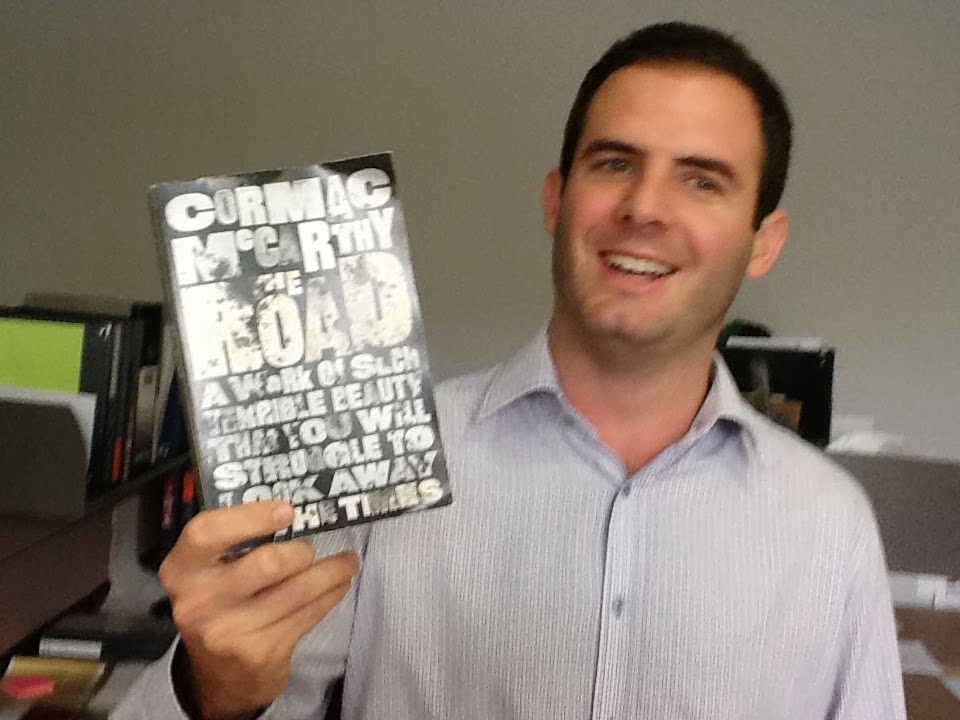
"If there are no more questions, let's take a look at the next novel we'll be discussing: Cormac McCarthy's The Road."

“If there are no more questions, let’s take a look at the next novel we’ll be discussing: Cormac McCarthy’s The Road.”

Idealism in the Church

Of course, there is plenty of art and pop culture that portray joy and optimism. But unabashed idealism is hard to come by.

As a minister, when I watch The West Wing, I can’t help but transfer some of its pie-in-the-sky views to the Church. Idealistic action rarely claims victories in our modern world, and a rapidly growing number of Americans see Christians not at people of irresistable joy and impressive integrity, but as corrupt and unprincipled. Today, churches are accused of being wayward and incompetent.

Consider the exception that proves the rule. One of the few figures that has fascinated many non-believers in recent months is Pope Francis. I think the reason so many non-Catholics admire Pope Francis is that he has not adhered to the assumptions of what a Pope is supposed to do. His Eminence is speaking and acting less like a pietistic empty shirt and more like a living, breathing example of pragmatic idealism. People appreciate that… at least in small doses.

Wishful statements are made that today’s churches need more people like Pope Francis in them. I agree, of course, but I can’t help but wonder if it is still possible to cultivate that kind of fleshed-out idealism in the modern Church.

Genuine emulation will probably cost a bit more.

Genuine emulation will probably cost a bit more.

Don’t get me wrong – I don’t mean to be a pessimist. I want to be an idealist. But do we have the courage and determination to cultivate such a committed belief in our church’s members – that the greater good must trump personal comforts?  Can such idealism become a viable, sustainable reality in our churches? Could it really last, or, like most of Sorkin’s television dramas, would it only be tolerated for a few brief seasons before its luster wears off?

Critics of The West Wing often pointed to the fact that the decisions and actions of characters on the show would never happen in real-life Washington D.C., either because of legal issues or simply because no one with such a viewpoint would last long in a job like that. I sometimes fear that the same drab reality may be true in the majority of our churches.

What do you think? Is it possible that an authentic, visionary faith can be reawakened in the Church? Can the current few genuine idealists we have in our churches become a potent multitude of uncompromising ambassadors of hope? Can more of the people of God act like the people of God?

Or will we continue to be sidetracked by a plethora of distractions, from popular political squabbles that unnecessarily divide us to the weekly hassles of why the preacher moved the pulpit? Will we insist that all of our members learn how to share the gospel, or look the other way while some of them only share gossip? Will we spend our money on global initiatives dedicated to alleviate the suffering of all people, or on activist groups who want to take a Hollywood production company to task for the creative liberties they took filming the story of Noah?

Noah-Watcher V2 -luca nemolato

“Rock monsters! I’m, like, 99% sure that’s not in the Bible!”

What do you think? Am I off-base here? Is idealism dangerous? Is it deluded? Dead? Or, does it have a place in today’s churches?


In part two of this article, I’ll further explore what idealism looks like when it’s lived out in a church. Stay tuned…