All Who Take the Sword

“You’ll never take back our country with weakness. You have to show strength, and you have to be strong.”

President Donald J. Trump

Jesus answered, “My kingdom is not from this world. If my kingdom were from this world, my followers would be fighting to keep me from being handed over to the Jews. But as it is, my kingdom is not from here.”

John 18:36-37

I wonder what was going through Simon Peter’s mind the moment Jesus rebuked his act of violence. As the servant of the high priest dropped to his knees with his hands pressed against his gushing wound, and the guards charged forward, and Peter took a step back and prepared to meet them, sword in hand, he and the rest of his fellow disciples must have believed this was the moment. This was the day they would take back their country.

Of course, they were no match for the Temple police. But what must have left Simon flabbergasted was his master’s statement, which immediately followed: “Put your sword back into its sheath. All who take the sword perish by the sword. Am I not to drink the cup that the Father has given me?” (Mt. 26:52, Jn. 18:11).

Or what was he thinking only a little while later when the woman, who was guarding the courtyard gate of Annas’s house, asked him whether he was a Galilean sympathizer (Jn 18:12-18)? His response was a quick, “I am not.” It was a denial of convenience, a little white lie that gained him access to the proceedings within, where a contingent of the Sanhedrin were set to condemn Simon’s master.

Two thousand years removed from that fateful night, Christians consider all of Simon’s actions – the drawing of his sword, the three denials – to be blatantly sinful acts. But I suspect Simon Peter thought little of them at the time. His goal was to draw closer to Jesus – first to protect him, then to remain nearby, ready to do what needed doing for the sake of God and country. He was convinced that peace and order were on the line. Morality and righteousness and truth and justice were being threatened. In this scheme of things, what was one small denial?

So, it wasn’t the actual words he spoke that left Simon Peter weeping before a Judean sunrise. It was the dawning realization of just how misplaced was his passion, how misguided was his patriotism. What brought him to shameful tears and chased him into the dusty street was a recognition of just how far he had strayed from the will and way of Jesus, his Teacher and Lord.

A Tale of Two Cities

Simon Peter exemplifies an important truth for all who profess belief in Jesus, who call themselves “Christians.” It is that even the most fervent believer can disobey. Even the most ardent follower can get it wrong. He can mistake the vision. He can misconstrue the path.

Simon Peter spent years in Jesus’ inner-circle. He had the extraordinary privilege of sitting in his presence, listening to him speak, asking questions, witnessing first-hand the way his master spoke and acted. And yet, at the climax of that experience, when everything he had seen and heard was coming to a head, Simon chose a worldly kingdom over a heavenly one.

It’s this tragic mistake we’re witnessing more and more starkly in America right now. As I write this, throngs of protestors are storming the Capital building in Washington, D.C., threatening and demanding that Congress overturn the results of the presidential election. Their actions today are akin to Simon Peter drawing his sword. They have offered up their lives not for a heavenly kingdom, but an earthly one. We can see quite clearly the tale unfolding – it is a tale of two cities. No matter what religious affiliation they claim, if any, these trespassing protestors have chosen the city of Man over the city of God. I suspect some have trouble envisioning how the two might actually be different.

A Kingdom Not of This World

To follow Jesus requires a shift in one’s allegiances. This isn’t something a lot of Americans want to hear, but it’s clearly on display in the Gospels and throughout the New Testament. For the first disciples, it required being labeled religious blasphemers and political insurrectionists. It put them in the cross-hairs of the Temple authorities and eventually led to derision and bloody persecutions at the hands of the Roman Empire. So it is that even for those modern-day believers who are convinced our religious freedoms are being systematically stripped away, our instruction from Scripture is to assume the positions of humility, peacemaking, and non-violence.

By no means must Christians assume a position of indifference to governmental rule, but their allegiance to any worldly government – friendly or not – is fundamentally a limited allegiance because it isn’t their highest allegiance. The highest is reserved for a King who insisted his kingdom was not of this world, that it must never be confused with any earthly government.

Perhaps one of the most extraordinary transformations in the entire Bible is the one that takes place in the years between a zealous Simon Peter drawing his sword in Gethsemane and a timeworn Saint Peter, who toward the end of his life held out the following teaching:

For the Lord’s sake accept the authorities of every human institution, whether the emperor as supreme, or the governors, as sent by him to punish those who do wrong and to praise those who do right… As servants of God, live as free people, yet do not use your freedom as a pretext for evil. Honor everyone. Love the family of believers. Fear God. Honor the emperor.

1 Peter 2:13-14, 16-17

As a reminder, tradition tells us that soon after this teaching was offered, the emperor whom Simon Peter encouraged all believers to honor ordered that Simon Peter be crucified for treason.

I don’t doubt Simon Peter was concerned about the government’s injustices. Nor do I think he was turning a blind eye to the crescendo of ostracization and persecution against Christians. But what old Peter understood that young Peter didn’t was that our responsibility as followers of Jesus is to be the hands and feet of our Savior in this world. It’s to embody his way, to cling to the example he offered even as he was accused without cause, tried without evidence, and executed without remorse.

To follow Jesus is to choose peace over contention, humility over cynicism, and forgiveness over fairness. We are commanded not to stand up for our own rights, but to surrender them that we might inherit God’s greater plan. Doing so isn’t always convenient or comfortable, of course. It may indeed look more like weakness than strength, like you’re letting the world walk all over you. Even though they profess to serve Jesus, some believers may not be able to stand the idea of not taking their stand, especially when it seems their world is falling apart.

But as it is, his kingdom is not from here. It’s not a kingdom that must be guarded or contended for or fought over. Just as his salvation is not a battle but a gift, so it is with his kingdom.

It cannot be won. It can only be received.

The Stall

1

I do my best to hide the pain.

The little house is crowded. With the relatives in town, there is hardly a place to sit, let alone a private room or a bed to oneself. I share with Yosef’s younger sisters, but at night I must turn about constantly. Eventually, one of the sisters takes hold of a blanket and moves to the floor, not far from where her brothers sleep. This morning, I wake with an aching back and an odd cramping pain that flares up at random. Throughout the day, I bite my lip, trying not to show how uncomfortable I am.

Lately, the baby seems completely uninterested in sleep. He moves about my womb with a great, bouncing restlessness. The women of the house say he’s eager to be born, that he’s impatient to meet everyone. One of the sisters wonders aloud if all the kicking and shifting means he’ll be a handful to raise. I feign a laugh, but I’m wondering the same thing. The child’s abiding energy unnerves me.

I count it a grace that the women even indulge my presence. None of this has come easily for them either. I don’t begrudge the forced kindness in their tones, or the way they maintain a slight distance from me most of the time. Occasionally I’ll turn my head and catch one of the sisters quickly averting her stare. It’s to be expected. Here in the southern lands there are less whispers, but whispers nonetheless. These women may trust Yosef, but that doesn’t mean they’ll ever fully trust me.

It’s difficult not to have Yosef nearby. Everyone is more gracious when he’s around. He has a calm and quiet way. Without saying a word, he can evoke goodness and courtesy from an entire household. But he doesn’t linger in the house. When the morning sun gilds the eastern hills, he’s out the door, his purse thrown over his shoulder and weighed down with tools. The better part of each day he gives to the community – repairs their lentils, patches their roofs, restores the walls in their homes that have begun to crumble. Like his father before him, Yosef is an agent of renewal for this village that has watched him come of age. And now, with the census, there’s more work to be done, more people to shelter, more mouths to feed.

cl306_24x20

The odd morning pain has increased. It no longer seems random, nor does the discomfort abate for long. I try to mask it, try to turn my winces into smiles. My heartbeat quickens. I know what’s happening, and I’m afraid.

Not now. Not yet.

Some evenings, Yosef eats with those whose homes he has serviced that day. The others, he appears only briefly, hardly long enough to dip a hunk of bread in the stew and chew, before withdrawing again to the ongoing project outside. From where I sit now, furtively breathing through the contractions, I can hear them on the other side of the house wall – Yosef and his younger brother scraping and packing and grunting from the weight of the materials, and the short statements from their father, Yakov, whose knotted, shaking hands have long-since precluded him from work, but who still points trembling knuckles and offers experienced advice. It is slow work, and now I worry it has been too slow. My throat lumps, and tears push against the back of my eyes. After all, it’s my fault the room hasn’t been finished. Yosef is more than a capable builder, but because of all that has happened, and the way it has happened, he hasn’t had enough time to complete the job.

Yet it seems HaShem has completed his.

2

“Are you all right, child?” Yosef’s mother is gazing up at me from the bottom of the stairs that lead to the lower level of the house. She has been lining the mangers with hay. Behind her, the sisters lead the animals inside for the night – a goat and two ewes freshly sheered, one of which carries a lamb of her own. She walks slower than the other, bleating meekly as she’s jostled inside. I know how she feels.

“I’m fine.” The old woman eyes me carefully. “It’s just… just the baby moving again. There’s no room.”

“Sounds to me like there’s plenty of room,” she replies.

The sisters finish shooing the animals to the troughs. Their mother hands a large clump of hay to one of them to take to the work ox, which is tied up outside – a shared possession among the neighbors. The dog trots inside as well and takes his place at the foot of the stairs. Yosef’s mother closes the door, then steps deftly over him and ascends the three steps to the main level. She meets my eyes and continues. “To be moving about like he is, there must be room enough.”

I nod. A tremor rattles. I exhale nervously. I know Yosef’s mother has been keeping watch over me. She’s nothing if not perceptive. I squeeze my eyes shut and try to conjure peaceful thoughts.

The one that comes to my mind – that has sustained me even as my anxieties have swelled – is the image of Yosef stepping across the threshold. Not the threshold of this house, but rather my father’s house.

j10157p1_149686e7-2087-44db-8c7a-4e266b44392e_1024x1024

Only four months ago, he turned from me. I had begun to show, and the rumors were spreading. Our confrontation was inevitable. I told him everything, as bewildering a tale as I knew it would be. The more I said, the more those expressive eyes of his flared with stifled fury and humiliation. Of course they did! How do you describe something like that and not sound utterly mad? His warm expression grew cold as he listened. His lips were set like a seal, locking in all emotion. Then my father sent me out of the room, but even from the courtyard I could hear their tense conversation, the shock and frustration in Yosef’s voice. I knew something had been broken. Like water from a cracked well, his trust was draining away.

I didn’t expect to see him again. No one did. But now, in my mind’s eye, the scene unfolds anew, and for a few moments it calms my nervous breathing. I see Yosef at the door of my father’s house, not a month later. His hands are clasped in front of him as he steps inside and removes his sandals. I watch, my heart in my throat, as he kneels in front of my father and asks his mercy. Then I am left open-mouthed when he does the same to me. “Forgive me,” he whispers. “I didn’t know. I didn’t understand.” I want to cry and laugh and speak all at once. I want to tell him that I hardly understand it either. I want to ask him what has changed, why has he returned? But I have no words. Here he is, back in Nazara, back in the home that scorned him, and he is on his knees like a chastened sinner, deferring to me. “Forgive me, Miriam,” he says, and the only response I am capable of is to reach out and take his hand in mine.

I’ve clung to that hand ever since.

3

“When do you think they will finish?” one of the sisters asks as the goat and the sheep nose eagerly at the hay in the mangers. The other sister is about the work of preparing the house for another crowded sleep – spreading blankets on the berths and the floor. Outside, scraping sounds testify that mortar is being spread. Incrementally, the walls grow. Just a few more days is all Yosef needs to finish it. I imagine the privacy such a room could offer. If only it were already finished.

“Soon enough,” Yosef’s mother answers.

“Will someone be able to sleep there?”

“Of course,” the older woman answers. “But not until after the ceremony.” She unfurls a blanket and spreads it below the bed I’m to sleep on. A few feet away, Yosef’s youngest brother is already asleep, snoring loudly. Yosef’s mother surveys the room, a grimace on her face. I know she recognizes how small the house has become. She doesn’t let on, but her concern for the new room to be completed is as heightened as mine. She tosses a fleeting look in my direction, evaluating me with a glance. I try to keep my composure, but I’m sweating now. I wonder if she is aware that time is up. The room is not finished, and there is no place available inside either. No suitable space for what is about to happen.

She turns away to fetch another blanket. That is when I double-over as another wave of pain rolls through me. Gripping the edge of the table, my fingernails dig into the rough wood.

“Will the ceremony be… before…?” Yosef’s sister falls silent. From across the candlelit room, she sees.

“Let’s not discuss it right now,” says her mother softly. Then her eyes catch sight of her daughter’s gaze, and she whirls to look at me again.

4

Before anyone can speak a word, the door to the house opens and in steps Yosef’s father, brother, and, finally, Yosef himself. Chilled night air billows in behind them. Yakov walks right past me, shedding his cloak. “It’s started raining,” he announces with disappointment. “Not long, I reckon, but we’ll have to take a break for now.”

Yosef’s mother ignores her husband. She rushes past him and both brothers to kneel at my feet. She lays her hand on my shoulder. “Are you all right, child?”

“Miriam?” Yosef’s soft voice is tinged with concern.

a1dba2680986424c502588526d861094

I hardly want to move for fear I’ll make the pain worse. My face contorts. This newest wave is horrible. Is it supposed to feel like this?

“Breathe, my dear,” says the old woman, taking my hand. “Breathe long and slow.”

“I can’t… there’s no…”

“Don’t speak. Breathe.”

“But there’s no…”

“Just breathe.”

A shudder overwhelms me, from my shoulders down to my feet. My jaw tightens. I want to speak, to raise a protest – I can’t have this child here! There’s no room! – but my body won’t allow it.

“Breathe, Miriam,” she urges. “It helps to breathe.”

“What can I do?” The inquiries come from all directions, from Yosef’s brother, from Yakov, even from the younger one who, in the suddenly tense and crowded house, has sat up rubbing his eyes.

One of the sisters rushes forward and crouches next to us. “Fetch a basin and as much clean cloth as you can find,” her mother commands. Through squinting eyes, I see her gaze pass over the room once more. Her brow is furrowed. She looks dissatisfied, disappointed. I want to apologize, to tell her how sorry I am, sorry for what I’ve done to their family, for the turmoil I’ve caused, but I’m still paralyzed by the contractions.

“Mother,” says Yosef, kneeling on the other side and taking hold of my other hand. I immediately squeeze it, and won’t let it go.

“Don’t fear, my son,” she says, but she doesn’t look at him. She is still considering the room.

“It’s not finished,” he tells her. “The walls, or the roof. And it’s raining.”

Red-faced, I suck in breath. A moan escapes my clenched throat.

“I know,” Yosef’s mother whispers. “We need space and privacy. There are too many people in this house!”

Finally, the intensity lessens, and I release a long, ragged breath. Tears immediately follow. My shoulders tremble with sudden, uncontrollable sobbing.

Yosef places his other hand over mine. “Miriam, it’ll be-”

“Draw some water,” his mother interrupts, “and heat it. Quickly.”

“No!” I cry as Yosef stands up. I can’t bear him leaving my side.

“Don’t be afraid,” she tells me, taking hold of my hand and working it free. She is surprisingly strong. Yosef hurries away. His brother frantically stokes the hearth fire. “I want you to try to stand up,” she says softly. She’s come around and is already lifting me from the chair.

Somehow, I gain my feet. My knees shake. Where are we going?

Yosef’s mother looks for her other daughter, finds her standing frozen at the foot of the lower level steps, eyes as full and wide as the moon. “Put the animals out,” she says abruptly. “And bring in more straw.”

“But… but where is she going to…”

“Don’t stand there blubbering, girl! Do as I say. We need room, however we can get it.”

“My dear,” Yosef’s father says. “The stall?”

Still holding me tightly, she turns to her husband. “Yes, Yakov. The stall.”

church_nativity_scene_cave_bethlehem

I’m hit again. Unable to hold back a scream, I collapse against the old woman, but she keeps me upright. “Breathe, child. Breathe.” Then she looks back to her husband. “If there’s no room, then we’ll have to make room. Help us down these steps, and then go give word to the women. Tell them where to find us.”

“Mother,” says Yosef’s brother. “Let me go to the neighbor’s and ask if we might-”

“Enough of that,” the old woman insists. “We’ll not be shooing this poor girl all over Bet Lehem. She is in no condition for it. The stall will do. What matters is the child. Now, be silent and fetch some blankets.”

Yosef’s mother is practically carrying me, an astonishing feat for a woman of so small a frame. Her daughter frantically shoves the animals away. The dog scampers back, and the pregnant ewe gives an irritated bleat as she waddles back through the stall door and into the courtyard. Yakov, soon to become my father, somehow keeps the two of us balanced with his palsied hands. We slowly descend the wooden steps to the dusty, straw-laden floor. The smell of musk, hay, and excrement greets my nose. Nausea floods through me.

“I can’t,” I tell them. “It can’t be here.”

A voice behind me, confident and calming, says, “It will be all right, Miriam. I’m here. I’m going to stay by your side.”

“Don’t be afraid, child,” his mother whispers in my ear as we shuffle toward the rear stall, as private a spot as can be found in the little house. “I know it’s not the way you wanted or the way you expected, but even in such a place as this, HaShem is with you. He is with us all. You’re not alone. You’ve never been alone.”

A Few Moments of Peace in the Peaceable Kingdom

Outside my window is a pallid sky, an unremitting drizzle, and the kind of mugginess you get when autumn reports for duty but summer stubbornly contests the election. It’s a sunless day. Gloomy, lugubrious, melancholy. Pick your adjective.

On boring, featureless days like these, hope feels hard to come by. The pandemic continues to siphon our nation’s positivity. The relentless cacophony of politics drowns out our optimism for the future. We keep talking past each other on issues of race, climate change, the economy. And so, while hope has become a precious commodity we need more than ever – more valuable than toilet paper in March – unfortunately there seems less and less to go around.

Maybe that’s why today I found myself daydreaming of heaven.

My imagination wandered into that mysterious realm, that inscrutable kingdom that lies both in our future and outside of time itself. I did not picture the eye-rolling stereotypes of clouds, golden gates, and Roman columns, since none of those come anywhere close to sound interpretations of Scripture and the handful of enigmatic images it provides. No, I pictured that prophecied coupling of heaven and earth from Revelation 21-22, in which every inch of our world is saturated with the goodness, beauty, and truth of God’s presence. Skeptics and atheists may say this is a desperate and pitiful reverie, an utterly incongruent idea when placed next to what we know of human history. Still, the thought of this heaven is the boost my heart needs when the streams of hope run dry.

Of course, whenever I envision the light of the New Jerusalem gleaming like some divine Minas Tirith, I end up with more questions than I do certainties. Not what will such a land look like, necessarily, but what will life in that great new age be like?

OK, cue the predictably lame “I Can Only Imagine” jokes…

That’s the point of the exercise, right? Not simply to picture a beautiful place, but also to cast our hearts and minds to an existence rescued from all the societal unrest, ugly partisanship, and tragic wilting of truth.

And so I wonder…

Will There Be Politics in the Kingdom of God?

You laugh, I know. After all, right now the very thought of politics brings a grimace to the face of Trump and Biden supporters alike. But if I read what is inarguably the most beautiful scene in the Book of Revelation to its conclusion, I find this curious detail:

The city does not need the sun or the moon to shine on it, for the glory of God gives it light, and the Lamb is its lamp. The nations will walk by its light, and the kings of the earth will bring its splendor into it.

Revelation 21:23-34

Did you catch it? Alongside that divine capitol city, there are nations… and kings… and state visits, apparently. Which means even in the glorious kingdom of God in some form or another there are gates and borders and territories. There are regions and locales, dominions and jurisdictions.

It seems John’s vision, or at least his perception of that vision, unfolded according to something like a system of suzerainty, in which tributary states prosper as protectorates under a greater sovereign state. Whether or not this form of international relations is simply a way for our finite minds to comprehend the incomprehensible, or is actually God’s chosen structure for his consummate Kingdom, one fascinating aspect it assumes is that eternal life progresses within a perfected governmental structure, of which the Lamb is the head. There will be monarchical oversight, perhaps a Camelot-like administration, yet completely devoid of scandal, hypocrisy, and duplicitous agendas.

Thankfully for everyone, God is not on Twitter.

I know, I know… I’m already lost in the semantics of this otherworldly reality. Still, with every bombastic tweet, every puerile power grab, every legislative bottleneck, and every vindictive political meme a friend callously posts on Facebook, the promise that God will not merely eradicate politics but rather teach us what governing truly looks like is the kind of hope I want to cling to on gray days like this one.

Will There Be Art in the Kingdom of God?

I remember how my friends and I used to regularly pester our poor youth minister. Only in his early twenties himself, Stephen somehow dealt with our impertinences with the patience of Dumbledore. That didn’t mean he didn’t get fed up sometimes, though. One night in particular, we were peppering him with ill-conceived questions about heaven. After patiently fielding as many ridiculous inquiries as he could, in exasperation he finally held up his hands and said, “Look, guys, here’s what I think heaven is going to be like. I think we’re going to sing praises to God all day, and we’re going to like it.”

We winced and looked at each other. Praise God… all day? Like, all day? Just some endless worship service? Ugh! Would we have to wear church clothes?

“So, like, is the heavenly banquet like a big church potluck? Will I get in trouble if I bring deviled eggs?”

Thinking back to that moment, I smile. Stephen was doing his best to sketch us a picture while remaining true to Scripture, and yet we had worn him down so much he had little imagination left. Don’t worry, he assured us. In heaven, church’ll be fun.

Scripture does not paint a full picture of heaven, least of all what our main activities will be, but it does allude to moments of congregational praise of God for his glorious power and love. And rightly so. Worship would certainly underscore life in God’s kingdom. But we also know there are all sorts of ways to worship God – to express our awe, our adoration, and our thanksgiving. Music is one way, but so is writing, painting, sculpting.

Art is the expression of ideas and concepts too important for only one mind to possess. It’s a creative act bestowed by a benevolent Creator. For me, preaching a sermon is a form of art, while for another it may be photography, playing a great round of golf, composing a musical, or fine-tuning a stand-up routine.

If art is how we experience all that is good and beautiful and peace-giving in life, then art also extends beyond those activities commonly considered part of the medium. Thus, art is found in a fisherman expertly casting his fly, a carpenter deftly sanding down a length of wood, or a gardener gently guiding her plants into full bloom. It is expressed in that magic space where one’s power, patience, and passion meet.

While not Scripture itself, Gerard Manley Hopkins’s oft-quoted “As Kingfishers Catch Fire” reinforces the idea that our attention to beauty – and our recognition that there is beauty even in our most instinctual and mundane actions – is a core part of worship. The poem concludes,

Acts in God’s eye what in God’s eye he is — 
Chríst — for Christ plays in ten thousand places, 
Lovely in limbs, and lovely in eyes not his 
To the Father through the features of men’s faces
.

– Gerard Manley Hopkins, 1877

Is it too much of an extrabiblical stretch to believe our Creator will allow us to retain the capacity and love for creating, even within the perfection of our imperishable bodies? That in addition to singing the Lord’s praises, we might also write in reverence of them, paint in reverence of them, make music and movies and even amazing meals in reverence of them?

This may be just me wanting to take some of this world with me when I die. Or, perhaps it’s me wanting these beautiful things we get to experience in this life – things like Marilynne Robinson’s Gilead, Lin-Manuel Miranda’s Hamilton, or Tom Colicchio’s braised short ribs – to be more than just beautiful things, but rather genuine traces of heaven itself.

Will There Be Seasons in the Kingdom of God?

The expectancy of the seasons is a fundamental aspect of life on earth. Cynical philosophers may declare that time is merely a human construct, but scientific research actually reveals we don’t count hours, days, and months for arbitrary reasons. It’s actually a response to immutable natural forces. The concept of a twenty-four-hour day, for instance, is how we acknowledge the intuitive rhythm of our internal circadian clock.

The dang circadas are keeping me awake!

So, let’s talk seasons. While today’s mugginess isn’t pleasant, we’re nonetheless entering the time of year I treasure most. The welcoming cool of autumn, and its crisp scents and colors, is coming on. The season of harvest. Every year, it lifts my spirit. I marvel at God’s imagination, his astonishing attention to detail.

I know the same could be said for summer, but I’ve never been near as fond of it. It’s hot, humid. You have to schedule your morning run before 7 AM or you risk heatstroke. Even evening strolls make you want to shower afterward. Granted, I grew up in Texas and I live in Georgia, so you get what you pay for. But this is all the more reason why I adore fall, and why I hope the same unique and sublime sensations it brings will be present in the heavenly kingdom.

Here’s the thing, though. Again, the cynic will say, “Well, technically, autumn signals death and dormancy. It marks the withering of life (even if only temporary).” The leaves may change into beautiful colors, sure, but they end up a lifeless, brown pile on the yellowing lawn. Crops are harvested and fields are mowed. Sunlight retreats. It’s darker in the mornings, and it’s darker in the evenings. This is a season of senescence, old age preparing for expiration. As lovely as an autumn breeze may feel, what place would such morbidity have in the renewed and eternal kingdom of God?

A valid point, I suppose. The description of the kingdom in Revelation 21-22 does repeatedly claim there will be no need for the sun or the moon, for all illumination will come from God himself. So, if there is no day or night, how can there be a harvest season? How does one even sow seeds or reap their fruit?

On the other hand, the final image of John’s prophecy is of a restored Eden, in which there are indeed crops which yield fruit each month (Rev. 22:2). So, either there are no seasons and these crops are as magical as everything else, or in heaven the harvest season is a permanent state rather than a passing one.

Now available FOR ALL ETERNITY!

I don’t know. But here’s what I do know, or at least, here’s what I believe.

The gospel is the story of hope emerging, struggling, dying, and living again. It is the way of Jesus, who reigns as King of heaven, and every year hence the earth has, in its skies, its climates, and its seasons, retold his story. Through both splendid songs and harrowing groans, through both mountain vistas and dissolving glaciers, this world tells the story of its once and future King. It has offered its very being unto its Creator.

When you think of it like that, even the mugginess of this gray day is put into a greater perspective. In these times when all hope seems lost, the earth itself reminds us that these moments, however long they feel, are fleeting. They are but a single page in a grand book about the triumph of hope. And I can’t fathom why the telling of this glorious gospel would ever cease once heaven and earth meet. No, in the peaceable kingdom, I believe it will be on display with even greater eloquence than it is now.

I know, I know. It feels like an outlandish fantasy, even for the devout. No doubt I’m playing and bit too fast and loose with Scripture here. But, you know, given the spiraling fear and acrimony being sown today in our politics, our national discourse, even our homes and our churches, I’ll take a few peaceful moments in this heavenly daydream however I can get them.

Because they remind me that hope remains. It endures.

A Sense of Place

When I was a kid, I enjoyed rearranging my bedroom. Every once in a while, I was overcome by an urge to completely rework the space. Nothing was wrong with the prior arrangement; I just wanted something new. I know my parents heard me shifting stuff around back there, but they didn’t seem to mind. I pushed my bed across the room, shoved bookshelves into different corners, and reorganized the posters on my wall. Whenever I finished these renovations, I was brimming with pride over my visionary use of feng shui.

There was only one problem. No one else cared.

I had no siblings to invite for a tour. Plus, I lived far from town, so my circle of friends rarely congregated at my house. I believed I had created a thoroughly welcoming space, but few people would ever experience it.

Lately, I’ve realized the same dilemma plagues the local church. When it comes to our hospitality toward the wider community, we unwittingly operate from a “come and see” mindset. We push promotions and shove forward new programs in an attempt to draw people inside. Meanwhile, numerous research polls show that even as churches utilize cutting-edge technology to gain public attention, church attendance is steadily declining. Even the growth of large church bodies is primarily “switchers,” people who simply jump from one congregation to another, rather than the result of genuine new relationships forged in the local community.

churches

Collect them all!

Over twenty years of ministry, I experienced this mindset several times, particularly whenever the churches in which I served were engaged in a building program, whether it was the construction of a brand new campus or merely the renovation of an existing building. I’m sure there are thousands of pastors who, like me, were regularly approached by congregants and new acquaintances with questions about those building plans. In those moments, the easiest response is to speak from a “come and see” mentality – to talk about a state-of-the-art sanctuary with a seating capacity of this or that, or a sophisticated, interactive classroom environment for children, or an aesthetically pleasing multi-purpose space from which a dozen different ministries can operate. It’s easy to paint that mental picture, to extol the bells and whistles and fixate on the sleekness of it all. Just you wait. It’s going to be awesome!

But what does any of that matter if no one cares to see it? If we build only what our congregation needs, what have we accomplished other than an expensive room remodel? Too often in my sermons have I felt the need to pose this question: What good is it to build a warm welcome space if we haven’t first learned how to be warm, welcoming people?

Isn’t that an essential responsibility of a local church?

coffee

But… but… but we’ve got a coffee shop in the lobby!

I believe churches should exemplify a commitment to caring for the local community. Christians should consider not simply how their particular physical meeting spaces look to outsiders, but also how those places directly serve the neighborhoods, businesses, and organizations in their immediate vicinity. I don’t just mean how inviting your sanctuary looks, or how conspicuously you advertise your church name to the wider community. I mean being good stewards of the places and spaces God has given you by opening them to community use. Sure, becoming a polling location is great. You know what’s even better? Partnering with local government to facilitate town hall meetings, or with local schools for after-school clubs or tutoring programs. Yes, a food pantry is a wonderful resource. But what if, in addition to dedicating that large closet to collecting canned goods, you turned that extra acre of green lawn into a community garden or weekly farmer’s market that championed healthy eating habits?

“With a commitment to place, and with gratitude for the immensity of God’s gifts there,” write C. Christopher Smith and John Pattison in their excellent book, Slow Church: Cultivating Community in the Patient Way of Jesus, “our churches become catalysts of human flourishing: nurturing local economies and local culture, and seeking the common good of our places.” This is a community-minded extension of the Apostle Paul’s own encouragement, “Do nothing from selfish ambition or conceit, but in humility regard others as better than yourselves. Let each of you look not to your own interests, but to the interests of others” (Philippians 2:3-4).

But this kind of mindset is not exclusively a religious practice. Whether we’re talking about a church’s presence in its community, or simply a person’s presence among his or her neighbors, “come and see” is never as compelling as “go and be.” On its own, “come and see” allows us to pretend we’re hospitable without having to put our hands and feet into it. Over the years I’ve met a lot of well-intentioned folks who claimed they loved to entertain people in their home, yet I never once saw the inside of it, and whenever I would invite them over to mine, I learned their schedules were actually far too busy to accommodate such a visit.

planner

“I’ve got ‘Me-Time’ scheduled every other Thursday from 6:05-6:25 AM…”

We can get so caught up in arranging and re-arranging our own lives that we have little if any desire to welcome other people into them. Technology has made us remarkably efficient and productive, and yet we seem to have less and less time for actual community interaction. These days, we speak more to Alexa or Siri than to our neighbors. Groceries can be ordered online and picked up without ever having to set foot inside the store. Amazon leaves just about anything we could possibly want right on our doorsteps. Increasingly, as a result, our front porches are empty, our neighborhood encounters are fleeting, and involvement in community life is at an all-time low. And if you think Covid-19 hasn’t ingrained an even more rugged sense of rugged individualism into the American social fabric, you’re living in a fantasy world.

Recovering a sense of true community is no easy thing, especially in the middle of a global pandemic where the best preventative is “distancing” from each other. But if we will keep our self-preservationist instincts in check, then maybe we can begin to cultivate a willingness to provide for the needs of others with the same impulse that drives us to provide for ourselves.

Sometimes this will mean designing a church campus that strives to meet your community’s needs, not merely your own. More often, though, it will simply mean pausing at your mailbox to ask your neighbor about his day, respecting someone even if his or her political opinion doesn’t match your own, or engaging in a genuine conversation with the lady ringing up your purchase at Publix, even if you don’t like talking through that pesky face mask.

karen

Oh, and it also means actually wearing a mask. (Sorry, Karen.)

From time to time, we all get those urges for something new. But when you get that itch to rearrange your schedule, don’t forget to make some room for, well… for whatever opportunities might come your way. Because they’re everywhere. We just have to shed the “come and see” mentality, step outside our doors, and take those chances when we see them.


*this post was adapted from a recent column first published in The Jackson Herald 

From One Pastor to Another…

Dear Pastor,

I’m thinking about you today. I want you to know that I’m hopeful for you, concerned about you, nervous for you, appreciative of you, and fearful for you. Most of all, though, I want you to know how much I admire you. It hasn’t been easy, has it?

I write to you out of my own experiences, but truly it is you I hold in my mind. I know our circumstances aren’t identical, of course, but the equivalencies persist. Whether you serve a small church like I do, or a large church, or something in between, none of us found ourselves exempt from this struggle.

The Teacher says “There is nothing new under the sun” (Ecc. 1:9), which in one respect is true. But, still, no one we know has gone through this before. No professors, no mentors, no older pastors we look up to and occasionally call for advice. Sure, there have always been hard seasons. As we’ve told many a church member over the last few months, every generation goes through trying times, frightful times, life-altering-and-redefining times. There’s wisdom to be gleaned, for sure, and  we have squeezed every last drop from that sponge. Yet the unprecedented nature of these times remains; we’re still waking up each morning under a dark-cloud reminder that the old rhythms have withered and ministry has become far more improvised than we would prefer.

I admire you for sticking with it. If I’m being honest (and what’s the point of writing to you if I’m not), at times I’ve wondered whether I could stick with it. I’m trying, and I know you are, too. Some days are better than others. I place my faith in the truth that God is faithful. But those who claim this faith is easy are most certainly false prophets.

Going Online

First, there’s the struggle of “doing church online.” Just the phrase itself is rife with problems, both grammatical and ecclesiological.

I don’t know about you, but I was already frustrated with social media before this crisis. The fellowship it offers isn’t genuine. The connections and dialogue made available within its parameters are only phantoms, bearing no real substance. Facebook, Twitter, Instagram, Tik Tok… they serve a purpose, sure, but you and I both know they cannot sustain the deep needs of the human heart. After all, what does it profit a man to get a hundred Likes for posting a politically snarky meme, yet forfeit his soul?

When we try to use social media to foster genuine fellowship, it’s like trying to slake our thirst with a spoonful of salt. Now, however, we have little choice. We face a circumstantial compromise – for a season we must figure out how to conduct the genuine fellowship we once knew within the dimly lit halls of the social media complex, while all around us flutter a thousand and one black-winged temptations, the unspiritual disciplines of conspiracy theories and clickbait, the rotten fruits of screen addiction and instant gratification. It is not the catacombs of old, by any means, but ours is a harrowing time nonetheless.

I’ve gotta ask, how have you been delivering your sermons? I’ve been preparing them as best I can, though my preferred weekly schedule was quickly tossed in the garbage. But then I’ve had to set up cameras to film them myself, then download to my laptop, then teach myself how to use video-editing software… Preaching the sermon used to be the finish line of a weekly marathon filled with reading, prayer, reflection, research and writing. Once you finally preached it, though, at least you were finished. There wasn’t another four more hours of footage adornment and audio adjustment on the back end to make up for the handicap of it not being delivered in-person.

Meanwhile, you ache for your worship pastor, who is simultaneously engaged in his own struggle to lift congregants’ spirits and inspire them to raise their voices in their own living rooms, all while deprived of his full band or vocal team. Your Children’s Pastor is wracking his brain to somehow convert all his high-energy, hands-on activities to a video stream. And your Student Pastor, whose heart continues to fall as with every passing week fewer and fewer teenagers exhibit the patience necessary to gather online for Bible study because, for crying out loud, they’ve already spent hours on Zoom trying to complete their schoolwork. You want to encourage them, but what is there to say? This is not the way the church should function, and the proof is in the pudding.

I admire you, because despite these setbacks and the completely unexpected load of extra work, you’ve plunged forward into this unsettling new world. “To the work! To the work! In the strength of the Lord,” as the old hymn declares, “and a robe and crown shall our labor reward.” You’ve kept your eyes on the horizon, though it’s been hard, especially when you see the number of views or shares decrease (the cyberspace equivalent of a shrinking attendance), or when your deacons report that some church members don’t have a good enough Internet connection to even access what your team has labored over, or when you speak with church members who remind you that no amount of online content or phone calls or even cards in the mail (old school!) can combat the cruel loneliness that comes with protecting ourselves from the pandemic.

So Many People, So Little Time

Pastoral care was difficult even before Covid-19. When you become a pastor, you quickly understand the apostles’ decision in Acts 6 to establish and specify helpers. It’s hard to balance all our other expectations – directing the vision, collaborating with staff, planning worship, and preparing multiple sermons and Bible lessons, and interceding for the congregation and the community – with the personal attention people expect from their spiritual leaders. You try your best to get out of the office, to make phone calls at appropriate hours, but you quickly find the hourglass has once again run dry. There’s always tomorrow, sure, though tomorrow brings its own fresh set of challenges. What a blessing it is when your people call or visit you, because sometimes you need it more than they do.

Is it me, or has this working-from-home thing only made the sand drain away faster? All this extra work, all the challenges of trying to deal with ministerial issues and maintain congregational projects without being able to meet with all the players in person… It’s maddening how much more time-consuming that has become. Sure, I marvel at some of the technology we’ve been able to employ to keep things running these last few months, but I also know that the only Zoom meetings that run shorter than normal meetings are the ones in which people get so annoyed with the connectivity bugs that they give up and sign-off early. It may help us sustain productivity, but I haven’t experienced any advancements in efficiency, have you?

You want to go visit people. You really do. Here and there, you make a socially-distanced drive-by. You even take your family along, because you’re keenly aware you’re not spending enough time with them these days either. But even if some of your congregants wouldn’t mind having you in their home, you recognize the risk of that, and one thing you must do as a pastor-shepherd is protect the flock, even if that means protecting them from you. In between all your projects, you make phone calls or write notes. And you pray. Oh, how you pray!

At the end of each day, you feel like Oskar Schindler at the end of Spielberg’s film, insisting you could have done more, couldn’t you? You fall asleep thinking this, only to dream of CDC guidelines and controversial recommendations. You awake with a mounting burden of ignorance, of not knowing for sure how your congregants are doing.

You Shall Know the Truth

Top all this off with the struggle you’re now experiencing to determine whether reopening/regathering/resuming (call it what you will) is the right call, and, if so, what precautionary steps should be taken to protect the people even when it’s become virtually impossible in our country for people to agree on which precautionary measures are sound and which are bogus. Sure, you consult the CDC and the WHO, among others, because certainly it is for such a time as this that they were commissioned, but then you discover some folks are skeptical of these organizations. A few even consider them part of a massive hidden agenda to keep us all desperate and fearful. So it is, to your utter exasperation, that determining a set of health guidelines is to flirt with controversy, and the last thing you want to do is stir the already roiling pot of controversy. You want controversy and partisanship and all those awful, divisive poisons as far from your community as possible, but lately there seems no way around them. The truth feels elusive, camouflaged, and so you spend your days researching even more – health reports and medical journals and watching online seminars with epidemiologists – which only adds to your fitful sleep and the weird dreams you’re having at night.

All you want is to regather your church, to call them back from this forced hibernation, to provide space to connect with God and one another, to experience anew the sacred relationship between worship and fellowship. With the mounting unrest in our society, and anguished voices crying out louder and louder each day, never has it been more important to gather in the Name of the One who makes all things new.

You know people are trusting you and – if you have one – your staff to make the right decisions, but man! It’s so easy to second-guess and third-guess decisions right now. If you don’t have a staff to collaborate with, I pray an extra gift of wisdom and discernment for you. I can’t imagine doing this all alone.

Of course, you’re not alone. None of us are. That’s what I have to keep reminding myself. This stay-at-home stuff would have us believe we’re doing this solo, but then we talk to those church members who are doing everything they can to support us and each other. Those deacons who are faithfully calling the people. Those prayer warriors who have not missed one day interceding for us all. We are not alone. Our churches will always be more than me and you, and thank God for that! They are strong not because we are strong, but because the Savior is strong. “His power is made perfect in our weakness” (2 Cor. 12:9).

So, I admire you for keeping the faith. Now we know a little more about what Paul means when he says, “I have fought the good fight” (2 Tim. 4:7) – there are days when this is indeed a fight. We are contending not against flesh and blood, but against the principalities that would use our doubts, our shortcomings, and our character flaws to quell the Spirit’s fire and deal a mortal blow to our faith. Thank goodness we need not fight this battle alone.

Hang in there, Pastor. The struggle is real, but so is Jesus. This too shall pass, but even if it doesn’t, salvation remains. Remember the God of the ages is with you. He blesses, he keeps, he makes his face shine bright to those who seek him.

Grace in omnibus.

A Homebound Good Friday

Today is Good Friday. Today is also Day 26 of my family’s self-quarantine during the Coronavirus pandemic. My thoughts have been leaping back and forth between these two things all morning…

Outside, the wind is gusting. Blowing in from the west. Howling under the eaves. It whistles across the chimney cap and rattles the hood above the kitchen stove. The day is bright, cloudless, but also cold and blustery. It is a day that might invite sun-bathing or a leisurely stroll, if not for the relentless wind.

The kids are inside, sitting at the counter working on a time capsule specifically for the pandemic, which right now is gusting across our country and throughout the world with an unprecedented tenacity. Trying to gain control of its spread has been like trying to control this westerly wind.

I’m at the kitchen table, feeling powerless, scattered, unmoored despite being stuck at home. I’m thinking of the significance of the day – Good Friday – and wishing I could be in a sanctuary somewhere, listening to the readings of Christ’s last hours, singing the words of “When I Survey the Wondrous Cross” and “O Sacred Head, Now Wounded.” Perhaps, as a pastor, I could have put together yet another online engagement for this very purpose, but the effort involved in crafting Sunday’s service has already dominated my time. (Like most of my work these days, I can only write this in fits and starts, between homeschool responsibilities, cleaning up perpetual messes, and taking the puppy out to pee.)

There is so much I want to do on this day. It’s been almost twenty years since I have not attended some sort of Good Friday service or prayer vigil – when I’ve not gathered somewhere to, as the song goes, “cast my mind to Calvary where Jesus bled and died for me.”

crucifixion-eduard-karl-franz-von-gebhardt

It occurs to me that over the last two decades I have been conditioned to a certain way of worshipping and observing holy days. I have had the great privilege of gathering freely to worship who I want in the way I want. In the past, I have actually evaluated Good Friday vigils and services like them based on how creative and insightful they were!

Now, I’d give anything for a chapel and an altar, for one measly upright piano and someone who knew their way around it.

I want a normal Good Friday, I think, and the preposterousness of the notion settles in my gut like a brick. What, after all, is a “normal” Good Friday, Bo? Is this day not a representation of the most abnormal thing ever to befall the world – the Creator God, who spoke the earth into existence, submitting himself to the lashes of whips, the spittle of soldiers, the agonizing weight of the olive wood upon his lacerated back, being impaled on spikes and asphyxiating before a crowd of mostly indifferent onlookers?

frans-francken-the-younger-the-crucifixion

Good Friday is a reminder of the darkest day of our humanity, when both faith and reason were set aside in the name of fear and for the sake of personal convenience. It is a moment in our history in which we proved our innate self-centeredness, our refusal to surrender our own neatly cultivated personal preferences. It is a day to remember that, on our own, we are lost. That when we think we’re in control, when we think we have it all figured out, when we think our opinions are correct and justified and will ultimately be found in the right, God once again opens our eyes to our finitude and frailty.

Good Friday is a day of mourning – mourning for our selfishness, and for the Savior our selfishness executed.

ec7d0611bbb9c4ee0110a106ba3a8b05

And yet, we call it “Good.” Good Friday.

Good because, despite what our selfishness would have us believe, we do not control the world. We do not have it all figured out. But God does, and he can turn into good even the darkest hours of our lives. As Augustine of Hippo summed up Romans 8, all things work together for good – even sin. This day is a good one because it belongs to God, not to us.

So let this westerly wind blow. Let it howl and whistle and rattle this little house of mine. Let it remind me of my frailty and my lack of control. I will look to the sun. I will trust in its warmth. And I will praise its Maker, who works all things for good.

Christians & Coronavirus: 4 Reminders

As Covid-19, the potentially life-threatening coronavirus, spreads across the world, people are reacting in a number of ways. Some drink bleach. Others hoard toilet paper. The rest slather their social media profiles in 100-proof speculation and consternation. Among these are professing Christians, whose anxiety over this health crisis is as palpable as everyone else’s, despite the fact that Christians are supposed to be “crucified with Christ” – it is no longer we who live, but Christ who lives in us (Gal. 2:20).

The Bible has much to say about fear, and how believers should cope with it. But it is important for Christians to remember and admit that we are as human as everyone else. We are just as susceptible to this virus, not to mention to the instinctual emotions of anxiety, fear, and panic. As such, even though “we know whom we have believed” (2 Tim 1:12), we do not always respond to crises the right way.

So, as a pastor currently waist-deep in the mire of this crisis and its far-ranging effects, I want to offer a few reminders for believers on how to maintain our calling as Christ’s ambassadors in the midst of this fearful time…


#1 – Stop Blustering. (It’s OK to Be Honest about How You Feel.)

tumblr_lwbl09hplc1qg4chbo1_500

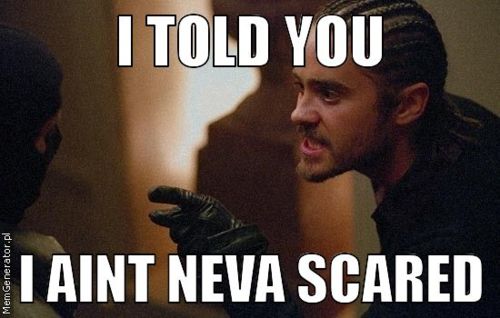
Have you ever watched a sitcom or a comedy sketch in which a bunch of people go to a scary movie, or to one of those haunted house attractions? Within the group there is always at least one person who acts like nothing scares him. He continually speaks derisively about the frightening elements, the joke being that he is actually terrified but won’t admit it.

Sometimes, saying “I’m not scared” can help decrease my fear. (I know as a parent I’ve had to do that on occasion, during a bad thunderstorm, or when there’s a sudden, strange noise in the house.) But putting on a false air of boldness, or ranting about how everyone else is overreacting and there is nothing at all to be concerned about, only makes a person seem increasingly out-of-touch and unhinged. There is nothing gracious or compassionate in ridiculing others for being scared in what is quite obviously a scary time.

It is better to acknowledge fear than deny it. To name it rather than pretend it doesn’t exist. To admit you are scared is to be honest (with yourself, with others, and with God) while to announce how un-scared you are is to bear false witness and only dig yourself a deeper emotional hole to wallow in.

Even if you are truly unafraid of  the coronavirus, Christians should recognize that a lot of other people are. As children of the living God, we should not be found rolling our eyes at people’s anxieties, but listening to them, and speaking gently out of our own experiences of leaning on the sovereignty of God over the shortcomings of man.


#2 – Stop Vilifying the Media

160512_wethepeople

Look, I’m not saying every report coming out about Covid-19 has been completely inerrant. Indeed, there are some elements of hysteria woven within our news cycle. However, the vast majority of media outlets and journalists are simply focused on informing people about the details of this virus, not stirring them into a frenzy.

How can I be so sure of this? Because journalists are people, too. I happen to know a few of them personally. They’re good people, trying to do their jobs in the midst of constantly shifting reports from federal agencies and response centers across the globe! I would not want their job for a minute, and I respect the work they are doing. Sure, without the media there might be less hysteria, but without the media we also wouldn’t know anything about this sickness, which would mean even more sick people and even more deaths.

In the last decade or so, Christians have really fumbled the ball on how we think about the media. I know several folks who are absolutely convinced that every major news outlet (except their particular favorite one, of course) is operating under an agenda so sinister it would make a Bond villain blush. It’s astonishing how quick we are to point a finger and cry “Bias!” and yet refuse to admit we may cling to some biases of our own, like a twelve-year-old with a security blanket.

Media offers perspective, and a free media is the lodestar of a free country. It is not something to be denigrated or perpetually distrusted. We may not always agree with a specific angle of media perspective, but, then again, why would we expect to? As followers of Jesus, whose identities are secured by his love and mercy, it’s our responsibility to receive the information distributed to us and then to weigh each point according to the truth of God’s Word. If we skip this second step, we do a great disservice to ourselves and the rest of the world, especially in times like these.


#3 – Contemplate Our Fragility

photographer-captures-the-indomitable-spirit-of-kids-in-war-torn-regions

In a country as technologically advanced as this one, most of our lives unfold a comfortable distance from extreme hardship. Certainly, we experience difficult times. Divorce, high crime rates, systemic poverty and mass shootings are significant plagues upon our society; neither are we immune to natural disasters like hurricanes, wildfires, and floods.

However, it is exceedingly rare for the whole of our country to face an apocalyptic reality on the level of what the coronavirus has delivered – the very real fear of exponential infection, of a scarcity of goods and services, of overflowing hospitals, of entire cities and industries grinding to a halt with no clear idea when normalcy will return. This is not something we Americans are familiar with. But it is what many other people in other parts of the world face every day. Think Sudan. Think Venezuela. Think Syria. What is frighteningly abnormal for us is, for them, just another Tuesday.

To be a Christian is to think beyond your national identity. It means recognizing we are members of a global movement, a people group that transcends race, gender, nationality, socio-economic class, and the privileges (or lack of privileges) that come with those things. Those of us who profess faith in Christ would do well to remember that extreme violence and extreme poverty and extreme sickness – the desperate groanings of a fallen world – are alive and well throughout the planet. What we are experiencing in America right now is frightening, but we can take comfort in knowing we have powerful infrastructures and trained professionals in place who can and will respond to the crisis. The same cannot be said for everyone.

In times such as these, human beings are confronted with the fragility of their existence. We see how quickly everything we trust in – all the little routines and comforts we hardly think twice about – can be taken away. Most folks in America expect they will be restored, and soon. If nothing else, may this crisis show us the extraordinary luxury behind that expectation.


#4 – Lean Into This Unexpected Sabbath

ea33b9082af3053ecd0b4401ee494194e66ae3d01db1144190f3c77b_1280-640x427-1

Speaking of things grinding to a halt, there might actually be a benefit hiding behind all this chaos of school closings and the cancellation of public events. Yes, I realize a plethora of people are still slogging to work everyday (thank you, medical professionals and first-responders!), and there are a lot of folks who are now forced to juggle childcare, not to mention worry about whether or not their small business will fail, or if they can even make enough money to pay rent. I don’t mean to make light of those concerns in any way.

And yet, many of us who too often find ourselves going-going-going, running from one to-do on our lists to another, chauffeuring children from school to sports practice, balancing grocery shopping with church activities with all the little appointments and family responsibilities sprinkled in… All of a sudden, a lot of these self-imposed obligations have disappeared. We find ourselves standing in the eerie quiet of a relaxed schedule, our aching shoulders suddenly relieved by a significantly lightened load. There is time to breathe. Time to think. Time to take things slow.

The Bible has a word for this. It’s called sabbath. At its core, it was a time to slow down, to rest from our labors, to set aside the to-do list and enjoy the peace that comes flooding in when you do. Scripture tells us that God intended his people to practice this once every seven days for the entirety of their lives, but in our modern culture we have all kinds of excuses why that just doesn’t work anymore. We keep ourselves so busy these days that we don’t even have time to feel guilty about ignoring God’s commandment. But all of a sudden, and in only a few days time, so many of the things that kept us busy are – poof! – gone.

Guess what isn’t gone? Guess what’s still hanging around, waiting to be indulged despite always playing second fiddle to our life-draining busyness?

Family. Storytelling. Reading. Laughter. Singing. Playing music. Long walks. Bike rides. Fishing. Hiking. Lingering over a home-cooked meal. You know, the things that make life worthwhile in the first place.

Yes, there are very real concerns to be aware of right now. There are dire needs to pray for, and a truckload of cares to cast upon the mighty arm of the Lord. This is a serious time. But Christians, especially Christians in America, have never had such an extraordinary chance to do good, to exemplify the principles of God’s kingdom, and to model what an honest, gracious, compassionate, and blessed life actually looks like.

Can we really afford to let this chance go by?

On Enemies

Years ago, after being hired to teach at a new school, I met a schoolteacher and we immediately hit it off. We had a lot of things in common. We were roughly the same age, we both gushed nerdy love for many of the same novels and writers, and we both believed that, no matter what career they eventually embarked upon, helping our students learn to be well-read was the pathway to maturity. I could tell we were destined to be more than colleagues; we were going to be confidants.

This is why I was so heartbroken when my newfound friend quickly turned his back on me. He stopped eating lunch with me, stopped asking my opinions on his lesson plans, and seemed to keep his distance socially. He was never overtly rude or insulting, but it was clear he had decided he didn’t want to be my friend after all.

The reason for his change of heart isn’t a mystery, though. I know exactly why he pulled away. We met in late summer of 2008, four months before the presidential election. One day not long after we had connected, our conversation turned to the candidates. I mentioned to him that, out of curiosity, I had recently watched one of Barack Obama’s speeches given earlier in the year at a church on the subject of religious conviction. I told my new friend I liked the speech, thought it was refreshing to hear a candidate speak openly about faith in a non-pandering way.

My new friend suddenly turned to me. “You’re not going to vote for Obama, are you?!” he asked, staring at me with wide, fearful eyes.

congress

POLITICS: ending friendships since 1776!

I was caught off-guard. Honestly, I hadn’t even thought that far ahead. The election only flickered in my periphery. (This was 2008, before political news became a ravaging lion seeking whom it may devour.) It was something I thought about sparingly, as there were far more pressing matters in my life, like beginning a new school year, setting up a home, and getting to know my colleagues. “I… well… I don’t know. Maybe. Maybe not.”

“But he’s a Democrat!” my new friend almost shouted, putting a little extra stank on the word “Democrat.”

It wasn’t long before this friend of mine ceased being a friend of mine. He became just another coworker. We hardly spoke other than in evaluation of certain students or other school business. We offered a congenial hello to one another in the hallways. However, he and his wife were always conveniently unavailable when I would invite them for dinner, but thanks to social media I was privy to plenty of selfies of them hanging out with other teachers, sometimes on the very nights they’d told me they had too much work to catch up on.

I’m not saying our falling out was only because I had something vaguely glowing to say about a Democratic presidential candidate, but that certainly was the tell-tale crack in the ice.

ice

“I’ll rescue you, but only after you admit you’re wrong and I’m right.”

Drawing Lines

One would think the things which had drawn me and my colleague together, the subjects that had dominated our conversations up until that moment of disagreement, would have been more than enough to salve whatever abrasion was inflicted on our budding friendship by differing political views.

The problem, of course, is that, over the last decade or so, We the People are far more preoccupied with what divides us than what unites us.

I’m talking about more than disagreements over politics here. I’m talking about all the suspicion and distrust running rampant in society today. I’m talking about unfairly assuming the worst in people whenever they express an opinion or belief with which my own opinions or beliefs clash. I’m talking about writing people off as valueless because even one note of discord must mean there can be no compatibility – no way forward. I’m talking about turning a deaf ear to those who dare to question the legitimacy of something I hold true, because if they don’t support that they must be a part of some opposing agenda hell-bent on destroying every single one of my principles. Best to be on-guard. You can’t trust anyone these days.

prolife

Look at these self-interested fools so carelessly promoting their own interests!

The vast majority of cable news shows and op-eds are saturated with this kind of social outlook, and because we’re oversaturated by the Hannitys and the Maddows and the Breitbarts and the Voxs these days, and because social media has turned into our own personal echo chambers, we’ve learned the very unspiritual discipline of drawing lines and erecting barriers. Dialogue between sides only happens when there is a guarantee neither side will come out a bigger winner. We are a culture of blustering cowards, quick to take offense and fearful of admitting we might be mistaken about a chosen belief.

A prime example of this is the recent tumult over the Christianity Today controversy, in which the outgoing editor wrote an article in support of President’s Trump impeachment based on the same reasoning the publication’s editors had called for President Clinton’s impeachment back in 1998. Yes, it was an article that sharply divided readers, which is to be expected. The greater concern, though, rose not out of the response of those readers and Christian personalities who disagreed with the editor (they are entitled to their opinion as much as he is), but the subsequent questioning of the magazine’s entire witness as a source for Christ-centered journalism. People angrily and ceremoniously ended their subscriptions not because they didn’t like the magazine itself, but because disagreement on a single issue had forever spoiled their ability to read anything else published under its banner. In one fell swoop, Christainity Today became the enemy.

As Christians, we like to laud the virtues of humility, empathy, compassion, and mutual affection. These, after all, were the things extolled by the apostles in just about every letter we find in the New Testament. However, these days it’s becoming increasingly rare to see these virtues lived out among even professing Christians who disagree. Whether its spiritual issues of theology or worship, or cultural issues of politics, sexuality, immigration, or the environment, more and more Christians are losing their objectivity and the grace that necessarily goes with it.

disagreement

“We may both be Southern Baptists who pray fervently, cherish God’s Word, and believe the Church should be taking the gospel of Jesus to the world, but your church sings way too many praise choruses, so…”

“Love Your Enemies”

All of this is a far cry from the teachings of Jesus, who looked his listeners right in the eye and said, “I know you’ve heard the teaching, love your neighbor and hate your enemy. But I’m telling you that won’t cut it. You’ve got to love your enemies, too, and you’ve got to pray for those who threaten you, because that is what children of the Heavenly Father do” (Mt. 5:43-45, my paraphrase).

Interestingly, the word “love” is the Greek agapao. It does not mean to merely tolerate, or to bite your tongue and just utter a curt “hello” while passing that person in the hallway. It means to welcome, to kindly entertain, and to love dearly. It means, in essence, to erase the barriers that stand between your enemy and you. Agapao is not easy. It’s risky. Love this way, and you can expect to be let down, to be pushed aside. But that doesn’t mean you give up. It’s the way Jesus loved, and loving this way led him all the way to the cross.

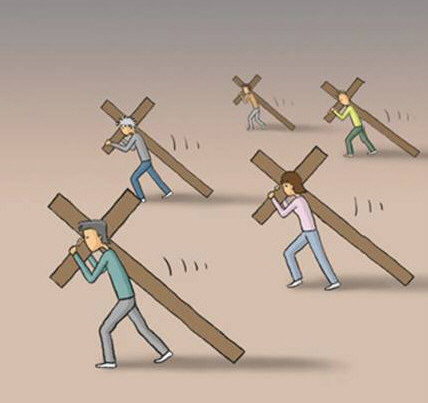
Maybe this is part of what Jesus meant when he told people to be his followers to take up their own cross. They didn’t have to die for their sins – that was his job – but they did have to embrace the kind of sacrificial love going to the cross requires. Love in a world that hates. Erase lines in a culture that is obsessed with drawing them. As far as it depends on you, welcome your enemies. Entertain them – which means opening dialogue, listening, and striving for understanding. If common ground still can’t be found, settle for mutual affection in spite of your disagreement.

cross

How about that? Your cross isn’t all that different from mine.

When we withhold kindness, refuse to engage in dialogue, or go so far as to break fellowship with someone simply because they don’t share a view we feel is particularly important, we’re failing everything that the Church should exemplify. We are not trusting in the power of the gospel to, like Simon the Zealot and Levi the tax collector, unite people in faith, hope, and love in spite of whatever political, cultural, or sociological differences they may hold. We may think our distancing has nothing to do with love. That we’re only protecting ourselves – standing on our principles and refusing to associate with weak-willed or deceived people. However, this only goes to show we’re the ones being deceived. The best way for the Evil One to hold back the kingdom of God is to get us to write each other off for peripheral reasons. When we do this, we carry the bad habits of our fractured world into the sacred bond of Christian fellowship.

Jesus didn’t tell his followers the world would know them by what Bible translation they preferred or what organizations they supported or who they voted for. He didn’t tell them the world would know them as long as they all looked the same and talked the same and held the same exact views. He told them the world would know them by their agapao. By their love.

So, the question is, who are your enemies right now? Who have you written off as useless because their view on something peripheral to this life clashes with your own? Maybe you’ve written off anyone wearing a MAGA hat. Maybe you’ve spurned anyone who’s criticized part of the President’s agenda. Maybe you think anyone who doesn’t accept the truth of climate change is a threat to the world as we know it. Maybe someone who dares pay attention to a “pro-choice” candidate is dead to you.

greta

Ugh, a sixteen-year-old who writes books and passionately advocates for lower carbon emissions instead of just Snapchatting her friends and binge-watching Riverdale all day. What is our world coming to?

Or maybe it’s even closer to home. Maybe you’ve distanced yourself from people in your own church because they interpret Scripture differently than you, or hold a different worship philosophy than you, or have a different perspective on missions than you. Jesus said to love our enemies, and often those folks are a lot closer to us than we realize.

I suppose we can go on distancing ourselves from each other, just to feel safer and little more confident in our own opinions about the world. But that would be taking the easy way out, and where’s the joy in that?

Thoughts at 40

Every few years, I add a birthday post composed of uncategorized thoughts and opinions currently rattling around the ol’ noggin. It’s a way, I suppose, of taking stock or marking time. Perhaps both. In becoming a senior pastor – which is a pretty significant thing that happened this year – I worried I would struggle to come up with content to teach my congregation each and every Sunday, year in and year out. What if the well ran dry?

I quickly realized two things. First, a lot of preaching is repetition. In the last eight months, I’ve repeated specific truths way more than I’ve introduced new ones. I suspect this is necessary, just as it usually takes several solid strikes to drive a nail. Second, while a lot of the beliefs, thoughts, and musings claiming real-estate in my headspace these days are significant, the abruptness of these opinions aren’t always the easiest to weave into a sermon. They are like unripened avocados – everything is there for edibility, but not yet easy to swallow.

This past Saturday, I turned 40. The big 4-oh! So, yeah, quite a bit fills my mind these days. Family, career, home ownership, community involvement… These are only some of the sources for the half-formed notions that follow. I offer no explanation for them here, nor have I listed them in any discernible order. They are merely strands of concern and conviction of this now forty-year-old pastor.

  • These days we hold at the tip of our minds a hundred different opinions we believe are not only significant, but are also indivisibly tied to our identities. As such, to have even one of these beliefs ignored or disagreed with has become the modern-day equivalent of a glove across the face.
  • Journalism is meant to be persistent for truth, to acquire and protect sources, and even, at times, to write critically of powerful people who attempt to gaslight the world. There is, of course, such a thing as “fake news,” but it very rarely comes from the places our current President would have us believe.
  • I don’t know why, but I’m proud to have never watched a single episode of The Big Bang Theory or Glee.
  • The American Church is fighting over scraps. We’re planting far too many new churches in towns already full of them, and this only contributes to an increase in consumeristic Christianity, not to mention an inevitable ethos of competition as each church strives not so much to bear witness to the gospel as to put on the best Sunday show and offer the most self-focused spiritual programming.
  • Three years ago, I rated my wife’s tendency to be right at 96.7%. Over the last three years, that percentage has held strong, if not gone up a bit.
  • I’m not sure of the specific reasons, but I know from experience it is increasingly difficult to find a doctor (be it a GP or a specialist) who actually cares about your physical ailments and will truly give his/her time and energy to helping you get better.
  • I find most people who quote Romans 6:14, “We are not under law but under grace,” vastly misunderstand Romans in particular and the Apostle Paul’s message in general. If I hear one more minister teach that the Old Testament law does not apply to Christians, I’m going to violate the sixth commandment (in my heart).
  • Climate change is not a hoax. When one looks past the fear-mongering of politicians (deniers and zealots alike) and the non-scientific activists and actually reads the scholarly reports, it becomes crystal clear human beings – particularly in affluent countries like ours – are doing terrible damage to a planet God commissioned us to care for like a gardener tends his garden. The Church must accept this and commit to action, or it will continue to decline in relevance.
  • The Avett Brothers may just be the two nicest, most genuine sibling-musicians in the world.
  • For far too many families in our society, youth sports has become a frighteningly compelling idol, demanding one’s money, time, loyalty, and passion yet giving hardly any lasting value in return.
  • Preaching weekly is difficult. Even for a guy who absolutely loves it, preparing a sermon of quality (as opposed to just slapping some talking points together) is much harder to do on an ongoing, weekly basis than I ever suspected. The thing about pastoring which I thought would come easiest has actually been one of the hardest.
  • My oldest daughter is showing tell-tale signs of my personality type, temperament, and general interests. I’m truly  interested to see what a female version of me looks like.
  • Those of you who ignore individual issues and policies and instead just vote straight-ticket Republican or straight-ticket Democrat… You’re not helping.
  • I miss having likeminded, intimate friends – whom I could talk with about anything – who lived close. It’s been a very long time since they did, and at times it feels like that distance is taking its toll.
  • I’m (irrationally) worried the seasons of autumn and winter won’t exist in the heavenly kingdom. They’re my favorite times of the year, but because they’re marked by withering, death, and dormancy, I fear these seasons are incongruent with heaven, particularly Revelation 21-22. I desperately need one of my professor friends to explain why I’m wrong.
  • The Berenstain Bears by Stan and Jan Berenstain is the most delightful series of children’s books in the world.
  • I’m embarrassed and ashamed that the only reason I maintain paid subscriptions to streaming services like Netflix and Prime Video is for the sake of, like, four TV series in total, each of which takes over a year to make a new season (which are usually only 6-10 episodes in length!).
  • I’ve never in my life been ridiculed for saying “Merry Christmas” to someone, and neither has anyone I know. I’ve also never expected or demanded someone say those words to me. I do not need to legitimize my beliefs by demanding baristas and department store clerks accommodate the vocal accoutrements of my religion. Despite what the politicians and cable news pundits may claim, there is no “war of Thanksgiving” and there is no “war on Christmas.” There is, however, a war on truth and common sense.
  • It is a strange and sensitive experience to change the name of a local church. The vision for outward ministry will inevitably collide with a desire for inward tradition. Conversations can easily devolve into matters of denominational heritage and exclusivity. The purpose of the change is regularly lost in the midst of semantic discussions. This is understandable, of course, though I wonder how it stacks up to Jesus’ words in Matthew 6:33.
  • On a consistently regular basis, I miss living in Germany.
  • I used to believe individualism was the Achilles heel of our society, but now I see that tribalism is the real threat. Tribalism is individualism on steroids. These days, the us-vs.-them mindset plagues our politics, our friendships, our family bonds, and, sadly of all, our churches.
  • I’m not sure why, but I’m increasingly drawn to English history period dramas. Wolf Hall, The Crown, Outlaw King, A Man for All Seasons, The King, Peaky Blinders… Perhaps the fascination stems from my discontent with the American political environment. Or maybe I just like the accents.
  • The most soothing, restful music on earth is currently made by a man named Gregory Alan Isakov.
  • We live in a headline-obsessed yet ironically news-averse culture, a society that pollutes the air through the burning of fossil fuels and pollutes human decency through the burning of our self-righteous indignation.
  • There are spiritual disciplines – practices that open us to God’s goodness and the blessings of the life he has given us. They include practices like centering prayer, fasting, Bible study, Sabbath, acts of compassion, meal-sharing, and church attendance. Then there are unspiritual disciplines – things we do that close us off from God and one another. These include rushing from place to place, watching too much cable news, texting when you really should call, ignoring your children, pressuring your children, resisting conversations with strangers, and looking at your smartphone while in conversation with another human being.

I could probably go to forty, in honor of this prestigious birthday, but twenty-five feels like more than enough to fling into cyberspace. I now consider these thoughts adequately documented.

The Curious Case of Kanye West

I’ve given up trying to have hip musical tastes. Life’s too short. I’m a month shy of 40, and I just want to listen to what I like. So, that usually means the Americana stylings of The Avett Brothers, the acoustic-driven songs of Gregory Alan Isakov, Josh Ritter, or Iron and Wine, or the smooth folk-jazz of Over the Rhine. I no longer concern myself with the Top 40 or the zeitgeist of pop, R&B, or hip-hop. As popular as these genres are, they don’t entertain or inspire me.

Hip-hop in particular was difficult to get into. I mean, I like “Lose Yourself,” but who doesn’t? I tried listening to Kendrick Lamar’s Damn after it won a Pulitzer, but it just didn’t resonate. It’s not that I think hip-hop is a lesser genre. It’s just never been my cup of tea.

music taste

The fact that I use the idiom “cup of tea” may be its own indicator.

Because of this, I have little interest in listening to Jesus is King by Kanye West.

Apparently that’s what every Christian under 45 years of age has been doing the last couple of weeks. If you haven’t heard, Kanye West has become a Christian, and he just released an album expounding upon his newfound faith. He has also stated he will retroactively adjust lyrics from past albums to make them less offensive.

As an exercise in theological evaluation, I suppose I am curious how exactly a notoriously narcissistic hip-hop star articulates the gospel after his conversion? Are his lyrics biblically sound or rough around the doctrinal edges? Is Scripture treated with reverence and respect, or culturally proof-texted to make a predetermined point? Then again, these are questions we should be asking of any album intended to proclaim the truth of the gospel.

My musical tastes will likely prevent me from asking Alexa to fill my kitchen with Kanye’s sick-yet-gospelized beats. Sorry, Kanye. However, I’m not wholly indifferent to news of your conversion. In fact, I’m far more curious about how our culture is treating that than the reviews of your latest studio effort.

What’s Really Going on Here?

It’s not Kanye’s new album, but rather his alleged conversion and the Church’s response to it, that intrigues me. I include “alleged” simply because I do not know Kanye, nor do I know the individuals in his life who claim to have witnessed his surrender to the gospel. I hope that his decision to follow Jesus as “King” is genuine. If it is, I believe it should be celebrated. After all, while I’m not hip enough to quote any of his lyrics, I’m familiar with enough pop culture to know Kanye’s reputation has been anything but humble and compassionate. Christians are right to celebrate when the gospel transforms a life, when a once self-involved individual starts serving the local church.

kanyeinterupts

“I’mma let you finish, Pastor, but first, would the parents of Caleb Williams make your way to the nursery? He ate too many graham crackers and got a tummy ache…”

But here’s the thing: I’m not sure we can call what a lot of Christians are doing in relation to Kanye West’s conversion a celebration of the gospel. Perhaps this is a slip toward cynicism on my part, but what social media posts and religious publications are saying about Kanye’s life-change seem more akin to when your favorite sports team acquires a quality first-round draft pick. It feels like some of us are cheering the success of a team, instead of the power of the gospel. Meanwhile, the other side (the skeptical ones) are quick to doubt the conversion based on any number of assumptions.

We do this a lot, actually. For decades, Christians in America (particularly evangelicals) have struggled with the concept of celebrities professing faith. Sometimes this is a known Christian who becomes more active on the secular stage (think musicians like Amy Grant and P.O.D., or politicians such as Mike Huckabee and Jesse Jackson). When this happens, Christians quickly split into two main camps – those who applaud the person’s courageous choice to exemplify faith to a dark world, and those who question the genuineness of the person’s faith, instead labeling them either a sell-out or an apostate.

annoyed

“They’re playing “Meant to Live” on the secular rock station. Switchfoot is dead to me now.”

This divide also surfaces when news breaks that a known celebrity has professed faith in Christ (e.g., Alice Cooper, Justin Bieber, the dude from Korn) or has been “outed” as a believer (e.g., Stephen Colbert, MC Hammer, Chris Pratt). Again, the camps form. Some Christians celebrate the person’s radical choice to turn from the wide gate and instead walk the narrow road of faith. Others scratch their heads and question whether the person’s faith is actually authentic. This is what we’re currently experiencing in the curious case of Kanye West.

In Search of Legitimacy

Often, when popular celebrities are revealed to be people of faith, this tends to legitimize them in the eyes of many believers. A kind of “team pride” dynamic emerges within Christian circles. Whether it’s Bob Dylan, Mel Gibson, or Kanye West, a lot of people feel the need to look back over a person’s career and point to moments that seem to indicate faith in the gospel, or at least an openness to it (“C’mon, man. Don’t you remember “Jesus Walks” from Dropout…“). Inevitably, some newfound fans will compare the newly converted to a certain Pharisee who experienced his own dramatic change of direction. They’re convinced that this one-time enemy of the faith is now a child of the light who will quite possibly have the same worldwide impact as Saul of Tarsus. After all, just consider their well-established platform, and all those current fans ripe for conversion now that their hero has surrendered to the gospel.

stoning of paul the apostle

That’s how things worked out for Saul, right?

While some of these hopes lie in the realm of the possible, there are some troubling implications to them as well. First, it assumes the spread of the gospel is based as much in popularity as it is in relationship. Joe Schmo may be able to win a couple close friends to Jesus, but imagine how many lives will be touched when Bieber brings Hillsong United on his next tour. There’s no comparing which person will spark the next Great Awakening.

Second, we’re quick to celebrate a profession of mind, but are rarely interested in considering a subsequent change of action. Usually, this is because we don’t want to appear judgmental. However, Scripture reminds us many times over that faith devoid of action can hardly be called genuine. Jesus asked, “Are grapes gathered from thorns, or figs from thistles? In the same way, every good tree bears good fruit, but the bad tree bears bad fruit” (Mt. 7:16-17). And James reminded the Church, “Be doers of the word, and not merely hearers who deceive themselves. For if any are hearers of the word and not doers, they are like those who look at themselves in a mirror; for they look at themselves and, on going away, immediately forget what they were like” (Ja. 1:22-24). He would later go on to point out that a profession of belief is not enough. “Even the demons believe,” he wrote (2:19).

Now, I’m not saying we should subject new believers to unreasonable scrutiny – especially those we’re acquainted with only through a pop-culture lens. Formation in the Spirit is a lifelong process. Neither am I advocating we should pounce on a believer’s missteps as proof of illegitimate faith. We must remember, though, that it is a Christian’s life that testifies to the truth of salvation, not just a Christian’s mouth.

When holding out for this form of evidence from an allegedly converted celebrity is considered divisive, we have a problem. But the choice to wait-and-see is very often labeled as cynical, judgmental, or even the biggest insult one can throw at a fellow Christian: pharisaical.

bttf

It’s considered offensive and uncouth for Christians to express skepticism at stories of famous people professing faith. Elvis Presley, Tyler Perry, Deion Sanders, every other country music singer… Questioning the authenticity of a celebrity’s profession of faith (true repentance or just a passing fad) often gets you accused of overly pietistic faith. “Someone has come along who can, by his mainstream appeal, validate Christian devotion!” some say. “But look at all the spiritual party-poopers threatened by what they can’t understand.”

I know I do not feel threatened by Kanye’s profession of faith. I’m not even sure what “side” I’m on. I’m certainly not with the doubters. If anything, I’m cautiously optimistic that his is genuine repentance. What I’m waiting for, though, is spiritual fruit, which Jesus reminds all of us is the evidence of true faith. An album called Jesus is King isn’t enough, just as Slow Train Coming and Saved weren’t enough for Dylan. There is more to following Jesus than writing a handful of Christ-themed songs.

What I am threatened by – or perhaps the better word is “concerned” – are those who defend a celebrity’s conversion not out of any actual familiarity with the person, but rather out of a desire to protect the legitimacy they feel a famous person’s faith now gives their own. If Dylan or Bieber or Kanye can be Christians, that must mean my own faith is not incompatible with the mainstream. Christians can be cool. The Church is back, baby!

pouting

“If Lady Gaga would go to church a little more, maybe Mom would let me listen to her albums…”

The Idolatry of Image

While our first experience of repentance may resonate in our very bones, it remains no simple task to follow Jesus daily. In twenty years of ministry, I’ve witnessed countless conversions – people prostrating themselves before sanctuary altars, teenagers walking aisles in tears, all-night conversations with skeptics who finally, in the wee hours of the morning, bow their heads in humble recognition of the Great Mystery. These were powerful moments all.

And yet, I need only glance at my Facebook feed to recognize not every one of these once-repentant souls are currently bearing spiritual fruit. While many lives were radically changed, others never really were. Some who passionately professed belief and spoke words of surrender returned to their old ways not long after that experience. A few have walked away from faith altogether, chalking up their conversion experience to naïveté or ignorance.

The point of this post is not to dismiss the genuineness of confession, nor is it to ponder whether one can lose his or her salvation. I’m merely pointing out that repentance, while central to our salvation, is only step one. Being remade by the Spirit is actually a lifelong process, and to be a true spiritual leader of others requires a lot more than having a built-in platform. There is good reason why Saul backed away from public life for three years before finally engaging with the apostles in Jerusalem (Gal. 1:15-18). Conversion is a glorious bloom, but if it’s going to blossom then a commitment to grow in faith – to be corrected, trained, and formed by the truth – must be joined with it. Saul of Tarsus did indeed have an extraordinary impact on the spread of the gospel, but that impact was not immediate. Several years passed between the Damascus Road and his first missionary excursion.

I have no reason to discredit Kanye’s fervor for the gospel, nor do I doubt the lyrics in Jesus is King come from a genuine passion for his Savior. However, what I know the man needs now is the opportunity and the space to grow in his faith, especially considering the materialistic, self-seeking celebrity culture in which he has lived for so long. Good trees don’t bear good fruit overnight.

Death-Valley-Mojave-National-Preserve-30

Saul went to Arabia. Maybe Kanye should spend three years in the Mojave.

We in the Church have a bad habit of making idols out of famous converts. To pin our hopes to their redeemed coattails and bask in the glow of our own newfound legitimacy. We would do better to treat these people like the young brothers and sisters in Christ they actually are. We should pray for them, and pray against the onslaught of temptation, the whispers of the Evil One who will try to tell them they were just going through a phase, just experiencing a moment of weakness, when they offered that sinner’s prayer.

So, maybe I should give Jesus is King a listen. Kanye’s beats may not be my cup of tea, but, while I don’t know the man personally, that doesn’t mean I can’t pray for him to grow and to learn and to prosper. And it doesn’t mean I can’t change the way I respond to these reports of celebrities who profess faith – entrusting each one to the Lord, and calling upon his name and his influence to bring about the furthering of his purposes.

It’s in Jesus and Jesus alone I place my trust. After all, as Kanye’s album reminds us, he is the King.