Is Your Quiet Time Turning You into a Pharisee?

This is the third post in a five-part series on the problems with keeping a personal, daily “quiet time.” Click here and here to read the first two installments.

Have you ever prayed to become a better Christian?

ManPraying

“Shh! If you say it out loud, it won’t come true.”

Well, stop it.

There’s no such thing.

Some believers are under the impression that a relationship with Jesus is meant to be an ever-increasing advancement – that the Christian life contains higher levels of capability and competence, like promotions within a corporation, and if we would just show up early, put in the work, and leave late, eventually we will climb the spiritual ladder. The worst part of this misconception is that a lot of new believers think that Christians who have attained these alleged higher levels don’t have to deal with the temptations and struggles that rage down in the mailrooms and custodial closets of faith. Up in the corner offices of Christianity are those who sit above all that stuff.

Sometimes we have to deal with this guy, though.

Though sometimes we have to deal with these weirdos.

While it is certainly true that we are meant to mature in our faith – to grow more trusting and find deeper reservoirs of strength – a relationship with Jesus is not about promotion. There is no such thing as “a better Christian.”

There are days when you may feel like you’re sitting high in that corner office of unchallenged commitment, but watch out, because before you know it, you may find yourself back down in the basement aimlessly sorting mail.

The misconception in Christianity that we can attain higher levels of faith is born out of a fear of failure. We don’t like to back-slide, to spurn our commitments and indulge in selfishness. So, we convince ourselves that there is some Rubicon within the Christian life – a point of no return that, if we can live obediently enough to reach it and cross it, we will never have to return to the laborious, unpredictable days of unripe belief.

"Actually, the crossing of the Rubicon signaled the start of conflict, not the end of it." - the Metaphor Police

“Actually, the crossing of the Rubicon signaled the start of conflict, not the end of it.” – the Metaphor Police

Of course, this belief drags several problems along with it. The first is that we can end up lying to ourselves about our spiritual health. If I believe in higher levels of the Christian life where fledgling struggles and beginner’s temptations no longer affect me, when those trials inevitably rear their heads, I may feel I need to pretend I’m not influenced by them. And, if I don’t end up lying to myself, then another problem I may encounter is self-devaluation. I will take my inevitable missteps and failures as proof that I’m incapable of attaining the higher levels, and will begin to hate myself (rather than hating only my sinful nature). Christians who continually deprecate themselves in their prayers and testimonies will find it very hard to accept the unconditional love of God.

But sometimes the biggest problem for people who believe faith is like a corporate ladder is that they can develop a sense of entitlement. If I am disciplined and obedient (to whatever predetermined extent), I deserve ______ from God. Some will fill that blank with recognition. Others, with particular blessings. Whatever it is, they unwittingly make God’s provision obligatory.

Several years ago, I found myself caught up in the throes of this third problem. So certain was I in the foolproof formula of a traditional quiet time that I truly believed my keeping it would rocket me upward into the stratospheres and ionospheres of faith. Maybe not right away – rocket boosters have to burn for a few moments before you see movement – but once I got going, “Houston, we have liftoff.”

"Corporations, the Rubicon, space travel! C’mon, Bo, pick a metaphor and stick with it!"

“Corporations, the Rubicon, space travel! C’mon, Bo, pick a metaphor and stick with it!”

But that feeling of incompetence continued, and after weeks and even months of seeing little difference in my attitudes and actions, I began to get angry. Angry at myself, but also angry at God. Couldn’t he see that I was trying? Didn’t he realize I was attempting to discipline myself? Why was he still standing far off? I was the lost son returning home – why wasn’t he running out to embrace me? Where was the party? Where was the fatted calf?

The only thing I knew to do, and was counseled to do by various church leaders, was to keep at it. God would show up, eventually. Read those Psalms, they told me; those folks had to wait on God, too, and they kept right on praying and praising.

The über-faithful could also rock a harp.

The über-faithful could also rock a harp.

And so, for years, I believed that strict adherence to a specific quiet time method would eventually result in some kind of breakthrough. I would wake up one day and my prayers would flow like a mountain river, the words of 1st Chronicles would suddenly become life-giving, and every sentence I wrote in my journal would be more profound than the last. Life itself would reverberate with meaning. Things would finally be easier. I would have reached that corner office, and all my present struggles and feelings of discontent would seem so small, so very, very far away. But that breakthrough never came.

Why?

Because my daily quiet time had morphed into devotion to a system rather than devotion to a Savior.

Without meaning to, I had become a Pharisee.

I really should grow a beard.

I really should grow a beard.

The if-you-will-do-this-then-God-will-do-that system of thought comes up time and again in Scripture, and time and again people get it wrong – the most famous example being the Pharisees of first-century Judaism. These people were the most influential sect of teachers, scribes and lawyers, and the ones who seemed to clash most often with Jesus. We often criticize the Pharisees for being legalistic and close-minded, and yet they appear to be the closest comparison to Christians in America today. In reality, among the people of the first-century, Pharisees were the most faithful students of the Scriptures. They were devoted to prayer and theological reflection, and they were adamant about the importance of an obedient lifestyle. Some of the most famous and gifted rabbis ever to arise in early Judaism were Pharisees.

The Pharisees believed strongly in the if/then promises of the Torah, and were careful to faithfully keep the “ifs” so that God might follow through with the “thens.” Several times, Jesus pointed out the main problem with this. The Pharisees had lost sight of the goodness of God, particularly the fact that he was even willing to offer promises to human beings at all. In so doing, Jesus informed them that they had fallen out of a real relationship with the God they so desired to please.

The irony was that the Scriptures – which they knew better than anyone due to such rigid devotional methods – are replete with reminders that what God is after is not a process, but a posture. In Psalm 51, David prays, “For you will not delight in sacrifice, or I would give it; you will not be pleased with a burnt offering. The sacrifices of God are a broken spirit; a broken and contrite heart, O God, you will not despise.” Long before Jesus came on the scene, the prophet Hosea bore witness to a sacrificial/devotional system that had lost all meaning, stating the people’s worship was “like the morning mist, like the early dew that disappears,” to which God responds, “I desire mercy, not sacrifice, and acknowledgment of God rather than burnt offerings.” In Matthew 9, Jesus tells the Pharisees they ought to take another look at Hosea, because no matter how ironclad the process might be, transformation is impossible without the right posture.
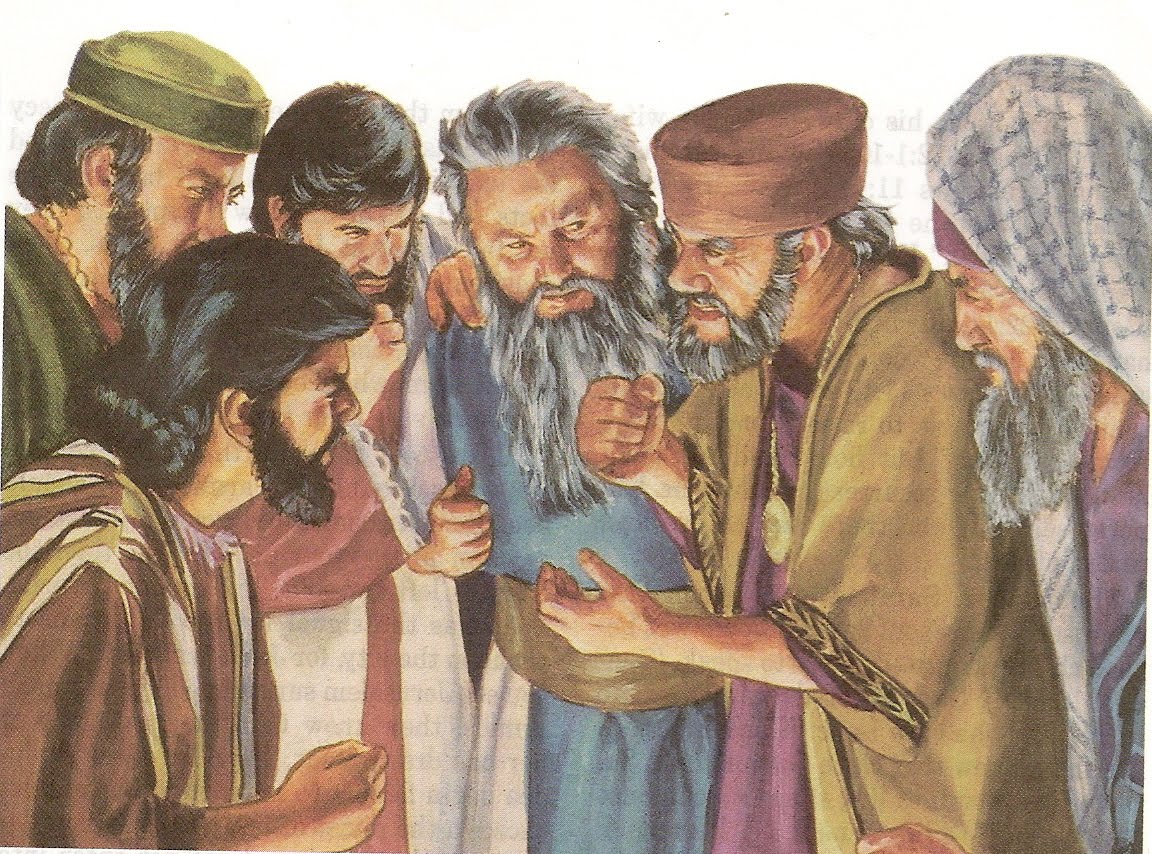
"Did that guy just give us a homework assignment?"

“Did that guy just give us a homework assignment?”

The Pharisees believed that God owed them something – that their status as God’s chosen people was not only based in history, but also sustained by their faithful keeping of the Torah. They believed their rigid loyalty to the Law of Moses had caused them to attain the higher levels. And so, they lived as if they resided in those corner offices of the faith. Jesus was disgusted with this sense of entitlement, as well as the fact that the Pharisees so often made life difficult for the mailroom clerks and custodians just trying to make ends meet spiritually. Those who had seemingly mastered obedience made no effort to help others with it.

There is no such thing as becoming “a better Christian.” And when it comes to quiet times, the most dangerous thing you can do is become a slave to a formula, believing dogged tenacity will accomplish the kind of spiritual growth you’re hoping for.

I will continue this series next week with an argument for why the traditional formula itself is faulty. However, may we be mindful of our motivations when we seek communion with God. In the same spirit as the Teacher’s advice regarding worship in Ecclesiastes 5, may we “draw near to listen rather than to offer the sacrifice of fools.”

On Quiet Times

I am a morning person.

That term is often used to describe someone who can wake up at some ungodly hour as alert as a fighter pilot passing through enemy airspace. Someone who doesn’t need even a hint of daylight to begin his or her day. This is not what I mean when I say that I am a morning person. Pulling away from the embrace of sleep and actually putting feet to cold floor does not fill me with positivity. The cold water I splash on my face in the bathroom is not the symbolic christening of a new day, but a necessary dousing for my senses to reactivate, like smelling salts under a boxer’s broken nose. I brew my first cup of coffee with a kind of desperation – the Keurig is never slower than at 6 AM.

No, I am not a morning person because I have no problem waking up early. I am a morning person because I recognize the value of the early morning hours. As a father of pre-schoolers, there are precious few stretches of silence in my house, and the ones that come after evening bedtimes find mine and my wife’s collective strength sapped. I have hardly enough energy to watch an entire Dateline episode or read more than a single chapter of a novel.

Shows like this are more compelling when you're brain is already half asleep.

Shows like this are more compelling when your brain is already half asleep.

So, despite the difficulty, every weekday I rise earlier than the rest of my family. I stagger down the hall to the kitchen, clumsily trying to avoid the creakiest of the floorboards, and hold a yawn so pronounced that most of my coffee brews before it dies away. Then I pick up my coffee, my laptop, my Bible, and whatever book on theology I’m currently working my way through, and I tip-toe to the living room. There, on the sofa under the lamp, I have my “quiet time.”

Growing up in an evangelical church, I heard that term a lot – quiet time. While there is no specific mention of the concept in Scripture, I was taught that, above all things, the obedient Christian is one who keeps a daily quiet time.

And the über-spiritual take it to the next level.

And the über-spiritual take it to the next level.

If you grew up in the Church, too, chances are you’ve heard the importance of something like this expressed. Most of the teachers I had in my youth not only encouraged the keeping of a quiet time, but they usually offered a formula for what one looked like. A quiet time, they said, consisted of the following:

  1. prayer, not only for myself but also for a list of other people (and a good Christian always kept a list)
  2. reading the Bible – either a Psalm or a Gospel story or a portion of a letter – with or without the aid of a devotional book (until you graduated to concordances and commentaries and thus added the spiritual discipline of cross-referencing into your quiet times)
  3. journaling, in which you muse on the intersections of life and Scripture, or perhaps write out your prayers (before Facebook and Tumblr suggested we share those thoughts and prayers with everyone everyday).

I spent years trying to make this formula work for me. I was white-knuckling it, trying to force an enlightenment that I was told was the natural product of keeping this practice faithfully.

It didn’t occur to me until much later that, just like the Sabbath, a quiet time was made for the person, not a person for the quiet time.

That awkward moment when you're unsure whether or not you just read something heretical.

That awkward moment when you’re unsure whether or not you just read something heretical.

It took years of student ministry for me to realize this, but after dozens of conversations with frustrated young people, I finally wised up. My heart went out to them, because they were struggling with the same deep sense of guilt that I struggled with, all because they had missed a day here and a week there, or because after months of forcing the formula, they felt very little difference in their spirits. Not only were they result-biased, but the drudgery of keeping the formula had cultivated an aversion to both prayer and Bible study within them. They were sick of it, but stopping meant conceding it was all for nothing.

"I bought my journals in bulk. I can't just stop!"

“I bought my journals in bulk. I can’t just stop!”

Next week, I will explore some of the reasons why people fail at the traditional quiet time formula as often as others succeed. In the meantime, however, let it be known that I have no “better way” to offer in its place.

What I have is what is unique to my own experience, but I think that is part of the truth about “quiet times.” What I have is a steaming cup of coffee, a laptop, a Bible, and a whatever book on theology I’m currently reading. What I have is a silent house and a sofa and a lamp. What I have is a physical body that is not ready to wake up, but a spirit that is eager to be awakened. So I do what I can for it – I read a short passage of Scripture, and part of a chapter on theology, and then I turn on my laptop. I work on the same old novel, or on a short story, because telling those stories engages my spirit more than any journal entry ever did. And after showering and dressing, packing my bag and heading off to work, I realize that I am happy, that God wants me to be happy, and that he has made me a certain way, with particular interests and energies, none of which should ever be formulated or templated for anyone else.

In the car, I breathe out prayers of thankfulness. I thank God that his mercies are not carrot-and-stick. I thank him that I have been remade – a new creation he sees and declares to be good. I thank him that there is no such thing as an ungodly hour.

Are We Up for This?

I wonder if most believers are really interested in the salvation Jesus offers people.

Let me clarify that statement. In my last post, I wrote about the alleged difficulty of defining the term “spiritual formation.” My argument was that the difficulty only comes when we lose sight of what those two words really mean. When you look at their roots, it’s not difficult to see what we’re describing when we’re saying someone is being spiritually formed. The Spirit is at work in that person, forming him or her into something different. Something new.

But for those who think that sounds perfectly agreeable, Jim Smith, executive director of The Apprentice Institute, reminds us, “Formation involves every single aspect of our lives: our thoughts, our emotions, our bodies, our experiences, our relationships, our resources, our time management, our loved ones, our health, our sexuality, etc. … There is no area of our lives that is not a part of our formation process. It is not, as I used to think, a separation of sacred and secular, of spiritual and physical, but a holistic, unified endeavor.”

I’m not sure many of us are up for that kind of formation.

But that’s the kind of conversion Jesus wants to bring to us. It is a far-reaching formation – a wholesale wholeness.

feature6

By and large, though, people have stopped seeing Christianity this way, as a comprehensive transformation of body, mind and soul. Instead, we’ve portrayed a faith that is concerned only with moral behavior, or “traditional” values, or what comes after death. Christians have ceased seeing the all-inclusiveness of God’s transformative power.

I’m a Spiritual Person

I’m a fan of modernity. As a former teacher of American literature, I didn’t think the curriculum became fun until we hit the 20th century. However, with the modernization of the West came the tendency to relegate “spirituality” to one facet of what we began to think of as a multifaceted existence. Those who wanted to maintain belief in the supernatural – in that Something beyond ourselves – nonetheless compartmentalized that perspective in such a way that “the things of the Spirit” gradually began to lose influence over the other aspects of our lives. As modernism permeated the culture, our identities began to look like a region full of autonomous city-states. The social/relational sphere of our lives won its independence from all the others, as did the vocational/financial sphere, the familial sphere, the emotional sphere, the physical sphere, and so on. Sure, there has always been interaction between all of these various parts of our identity, but people are quick to guard the self-sovereignty of each one.

Pictured: Our identities.

Pictured: Our identities.

A perfect example of this is the all-too-common referral to being “a spiritual person” (many professing Christians included). Rarely are these people referring to a tangible, active presence – or Spirit – at work in their lives. Rather, what they are describing is a more self-seeking posture that feeds off of feelings we can’t easily name but still enjoy. Modern spirituality has become an amorphous pursuit – a hobby easily tailored according to each person’s preferences. Because of this, it is not uncommon to encounter a person who claims to be very “spiritual” but whose other spheres of life seem mostly unaffected by that spirituality.

This was not the kind of spiritual formation Jesus was referring to when, in Gethsemane, he promised the disciples that the Holy Spirit was coming.

All the Fullness of God

Likewise, there’s a moment in the middle of St. Paul’s letter to the Ephesians when he expresses what his prayers are for them, a church he so dearly loves. Having challenged them to recognize that the mysteries of God have finally been revealed in Jesus, and that this revelation changes everything, he writes the following:

“I pray that out of his glorious riches he may strengthen you with power through his Spirit in your inner being, so that Christ may dwell in your hearts through faith. And I pray that you, being rooted and established in love, may have power, together with all the saints, to grasp how wide and long and high and deep is the love of Christ, and to know this love that surpasses knowledge – that you may be filled to the measure of all the fullness of God” (Eph. 3:16-19).

If Facebook were around in the first century, Paul would have been that annoying friend who always posts longwinded prayers in his status updates.

If Facebook were around in the first century, Paul would have been that annoying friend who always posts longwinded prayers in his status updates.

Paul was referring to a transformation that affected every aspect of a person’s existence. So was Jesus, when he said he came that we “may have life, and have it in abundance” (John 10:10).

Thus, the salvation offered by Jesus is not found in laying down only one sphere of my identity, but when I relinquish them all. Jesus is not the Lord of only the spiritual parts of my life. He is the Master of it all – my social interactions, my job and finances, my family, my emotions, my physical health, and so on. Jesus understood that just as we are not created in part but in whole, our recreation must happen the same way. Salvation is all or nothing.

Amen, Yoda. Amen.

Amen, Yoda. Amen.

Sure, there will be times when our rationalism causes us to doubt even a good and beautiful God, and we feel a need to hold something back. But this is why Paul’s prayer included a plea “to know this love that surpasses knowledge” – that our doubts would not lead to self-reliance, and our minds would be transformed alongside everything else. That by surrendering, we would learn surrender.

Simple, Not Easy

Like I said, I’m not sure we’re interested in that kind of salvation.

The Gospel is simple, but that doesn’t make it easy. We understand that by our own efforts we cannot save ourselves. Our healing and wholeness requires an act of God, and that act was Jesus. Believing this is simple enough. But responding to it is not so easy.

The problem for those who stop at mere belief is that salvation requires belief and response. What kind of response? Oh, just the relinquishing of every element of control you enjoy over your existence. Just the surrender of every sphere of your life into the hands of Another.

Amen, Neo. Amen.

Amen, Neo. Amen.

Simple? Yes.

Easy? Definitely not.

Maybe this is why so many of the most powerful stories of transformation we hear – the ones that stick in our minds long after we’ve listened to their telling – are the ones in which people surrendered their lives to Jesus after their lives became a complete wreck. They were at the end of their rope, the candle was flickering, the water was almost over their heads, there was nothing left to live for … and that’s when Jesus changed everything.

Perhaps too many of us still feel like we have something worth living for – a sphere of life we’ve arranged too much to our liking. Even if its not perfect, we’d rather keep things as they are than risk what might change if it were devoted to God.

I wonder why that is.

I’ve heard a lot of ministers complain that people are just too lazy to really seek after formation. But what if laziness isn’t our core problem?  What if our problem is bad theology? I mean, do we or do we not believe that God is good? That he is generous and trustworthy? That he desires the best for us, and that he has promised to daily care for us?

Because, if we really believe those things, what on earth has prevented us from responding?

The Answer in the Question

I’m two months into a new position at a new church. That position is Minister of Spiritual Formation. Apparently, the title isn’t self-explanatory, because upon introducing myself to church members, I am often asked to explain what exactly I do at the church.

Now, the puffed-up, self-centered part of me wants to balk at such questions, and the cynic in me wants to scoff and say, “What do you mean? Do you ask the music minister or the youth minister to explain what it is they do?” But, at the same time, the realist in me just gets anxious.

"Whatever happened to a simple "'preciate ya'" and a handshake?"

“Whatever happened to a simple “‘preciate ya'” and a handshake?”

Here’s why. Several years ago, I remember sitting in an interview with a church’s search team and being asked essentially the same question. The woman who asked it had done her homework on me; from where I sat across the conference table, I could see her detailed notes written into the margins of my resume, a legal pad replete with questions she considered asking me, and underneath that a black, three-ring binder containing photocopies of several posts from my blog. Perusing these for a few seconds, she looked back up at me and said, “You write a lot in your blog about ‘spiritual formation.’ It seems like that term comes up a lot. I was just wondering, what is spiritual formation?”

I remember feeling simultaneously excited and apprehensive by her question.

Excited, because this was one of the first interview questions that had to do with my personal convictions and interests in ministry (as opposed to programs I had started and events I had planned), and it would be refreshing to speak to a deeper level of what it means to be a minister.

Apprehensive, because I was hardly prepared to give a succinct and comprehensive answer to her question.

"Uhhhh... no comment?"

“Uhhhh… no comment?”

You see, at the time “spiritual formation” was still somewhat of a nebulous concept to me, despite however many times the term found its way onto my blog or into my lessons. It was something I was profoundly interested in, of course, but also something that intimidated me as much as it inspired me. I was convinced I wanted to focus on it in my ministry, both in philosophy and practical direction, but despite collecting several books on the subject, I was still unsure how to work with, in, and toward spiritual formation.

Still, it is not like me to forego offering my opinion on anything. So when this woman asked her question, I let very little silence fall before I opened my mouth to speak. However, another person on the search committee beat me to answering. He said quickly and dismissively, “It’s just another word for ‘discipleship.'”

His answer threw me off, and I slowly closed my mouth. It’s tricky enough to respond to the open-ended question, “What is spiritual formation?” Explaining the error in confusing it with discipleship, especially in the context of a job interview, is a whole other level of difficulty.

"Which brings me back to why you are all completely wrong and have no choice but to hire me to save you from your wrongness."

“Which brings me back to why you are all completely wrong and have no choice but to hire me to save you from your wrongness.”

The Hunt for a Good Definition

I learned two things in that interview. The first was that it is not uncommon to encounter long-time, active church members who have little idea what spiritual formation is. The second was that I was one of them.

Defining spiritual formation is not necessarily a hard thing to do. People have been offering their elucidations on the term for quite some time. (Jim Smith just wrote a great series of posts covering it from every angle.) However, because every person whom the Spirit forms is a unique individual woven together by an elaborate and distinctive collection of characteristics, attributes and idiosyncrasies, sometimes the only definition that seems to truly fit is the one you craft yourself.

How pompous can you be, Merriam-Webster?

You don’t know everything, Merriam-Webster.

After the interview, I at least knew where not to start. I knew spiritual formation was not simply another term for discipleship. The two are intimately related, for sure, but even my limited understanding cried out against belittling either term by calling it a mere synonym of the other.

I decided to start with defining discipleship, something that did not intimidate me as much. Oddly enough, it was this endeavor that led me to an answer for the other.

Defining discipleship seemed easy enough; I just looked more closely at its root word: disciple. Once I cleared away the cobwebs of antiquated Christianese words that were part of my small town Baptist church upbringing – words like “discipleship training” and “church discipline” and “Disciple Now Weekend” – I was able to return to the original meaning of the word. From the Greek mathetes, meaning learner, pupil or apprentice, it was often used to describe the students of a rabbi, and in the case of the Gospels, this means Jesus. Rabbinic disciples were meant to learn from their teacher, to emulate them in every way possible, and, eventually, to carry on that rabbi’s teachings – also known as their rabbi’s “yoke” – as a formative part of their own.

If this is not the very example provided us by the likes of Peter, James and John, I don’t know what is.

The Mount of Transfiguration. Also known as the original Disciple Now Weekend.

The Mount of Transfiguration. Also known as the original Disciple Now Weekend.

So, if discipleship is the commitment to being a disciple, and being a disciple means emulating one’s teacher, then Christian discipleship simply means, as one of his disciples wrote, “walking as Jesus did,” and another added, “fixing our eyes on Jesus, the author and perfecter of our faith.” Jesus is both the example and the focal point for our thoughts, words and actions.

And wouldn’t you know it, this was all right there in the word itself. It wasn’t complicated.

The Title Is Self-Explanatory

Naturally, this led me to reconsider the term “spiritual formation,” taking again the root word – or, in this case, the root words. “Spirit” and “forms.” I was struck by the fact that these two words alone was almost a workable sentence in itself. Spirit forms. What is more, it sounded as much like a declaration as it did a reminder. In John 16, Jesus declares that it is the Spirit who leads us into all truth. And every time I try to arrange and organize and methodize my life so that I might feel like a more effective person, my inevitable shortcomings bring God’s reminder: “No, Bo. The Spirit forms. Not you.”

This, then, must be the first step toward any measure of spiritual formation. There must be the element of surrender. I’ve heard some people describe the concept as a “pursuit of God,” but spiritual formation is not about us chasing after God. Rather, we are the ones who lay down our arms – the dependencies and life structures that rival his promised provision – and wave the white flag. It is not us creeping closer to God’s territory, but rather God invading our once guarded spaces. If it is a pursuit, it is a pursuit of man by the Holy Spirit.

I could do a whole predator-becomes-prey illustration thing, but not everyone sees the deep theological implications of this movie.

I could do a whole predator-becomes-prey illustration thing, but not everyone sees the deep theological implications of this movie.

This is similar to discipleship. Jesus said that if anyone wanted to be his disciple, that person had to deny himself. This doesn’t mean that discipleship and spiritual formation are the same, but it doesn’t reveal that an essential element of the Christian life is the relinquishing of control over our abilities and circumstances.

The difference between the two is that discipleship is the commitment we make to follow Jesus according to his call. Spiritual formation is what takes place once that following begins, when the Spirit begins its transformative work in our hearts and minds.

So, what exactly does a Minister of Spiritual Formation do?

If I’m shepherding a person effectively, then I am helping him understand the principle common to both experiences – that it isn’t all about him. A minister attends to the needs of others, so I’m reminding him that he doesn’t need the worship service to conform to his preferences. That his Bible study doesn’t need to utilize his favorite curriculum. That fellow church members don’t need to think and act the way he feels they should.

"Again with the rattlesnakes?! I really think he should use more copperheads! They much more aesthetically pleasing."

“Again with the rattlesnakes?! Copperheads are much more aesthetically pleasing, Pastor.”

I tell him that what is truly needed is something only God can give. And, if I do this well, he learns to accept that the community of God is something larger and grander than his own imagination’s limits. He comes to see it is infused by a very big and very beautiful God who has a purpose and an agenda so much greater than any one mind can grasp.

A Minister of Spiritual Formation provides opportunities upon opportunities that challenge people to experience the grandeur of God. I’m pointing them to ministries and programs and events and studies not simply because that’s what going to church is all about, but because these things hold the potential to reveal how, as Hopkins wrote, “Christ plays in ten thousand places / Lovely in limbs and lovely in eyes not his / To the Father through the features of men’s faces.”

It’s not always the easiest thing to explain, but not everything has to be easy to explain. When people hear my job title and ask me what I do, I’ve stopped sweating the question. Instead, I smile and tell them, “I make sure people aren’t so focused on their own lives that they forget they’re a part of something much, much greater.”

It may not be the answer they are expecting, or the one that clarifies things the way they were hoping when they asked the question. I’ve only been here two months, so I’ve still got a lot of work to do when it comes to helping people live into their own definitions.

But when it comes to explaining spiritual formation to someone, I’ve decided that is as much the Spirit’s job as it is mine.

The Problem with First World Problems

“First world problems.”

It was a funny categorization at first, but that phrase has begun to wear thin, don’t you think? It’s one thing to recognize that my problems aren’t as significant as other points of suffering in the world. Rarely, though, was this sobering realization followed up by action on behalf of those who are suffering with greater significance.

After all, few of us appreciate suffering. We don’t want to experience it, we get uncomfortable when we witness others go through it, and more often than not it is our guilt and our pity, rather than our compassion, that is aroused when we hear of global atrocities near and far. And, save for a bold few, it would seem that over time Christians in the West have lost their stomach for suffering.

Which is odd.

Because suffering is intimately connected to what Christians are taught to look to as the source and the power of our faith.

Pictured: suffering.

Pictured: suffering.

The ultimate activity of following Christ is to be made like him. It is the journey of sanctification – by the movement of the Spirit within us, we are slowly, day after day, made holy.

Our culture, however, encourages us to have our desires, needs, and aspirations met as quickly as possible. This selfishness is found in a slick-suit preacher who says, “Come to Jesus and he will make your life one joy after another.” While it is true that Jesus promised abundant life to those who would follow him, as the pioneer of that life, he set his “face like flint” (Isaiah 50:7) and walked faithfully on into a violent, fallen world.

Thus the question comes, what is more tragic: the poor and needy who have experienced suffering, or the proud and naïve who have no stomach for it?

If we are to become like Christ, suffering is necessary, and faithful perseverance is the goal. In his influential work, The Orthodox Way, Bishop Kallistos Ware writes, “The Son of God suffered ‘unto death’ not that we might be exempt from suffering, but that our suffering might be like his. Christ offers us, not a way round suffering, but a way through it; not substitution, but saving companionship.”

When we pray for God to reveal to us his glory, we should remember this. It was only after the visibly heartbroken Jesus washed his betrayer’s feet, broke bread for him, and bid him leave to fulfill his treachery that he was able to proclaim, “Now the Son of Man has been glorified, and God has been glorified in him.”

To identify something as a “first world problem” may be to communicate perspective on hardship, but may we never forget that suffering is not something to always be on our guard against. May we be open to whatever comes our way, trusting in the provision and the compassion of a God who truly has seen it all.

Confessions of a Car Thief

The first sin I remember committing was stealing a car. I was four years old at the time.

That's the way life is out here in da 'burbs.

Yo, dat’s the way life is out here in da ‘burbs.

I should probably clarify. I stole the car from my neighbor’s garage. And the car I stole looked exactly like this.

"Yee-haw."

“Yee-haw.”

Swiping that Matchbox car from my neighbor’s house is the first memory I have of knowingly doing the wrong thing. I can remember feeling both exhilaration and immediate guilt. I realized that if I kept this toy car (which I’m pretty sure I did), I could never tell anyone where I had gotten it. Thankfully, I had about a dozen other General Lees, so I figured my parents wouldn’t notice a new addition to the collection. But that makes my first act of wrongdoing all the more puzzling. I didn’t need that car. I’m not even sure why I wanted it. I had twelve others back in my bedroom!

This is the mystery of selfishness, which I am convinced is at the heart of all wrongdoing – what Christians call “sin”: that our self-serving deeds seem completely logical but, when unraveled and examined, show themselves to be illogical.

We can understand the reason for our selfish impulses. From a sociological perspective, we recognize that people are wired to preserve their lives and protect their interests. This is as much instinct as anything else. And from a Christian perspective, we understand that the divine creation was corrupted by this. The original intent for human beings was to be wholly dependent upon God’s provision and order, but in our free will, we chose instead to depend on our own desires, judgments and innovations. This is the heart of Genesis 3, and even people who find it difficult to take that story literally would, in their most honest moments, be apt to agree that this is the tendency with all people. More often than not, we rely on our own way rather than on the way of another.

I mean, c'mon, who doesn't get a feeling of superiority when you ignore these things?

I mean, c’mon, who doesn’t get a feeling of superiority when you ignore these things?

It seems logical, doesn’t it? If our instincts are geared for self-preservation, then our acts of selfishness make perfect sense. Sure, every once in a while I make choices for the betterment of others (sometimes I’ll even make personal sacrifices in order to help someone else), but the more deeply I examine my day-to-day activities and decisions, the more convinced I am that the majority of these things conform to an attitude of self-service.

What’s the illogical part?

Well, if we return to the Christian perspective, one of the truths we recognize is that no matter how many careful acts of self-preservation we commit, we are incapable of fully preserving our lives. Selfishness can delay trouble, but it will never defeat it. And what is more, we also believe that the man who completely shuts out the world – who does everything on a “me-first” basis while forgoing nothing and making no acts of personal sacrifice – becomes a pretzel of a man. He is twisted inward so dramatically that he has tied himself into a knot of uselessness. He could even be a wealthy man who invented something found in every household, but when it comes to basic human interaction, he has made himself worthless. And he has revealed the illogical nature of selfishness.

I'm looking at you, Ettore Staccone, inventor of the shower squeegee.

I’m looking at you, Ettore Staccone, inventor of the shower squeegee.

Consider this famous excerpt from the C.S. Lewis classic, The Four Loves:

To love at all is to be vulnerable. Love anything and your heart will be wrung and possibly broken. If you want to make sure of keeping it intact you must give it to no one, not even an animal. Wrap it carefully round with hobbies and little luxuries; avoid all entanglements. Lock it up safe in the casket or coffin of your selfishness. But in that casket, safe, dark, motionless, airless, it will change. It will not be broken; it will become unbreakable, impenetrable, irredeemable. To love is to be vulnerable.

Ever wonder why acts of love and devotion are such a pervasive theme in movies today, especially Disney and Pixar films? Because while we’re getting tired of Hollywood remaking and rebooting and reimagining stories we have already seen, what we haven’t tired of (and never will tire of) is the age-old theme of sacrificial love. Rick tells Ilsa to get on the plane to Lisbon. Atticus Finch jeopardizes his reputation to defend Tom Robinson. Kyle Reese gives his life to protect Sarah Connor. William Wallace does the same for the sake of his countrymen. Captain Miller leads a dangerous mission into Nazi-occupied France solely to locate and rescue a single soldier. With her last bit of energy, Anna steps between her sister and the man with the sword. We love these films because they celebrate triumph while acknowledging that we are at our very best when we have chosen vulnerability over personal comfort or safety.

For the antithesis of this, go watch The Wolf of Wall Street. Only, you know, please don't go watch The Wolf of Wall Street.

For the antithesis of this, go watch The Wolf of Wall Street. Only, you know, please don’t go watch The Wolf of Wall Street.

What’s the point of all this? What does it have to do with stealing a Matchbox car when I was four? Simply that whether you are four years old or thirty-four years old or sixty-four years old, you can’t escape the addiction of selfishness. This side of the heavenly kingdom, it is the opponent in the ring of our hearts and minds, knocking its gloves together, itching for the next round to begin. It’s a natural thing to want to serve ourselves, and yet, oddly enough, it is a natural impulse to appreciate acts of kindness and stories of sacrifice.

May you come to see that living a good life is less about self-concern and more about concern for others. May you perceive new opportunities to turn away from me-first decisions, and may that act fill you with a greater peace than self-serving decisions could ever produce. And may you learn to love sacrificially, for, as the Prayer of St. Francis reminds us, “It is in giving that we receive; it is in pardoning that we are pardoned; and it is in dying that we are born again to eternal life.”