Irregular Christianity

SCOTUSmarriage

Today was one of those days I am reminded how difficult it can be to live as a Christian in the United States of America.

I am not referring to any type of persecution, nor to defamation of character. Those Christians who claim to be under some kind of deliberate attack when social constructs or political entities don’t abide by their interests are woefully off base. American Christians know very little of religious persecution. For insight into what it really feels like, we might consider talking with the folks who worship at the mosque down the street.

At the same time, when I claim being a Christian in America is difficult, neither am I referring to the despondency many of my brothers and sisters have no doubt experienced since news of the Supreme Court’s decision on marriage equality broke. Despite what some may claim – and what will almost certainly be part of the talking points of many a Sunday School class this weekend – rulings such as this one are not the savage blows to our faith we fear them to be. The Church has existed – it has even thrived – in societies with all sorts of political, cultural, and moral norms that contrasted with orthodox teaching. Not only so, but in these societies Christians strove to live ordered, submissive, gracious lives within “the state,” even as they maintained devotion to the God they believed reigned far above it all (see 1 Peter 2). Sure, at times the state has viewed the Church as obstinate, but mostly in regard to the latter’s refusal to bow to idols, not a spurning of compassion for her fellow man.

So, what is it that makes being a Christian in America difficult? If days like today have not made me afraid or driven me to despair, what struggle do I face?

It is living with and within the tension that exists between so-called progressive ideologies and the presumed hallowedness of ancient, biblical tradition. It is coping with the desire to live as a faithful citizen of the country while remaining a person of religious conviction and depth. It is constantly evaluating how to embrace the celebrated little freedoms of the City of Man while clinging to the grand Freedom of the City of God. It is forever asking the question, “How much of this can I support… how much of that should I ignore… how much is too much?” As a friend and I were recently discussing, it can sometimes feel like you’re walking a tightrope, desperately trying to keep your balance amidst cries to declare allegiance to this theological viewpoint or that political cause.

An honest example: the more I reflected on today’s Supreme Court ruling, the less anxious I felt about the whole thing. I could not help but think that – after reading statements from both sides of the decision – perhaps this was the good thing so many people were hailing it as. Had I become a supporter of the ruling, rather than a dissenter? If so, did that mean I’d lost sight of my religious conviction? All I know is, whatever disagreements I may have with the core practice at the heart of the issue, I also believe strongly in justice, especially when it sides with compassion. I can only imagine the anguish that would come from having basic rights withheld from me – rights that, in reality, I have almost always taken for granted – simply because my lifestyle was viewed as depraved or, at best, sub-standard. And given that it is not the Church but rather the state that affords such rights, I have found it difficult to balk at the crescendo of voices calling for marriage equality in America. To me, it seems justified. And today my appreciation of such fairness held firm, despite those who claimed the definition of marriage (which, confusingly enough, so many people seem to have different source arguments for) had been defaced.

Of course I understand the “can of worms” concern – that this only creates stickier situations for the Church – but part of walking this tightrope of faith is being very, very careful to not give in to one’s emotions. How much of a reaction is too much? To give in to anxiety (“If they legalize this, what’s next?”) would be to step out of the Spirit’s provision of peace and faithfulness and instead plummet into the turmoil of stress and worry. To react in anger (“This country’s headed to hell in a hand basket!”) would be to squelch the fruits of joy and patience from my life, a costly abandonment. And to fall victim to fear (“This is going to ruin everything!”) would mean to lay aside love and self-control. If I’m not careful, in my effort to contend for my Christian faith, I could end up losing the very essence of it.

“We don’t get to be Jesus in the story,” tweeted my friend, Mark. “When it comes to morality we have two choices: deal with our own sin or drop our rocks and walk away.” Such is the tension I am laboring to describe. How much of the desire to resist the movements of our society is the inclination not of the Spirit who indwells our hearts, but the selfish old man who was evicted when salvation came? So often I find myself wondering if we Christians are just as guilty of the culture-defining adage, “Do what you think is right,” as everyone else.

It is irregular Christianity, this faith I live. It is not the bigoted Christianity of the skeptics, nor the uninvestigated Christianity of the folk believers. It is bigger than me, reaching to heights and depths far greater than I have the capacity to explain. It is like reading Joyce’s Ulysses or Proust’s In Search of Lost Time – there is more here than I will ever comprehend, so I must appreciate it for all that I will never understand as much as the little that I do. And within this glorious, vast orbit of faith, hope and love, there stretches on into the darkness of future time a tightrope. It is thin, straight and taut. I walk it slowly, carefully, with as much ease as I can manage. After all, one cannot successfully walk a tightrope under strain or with knotted nerves. I must remain calm. I must breathe steadily. My eyes must be clear and watchful.

And now that I think of it, it wouldn’t kill me to smile.

The Suit Maker

For Bayo, my friend

bayo

“Just you wait,” my pastor told me. “Pretty soon, he’ll make you one, too.”

In addition to being an expert couturier of incredible skill, the person in question was a faithful deacon and usher in the church, not to mention the director of a nearby community outreach ministry. And just as predicted, only two weeks later, this man walked up to me with a smile on his face and, in his thick Nigerian accent, said, “I would like to make you a suit.” As always, he was impeccably dressed that morning, wearing one of his own handmade suits – a light gray set accented with a beautiful scarf of magenta and scarlet. “Would that be all right with you?”

“Oh,” I said, surprised only by how soon my pastor’s prediction had come true. “That’s very kind.”

“First, I will need to measure you.” He had a small tape measure in his pocket. After the worship service began and everyone had been welcomed, we went to my office. In a flurry of fluid movements, he measured the lengths of my arms, legs, waist, and shoulders. Some of the assessments I had never seen a tailor take before. Some he wrote down on a little scrap of paper. Others, he seemed only to file away in his mind. When he was finished, he said, “I will have it for you next week.”

“Really?” I asked, a bit incredulous. “Next week?”

“Oh yes,” he replied with a smile.

It was an odd thing to anticipate the unveiling of that suit. It wasn’t just that he had not asked my preference regarding style or color, leaving me no idea what it would look like. I also couldn’t help but wonder what kind of use I would get out of it. Only a week earlier, an older gentleman in the church had shown up at the office, interrupting me amidst a day full of meetings only to inform me that he was disappointed with the way I dressed on Sundays. He described my appearance as discourteous, unbecoming of a minister. I did my best to hold back my anger, but I felt terribly insulted and disrespected. That man’s comments remained with me throughout that week and into the next. It made me self-conscious on Sunday mornings and Wednesday nights when I interacted with other church members. I couldn’t help but wonder if this was all some people were thinking about when they looked at me, when they sat in my Bible studies, when they bowed their heads as I led them in prayer.

It wasn’t like I was wearing blue jeans and sneakers around the church. I wore nice pants, though they weren’t always of the more formal, pleated variety. I wore button-up, collared shirts, though not always with a tie. I tucked my shirt in; my hair was combed somewhat. I’d been a bit overweight lately, but all things considered I couldn’t look that disheveled, could I?

As I weighed the argument about my physical appearance, and considered what level of importance, if any, modern fashion should have in the worshipping life of a church, I began to wonder if the suit maker felt the same about me. Had he offered to make me a suit because he also disapproved of the way I dressed? Had I disappointed him as well?

It wasn’t that I didn’t own other suits, or that I see no value in them. I did, and I do. What bothered me was the prospect of formality, propriety and tradition becoming wedges between me and the congregants of the church. Was genuine relationship contingent on approval of someone’s physical appearance? Would giving in to wearing a suit and tie every week be a perpetuation of shallow relationships? What of the sobering statement from 1 Samuel 16, in which the Lord reminds Samuel that He “does not see as mortals see; they look on the outward appearance, but the Lord looks on the heart” (v. 7)?

As such, I was anxious to receive this undeserved, unsolicited gift. However, I was also anxious about how to properly honor the man willing to make it for me.

The next Sunday, he brought it to me on a hanger, and once again we went to my office where I tried it on. It was beautiful – a dark, navy blue two-piece suit with light blue pinstripes. I was astonished at how luxurious it looked and felt, and that it needed no alterations. His measurements had been perfect in every respect. I was at a loss for how to thank him, simply saying again and again, “Thank you so much. This is so nice. Thank you so much…” He only nodded humbly and told me it had been his pleasure, backing away as if he knew I had more important matters to attend to that morning.

I was scheduled to preach in the morning services the Sunday after that, and over the course of that week I found my thoughts were shifting. I was no longer uneasy about my perceived appearance, but rather moved by the rare and unique feeling of being the recipient of an unmerited blessing. I thought about the suit, about the beauty of it. I thought about how its superior, hand-crafted quality far exceeded even what the older gentleman who had criticized my appearance probably had in mind when he wished for a better-dressed version of me.

On that Sunday, my suit maker said, “That suit looks wonderful on you!” It was a few minutes before the early worship service began, and we stood by ourselves near one of the hallway coffee pots. “And that tie is perfect!”

“You think so?” I said, looking down sheepishly at the sky blue, paisley tie I had chosen that morning.

“Oh yes,” he said.

“I feel so fancy,” I said with a nervous laugh.

I could see that he was grinning with pure enjoyment of the moment. Reaching out, he touched the lapel of the coat, his old fingers tracing the tiny stitches he had done himself. Memory in the sense of touch. “But, you know something?” he said. “It is not the suit that makes a man look good. It is the way he wears it. And you… you wear that suit well.”

Again, a fluttering of inadequate thank-you’s. Then I said, “I was planning to mention you briefly in my sermon today. Would that be all right with you?”

He gave a humble nod.

And so, that morning I stood before the congregation and spoke about using everything God has given us to impact others – from our manner of speaking, to the specific life interests that bring us joy, to the unique skills with which we have each been blessed. I told them how I had acquired the fine suit I was wearing that morning, and who had been its maker. “I don’t think he made me this suit because he thought I dressed poorly,” I told the congregation. “No, he made me this suit because he makes suits – very nice suits. He’s good at it, and he wanted to bless me in the best way he knew how. God created him to bless this world through specific gifts, and one of those is making beautiful suits. It’s one way that he shows the steadfast love and kindness God wants to pour into the whole world.”

I looked to the back of the sanctuary where my couturier stood in his own lovely suit. “Thank you,” I said to him, “for being obedient with your gifts, and for blessing my life in a most undeserved way.”

He only nodded that humble nod, the remnants of that excited grin still on his face. He lift a weathered hand as a way to communicate he was more than honored.

___

This Thursday, I will wear the suit again. So will many who were similarly blessed when they, too, received their own handmade suits from the selfless man who was at his happiest when he was uniquely blessing others. We will wear what we each affectionally refer to as our “Bayo suit” to the memorial service that will celebrate his extraordinary life.

Bayo Otiti was an extraordinary man. Born and raised in Nigeria, he found great success as a couturier and clothier in America, eventually outfitting people far more famous and successful than a lowly church minister. However, his passion extended well beyond suit-making. A former Muslim whose wife prayed for him to respond to the call of Christ, Bayo not only became a committed follower of Jesus, but established a vibrant ministry in the towns of Clarkston and Chamblee in metro Atlanta, where he worked closely with at-risk children and immigrants, spearheading community outreach programs and building deep relationships with everyone with whom he came into contact. His life was far more exquisite than the beautiful suits he made. And, believe me, that’s saying something.

I knew him only a short time – not even a year – but I did learn one thing from Bayo I will remember always: Just like a fine suit, what a person’s life looks like on the outside does not matter near as much as how that person lives it.

If you would like to know more about Bayo and his ministry, click HERE.

Thaw

icy oak tree branches 8546n copyright chrisazimmer feb 22 2011 s

Today, the trees were turned to glassy silver.

This was the result of a collision between two of the most ubiquitous realities of the present season: dreary precipitation and bitter cold. In some places, like New England and New York over the last few weeks, the ratio is such that what you get is heaping after heaping of white snow. In other places, like the region of central Texas where I grew up, you get sleeting rain and slick ground. Today, in Georgia, I woke up to crystalline trees.

Underneath the early morning cloud cover, there was something dismal and austere about them. They stood there, frozen and gunmetal gray, hardly moving in the still morning air. Creation itself seemed appalled by the cold. And yet, as the day unfolded, the overcast sky began to dissolve, and patches of pale blue were made visible. And through those patches, here and there, spilled sunlight. It had been there all along. Only hidden. Not absent.

And those trees, their limbs encrusted in ice, began to sparkle. Beneath those paroled rays of sun, all that had been frozen became lively, ebullient. They caught the eye not with gloom but with hope.

And I thought to myself, how beautiful it is when something is frozen.

But then I realized that what made the limbs of all these trees beautiful was not the fact that they had been frozen, but the fact that they were in the process of being unfrozen. It was not the ice itself that dazzled my eye and filled my heart with promise, but rather the thaw.

The sunlight played within those crystals of ice in extraordinary ways, while the slight rise in temperature began to soften them. The trees were slowly, methodically warmed, and their limbs were, little by little, liberated.

So it is with my own life, and, specifically, my own selfishness. On the eve of Ash Wednesday and the beginning of the season of Lent, I cannot help but see myself as one of those frozen limbs, and the Church as that great tree appalled by the turn of coldness in the world – a world from which we do not stand separate. There is so much selfishness, it seems. It lays as close to us as a winter chill on the skin. We feel hardly able to move, sitting numb under a leaden sky and a bleak horizon.

Ah, but the Son is peeking through. He is not absent. He sees us, shines on us. He is the One who begins in us a great and liberating thaw.

He makes us beautiful.

3 Helpful Tips for 2015

We are two weeks into 2015, and despite the disappointment many of us are feeling at the absence of Mattel hover boards, flying cars, and three-second pizza hydrators, materialistic advancements shouldn’t dictate our level of optimism. Besides, just because our present isn’t a Zemeckisian future doesn’t mean we can’t experience some improvements and upgrades in our own lives that make living them more enjoyable than ever.

Plus, if you count Deep Blue Sea, Piranha, Mega Shark vs. Giant Octopus, and the Lake Placid and Sharknado series as part of an expanded universe franchise, we've just about accomplished this one.

Plus, if you count Deep Blue Sea, Piranha, Mega Shark vs. Giant Octopus, and the Lake Placid and Sharknado series as part of an expanded universe franchise, we’ve just about accomplished this one.

From a spiritual standpoint alone, there is plenty you can improve upon as you journey hoverboard-less through 2015, and none of them are incredibly difficult or far-fetched. At a time of year in which droves of people are making the same old New Year’s resolutions (which studies show only have an 8% success rate in the first month alone!), why not instead to commit to a process of growth rather than berate yourself for reaching goals that are rarely realistic in the first place.

Here are three practices that can help you experience a brighter 2015, and the great thing is that none of them become lost causes if you happen to neglect them once or twice before spring arrives. The point, of course, is to keep at them – transformation is a slow burn, not a sudden explosion.

#1 – Engage in Spiritual Exercises

When you think about it, physical exercise and spiritual exercise are a lot alike. Not only do both require long-term commitments of time and focus in order to notice significant change, but they also involve forces that are not under our control. Physical exercise involves working our bodies into a state in which internal, metabolic processes can do… whatever it is they do… so that we can experience the benefits of greater strength and health. No one is able to force those internal processes to start – it is simply what takes place with increasing effectiveness the longer one commits to an exercise regimen. In short, I do what I can so that my body is able to do what it does best.

Though I can certainly do better than this.

Certainly, though, I can do better than this.

And it’s nearly the same with spiritual exercises (sometimes referred to as “spiritual disciplines”). It is not the outward commitment to prayer, study and meditation that actually transforms heart and mind. The Bible reminds us that “it is God who works in you to will and to act in order to fulfill his good purpose” (Phil. 2:13). In other words, I do what I can so that God’s Spirit will begin to change me from the inside out.

The thing is, a lot of Christians live as if there are only a couple of accepted spiritual exercises. Many “quiet times” are composed of little more than reading a short passage of Scripture (with or without the aid of a devotional book) and praying through a perpetual list of wants and needs. While there is nothing inherently wrong with either, such a meager regimen often becomes stale, and it doesn’t consistently focus us on what God’s Spirit desires to accomplish in our lives. I wish that more Christians would reclaim the wealth of disciplines and exercises that have been undertaken for centuries.

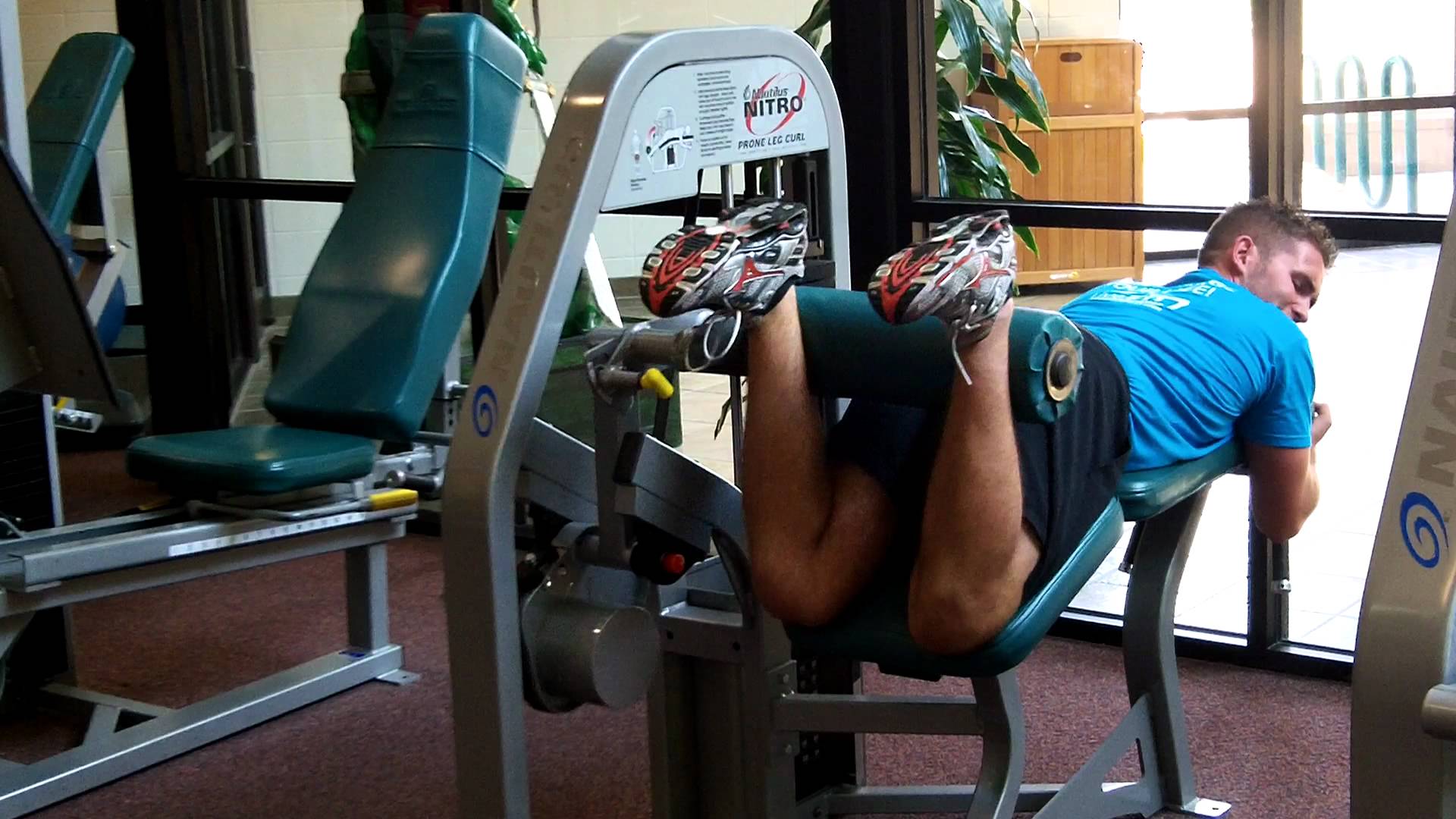
Ever walked through the weight room at your local fitness center and wondered how several of the stranger-looking machines operate, or even what muscle groups they work? No matter how beneficial a particular exercise might be, we normally don’t like to change things up. That is, until said exercise becomes the next big thing “everybody’s doing.” But until then, like awkward gym machines we won’t go near, many Christians avoid any spiritual exercises other than the common standards, if for no other reason than the common is what we’re comfortable with.

I'm not sure I'm in this thing correctly.

I’m not sure I’m in this thing correctly.

But there are others, and maybe 2015 is the year to move your “quiet time” out of your comfort zone. For starters, try silence. Not inaudible praying – just being silent. Close your eyes, take deep breaths, slow everything down. Imagine God’s Spirit flooding your body like a deeply inhaled breath, sanitizing the spoiled places and purging the pessimism from your mind. Or, what about praying through a psalm? Not studying Psalm 25 in order to grasp the historical significance or interpret it according to modern life, but simply allowing it to be your prayer. Read through it every day, reflect on it in the car, whisper the words again at night. Let those ancient words fall anew upon your own life. You might be surprised how eye-opening and world-enhancing such an exercise can be.

And, if these quiet exercises only make your eyes heavy, you might consider just getting more sleep to be a worthwhile addition to your spiritual exercise regimen. Mind and body are linked (Matt. 15:18-19). That means, among other things, if you neglect the health of one, you won’t truly experience wholeness with either. In truth, spiritual disciplines do not begin with opening your Bible, just as physical exercise doesn’t begin by climbing onto the elliptical. No, you have to make time for exercise, and that is a discipline in itself. Stop sacrificing rest, and commit to saying “No” to some things in order to eliminate some of the hurry and stress in your life. Creating plenty of space for spiritual exercises is just as important as the exercises you do.

"Let's see. If I check all my e-mails on my phone during the 9 AM staff meeting, and respond to texts during the 10:30 presentation meeting, I might be able to squeeze some silence in before that early lunch with..."

“Let’s see. If I check all my e-mails on my phone during the 9 AM staff meeting, and respond to texts during the 10:30 presentation meeting, I might be able to squeeze some silence in before that early lunch with the clients from….”

#2 – Embrace the Resurrection

“Religion is the sigh of the oppressed creature, the heart of a heartless world, and the soul of soulless conditions,” Karl Marx famously wrote. “It is the opium of the people.” Echoing his sentiment, science-fiction novelist Robert A. Heinlein wrote, “History does not record anywhere a religion that has a rational basis. Religion is a crutch for people not strong enough to stand up to the unknown without help.” Even more recently, former Governor of Minnesota, Jesse Ventura, stated, “Organized religion is a sham and a crutch for weak-minded people who need strength in numbers.” Ouch!

I'm just going to leave this here.

I’m just going to leave this here.

Oh, we poor, pitiful religious people! Oh, we sorry, senseless Christians! We are not brave enough to face reality, too fearful to relinquish our irrational beliefs in the supernatural. Time and again, we stare into the sad unknown of death and loss and renew a preposterous belief in some magical continuation of life after death. What cowards we are!

Toward the end of his first letter to the Corinthians, the Apostle Paul writes, “If the dead are not raised, then Christ has not been raised. If Christ has not been raised, your faith is futile… If for this life only we have hoped in Christ, we are of all people most to be pitied.” (15:17-19) For Paul, the Christian’s hope hinged on the resurrection of Jesus, whom he referred to repeatedly as “the firstborn from among the dead.” Of course, a “firstborn” denotes there are others laterborn, and Paul insists these are the ones who place their hope in Jesus. Indeed, the paramount reason the Christian Church established itself back in the first century wasn’t simply the joy of getting their sins forgiven, but because they believed Jesus had physically risen from the dead, and, in so doing, had set in motion a long-unfolding fulfillment of God’s promise of resurrection and the restoration of all creation.

Unfortunately, with the Enlightenment and the subsequent eras of modernity and postmodernity, it became harder for people to accept such an outlandish, irrational event as a bodily resurrection. People don’t rise from the dead unless they’re in a George A. Romero flick. Such philosophical insistence, combined with the abiding assumption of a Platonic existence in which body and soul (assuming there even is something like a soul at all) are separate, disparate entities, seeped into human thinking everywhere, including the Christian Church, and throughout the nineteenth and twentieth centuries it became more and more common to imagine heaven as an otherworldly haven for disembodied souls, not as a radical renewal of all things, humanity included.

Who needs a restored, perfected Earth when I've got my own personal cloud?

Who needs a restored, perfected Earth when I’ve got my own personal cloud?

As such, Christian hope has weakened, and fear of death and what, if anything, comes after has increased. More and more Christians are uncertain of what to make of the resurrection of Jesus, as well as the promise that what happened to him would also come true for us. No wonder skeptics, atheists and nihilists consider religion, particularly Christianity, to be nothing more than a crutch for the weak-minded. Did not Paul insist that if Jesus wasn’t raised from the dead, we are to be pitied more than anyone? To people who don’t believe in resurrection, we must look pretty ridiculous!

But what would happen if Christians threw off the constraints of naturalism and Neoplatonism and returned to the actual claims of Scripture? What if you chose to make 2015 the year you embraced the resurrection not as some mysterious doctrine but as a historic and earth-shaking reality that infuses the present with meaning. Every act of kindness, every charitable effort, every declaration of your Christian faith – God can and will use it in his work of restoration, which, according to Scripture, will one day be completed when Christ appears again.

For many people, living “in light of heaven” has come to mean enduring unhappiness and hardship because they believe they will one day be removed from this corrupt world. It’s time to reclaim that phrase – to live in light of the resurrection, in which heaven and earth are ultimately joined, and our world will be restored to the beauty and peace God always intended – and allow it to motivate us to faithful service in this life. As a great American hero, Maximus Decimus Meridius, once said, “What we do in life echoes in eternity.” His words are themselves an echo of the Apostle Paul, who reminds the Corinthians, “Be steadfast, immovable, always excelling in the work of the Lord, because you know that in the Lord your labor is not in vain.”

Are you not cross-referenced?

“ARE YOU NOT CROSS-REFERENCED?”

#3 – Lean in to Your Church

The thing about spiritual transformation is it is more likely to happen in community than in isolation. There is something about interacting with fellow believers that truly helps to fortify a lot of the virtues that begin to emerge when we engage in spiritual exercises and embrace the coming resurrection. We need others to help us identify the fruit we are bearing, as well as the fruit that has not yet appeared. It’s not about comparing ourselves against each other, but rather understanding each other. When the New Testament speaks of concepts like salvation and sanctification, it is almost always referred to in a communal context over a merely individual one.

But this isn’t brand new information. Even amidst a growing “Jesus and me” mentality in Western culture, the majority of Christians are not so naive that they have completely written off the importance of their local church. For them, the issue isn’t recognizing that their church community is valuable, but how exactly they are supposed to interact with the people there.

Pictured: the wrong way to interact with church members.

Pictured: The wrong way to interact with church members.

This is the point where the good and faithful minister in me wants to say, “Serve.” Get plugged in and get to work, of course! Service is a discipline, and it is also the proper response of one who holds a renewed hope in God’s restoration of his creation. A church community lives or dies based on how dedicated its members are to serving one another. And yet, I’m beginning to realize that service is neither the objective nor the goal of Christians’ activity in the church. While many pastors and many church programs make service the focal point, being a servant to your fellow believers is really just a by-product of something else.

Love.

Before turning to the subject of resurrection in his letter to the Corinthians, the Apostle Paul first addresses the myriad problems prevalent in that church. His solution does not stop at encouragement to serve one another. He takes it much deeper. He advocates for love. After twelve chapters of pointing out disunity, moral failures and status worship, Paul’s letter comes to a head when he writes, “I will show you a still more excellent way.” What follows is his famous poem on love, found in chapter thirteen. While the words have become a syrupy staple of weddings both Christian and secular, Paul never meant for them to be divorced from the rest of his letter. No, he meant for them to answer with finality the question, “How should I act within my church?”

"If I give away all my possessions, neglecting to register at Target and Macy's, but have not love, I gain nothing."

“If I give away all my possessions, neglecting to register at Target and Macy’s, but have not love, I gain nothing.”

Be patient and kind. Don’t act full of yourself, and don’t speak that way either. Don’t insist your ideas are best, nor celebrate when others’ ideas blow up in their faces. Be a picture of strength, faithfulness, indomitable hope and perseverance. If you’re committed to living this way, serving of others will not be something you must choose to do. It will take place naturally. As Rich Mullins once said, “If you’re a Christian, ministry is just an accident of being alive.”

This year, if you choose the way of love in your local church, you may very well find you’re not the only one who bears fruit. Once you considered yourself a solitary tree, but it turns out you were planted in an orchard all along.

Where did all you guys come from?

Where did all you guys come from?

So, there you have it. Three simple decisions – one of faith, one of hope, and one of love – that can have profound impacts on your life in 2015. Now two weeks into the new year, many of us are already struggling to adhere to the resolutions we made. If and when those crumble away, why not replace them with three aims that will work in you a greater change than you could have ever anticipated?

Happy 2015!

Style Points: The Gospel According to NCAA Football

Yes, you read that title correctly. I’m about to uncover biblical truth within college football. Hold on to your hats (or big foam fingers)…

If its a Florida State finger, enjoy it for a couple more days.

If it’s a Florida State finger, enjoy it for one more month.

We find ourselves approaching a turning point in college football. This is the first year of a college football playoff system for Division I football, in which a twelve-member committee, composed of current and former university athletic directors, former coaches, administrators, a professional athlete, a reporter, and a former Secretary of State, wields the power to choose four Division I college football teams they believe to be the creme de la creme de la conferences to play for a national championship. Their preliminary selections over the past month have stirred much controversy, as some teams feel their successes and talents have been unfairly ignored by the committee members who seem to reward the almost identical successes and talents of other teams by ranking them in the top four spots.

The committee’s chairperson, Jeff Long, has been pressed to defend the selections by highlighting certain factors the committee believes to be the most impressive qualities of a team. In press conferences, he has gone on about two things in particular: game control and style points. Simply put, game control refers to a team’s ability to maintain a comfortable lead throughout the game, preferably by at least fourteen to twenty-one points. And the second is related to the first. Style points refers to when a team is able (and willing) to run up the score so their win will seem like total domination, because apparently the College Football Playoff selection committee is taking their cues from Sensei Kreese.

Mercy is for the weak.

Mercy is for the weak.

And so, that’s what’s being talked about now by game commentators, radio hosts, reporters, and, of course, fiercely loyal fans. It is no longer good enough for the team you root for to win. They must win big, and that big win must never be in doubt. Otherwise, they cannot be considered one of the best teams. It used to be impressive for a team to win the majority of its games, and perhaps even claim their conference championship. But all of a sudden there is a new dimension necessary for those teams angling to be considered the best. Not only must they score more points than the team of talented athletes lining up in front of them week after week. They have to score enough points to effectively gain the praise of twelve specific people.

Don’t look now, folks, but this playoff selection committee has ruined college football as we know it.

That is not hyperbole, and it is not sarcasm. I’m completely serious. I truly believe that the sport so many of us have loved all our lives has taken a turn for the terminal. Not because the committee is corrupt, or their system is illogical, but because they’ve surgically removed nail-biting excitement and edge-of-your-seat tension from games that we used to hope would play out exactly that way. Those were the kinds of games we enjoyed watching the most! The back-and-forth battles in which game control shifted as dramatically as a playground seesaw. The down-to-the-wire finishes in which one set of players triumphantly rushed the field while the other set lowered their heads under the combined weight of exhaustion and defeat.

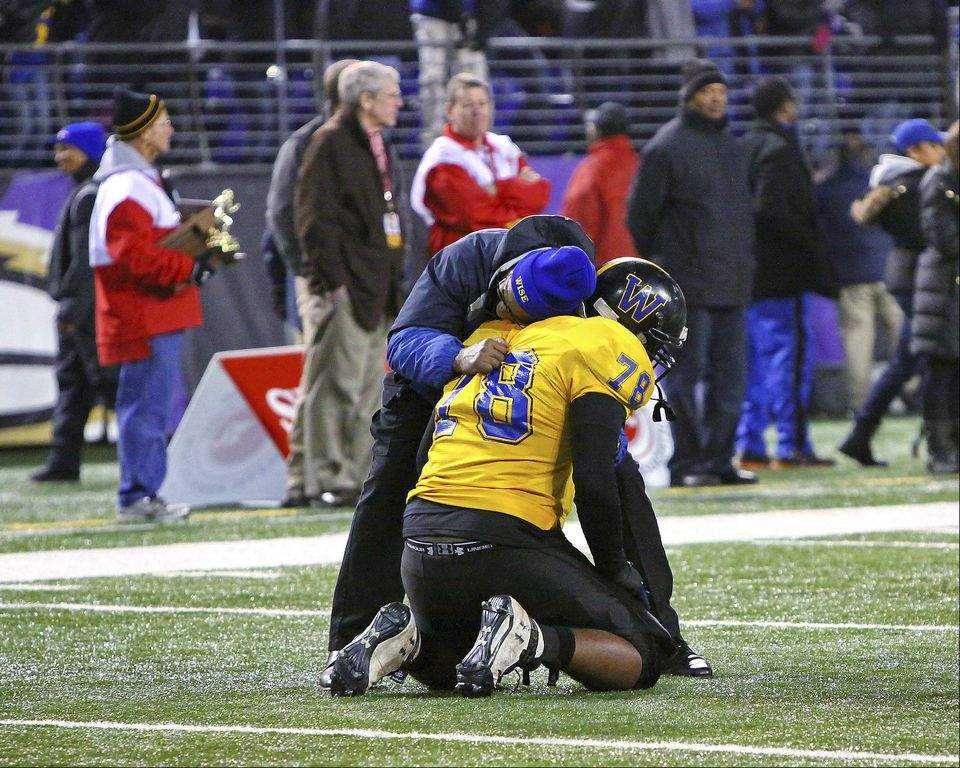
I sure hope a photographer isn't taking a picture of our misery.

I sure hope a photographer isn’t taking a picture of our misery.

If I had to choose the most entertaining bowl game I’ve watched in my lifetime up until now, I would easily choose Boise State versus Oklahoma in the 2007 Fiesta Bowl, but it wouldn’t be because Boise State won and I was rooting for them. It would be because that game was extraordinary: a David-and-Goliath match-up that, unlike the biblical story, went back-and-forth with each team claiming and then losing the lead on incredible, gutsy plays… and that was in the fourth quarter alone! Boise State finally won in overtime, 43-42, on a perfectly executed Statue of Liberty play for a two-point conversion (which means rather than easily kicking an extra point, they took the risk of either winning or losing the game on one trick play).

Those games, at least in regard to significance, are quickly going the way of the buffalo.

Not that Buffalo.

Not that Buffalo.

Oh, sure, we might still see something like it in a bowl game, when there is nothing to be gained from impressing the committee after the regular season is over. But consider the fact that endings like the one I described, as extraordinary as they are, have now been deemed unimpressive, especially when compared to a team that blows out its competition 43-0. Wins that come with great difficulty may be respected, but they are no longer proof of a team’s strength. This is what the College Football Playoff selection committee has already imparted to us, and I don’t like how easily I’ve conformed to their views.

For instance, last Saturday, I watched my favorite team, the Baylor Bears, white-knuckle a 48-46 win against one of their rivals, Texas Tech, who played with such desperate passion the team reminded me of a certain Fiesta Bowl champion from 2007. Baylor never trailed in the game, but ended up having to make two clutch defensive stops to prevent the Red Raiders from pulling off the upset. It was the kind of game I used to love watching, especially if the team I was rooting for ended up on top as Baylor ultimately did. However, for the last quarter and a half, as Tech mounted an improbable comeback, I was aware of a deep-seated anxiety rising within me. Not only had I become angry at my team, but that frustration lingered long after time expired. Baylor was currently ranked #7 by the playoff committee, three spots shy of that privileged top four, and I knew grinding out a two-point win over an inferior team was not going to rouse even one shred of admiration from the newly appointed supreme court of college football. So, despite a wild game that ended with a Baylor victory, I was left feeling disappointed and nervous for how their performance would affect their ranking.

And that was when I knew that college football, as I knew it, was over.

When all you care about is style points, you’ve lost sight of what the game is really about. If a genuine show of vigor from the opposing team is now only evidence of your own team’s mediocrity (rather than natural competitiveness between two forces that transcend statistics and rankings and the opinions of thirteen people in a boardroom), you have been led astray by a sports heresy. This is Neopelagianism on the gridiron.

Modeling next season's new uniform styles.

Modeling next season’s new uniform styles.

And this is where God comes in.

If the travesty currently befalling college football has taught me anything, it is that game control and style points have no place within the Christian faith. While Jesus called us in the Sermon on the Mount to “be perfect as your heavenly father is perfect” (Mt. 5:48), he left out any condition that said being perfect was the only way to get God’s attention or something you have to do in order to garner acceptance and praise.

For years, I tried to live my life as if game control and style points were what mattered most. I tried to live in such a way that my good behavior, faithful prayer life, regular church attendance, and increasing understanding of the Bible would get God to notice me and, in turn, bless me. I read ridiculous books like The Prayer of Jabez that essentially told me I had to pray for certain things a certain way if I wanted to get the good blessings God had to give. Much like the playoff selection committee, I felt what mattered more than anything (particularly those incremental improvements and small victories) was my “full body of work.” Had I done enough to impress God? Enough to warrant his favor and earn his endorsement?

And when the losses came (as they inevitably do), I was my own worst critic, a diehard fan who boos and jeers his own team. Those away games when I fell short of obedience, and those shocking defeats when the opposition exposed my weaknesses – they cultivated nothing but shame and self-loathing, a reminder that I would never be good enough. I would never be the kind of man I wanted to be.

In reality, it doesn't matter how hard you play. A loss is a loss.

In reality, it doesn’t matter how hard you play. A loss is a loss.

Sadly, there are a lot of Christians today who are still slaves to style points. They may call God full of grace and love, but, by the way they live their lives, they reflect a belief that he is as capricious and fastidious as a thirteen-member playoff selection committee. For them, grace, mercy and compassion have become nothing more than hollow, ineffectual terms relegated to Sunday School classes and hymn books. They have no place in the “real world.”

But the God I believe in – the God of the Christian faith – is full of those things. He looks upon us with kindness, forgiveness and generosity.

We don’t always live in control of our lives. In fact, most of the time we feel like life is a down-to-the-wire nail-biter, where anything can happen. Style points are a mythical luxury we are incapable of claiming. Praise be to God that grinding out a win is considered as virtuous as blowing out the other team. Even greater praise be to Him for sending his son to be the victor for us – to put the game out of reach and rack up more style points than we will ever need.

Do You Have Time for a Quiet Time?

This is the final post in a five-part series on the problems with keeping a personal, daily “quiet time.” Click herehere, here and here to read the previous installments.

I have not written on this blog in quite a while. I blame the world, but I know it is my own fault.

The thing about living in a world that everyday seems to spin a little quicker on its axis is that unless we’re willing to be mindful of our time, time will pay us no mind at all. I can blame the world, but that means I must also blame myself, because seeing myself as the center of the world is my default setting. And, like the world, my life is pitched forward into a swirling sea of stress, hurry and expediency. Sometimes I feel like I’m plunging down the slope of a ravine – not so much running as barreling headlong, with a point of collision racing to meet me.

rod-falling_366239_GIFSoup.com

The older I get, the more I seem to feel this way. Now, five days shy of thirty-five, I feel as if I would do anything to slow my pace, to reach out and grab hold of something stationary in a desperate attempt to slow my rate of descent.

The previous four posts were born out of a lingering, nagging concern that I have spent too many years going about this whole “quiet time with God” thing all wrong. As I’ve already mentioned, I grew up in a church culture that placed an incredible amount of emphasis on keeping a personal devotional time with God; unfortunately, though, it did not produce many leaders and teachers who knew how to properly shepherd a young person in such a commitment. As I got older, I found that some of these leaders were dealing with their own quiet-time struggles, others weren’t sure how to go about expressing their own methods, and still others never really practiced any of the disciplines they preached. When I first stepped into the life of a minister (specifically, the life of a youth minister), there were times when I typified each of these lifestyles.

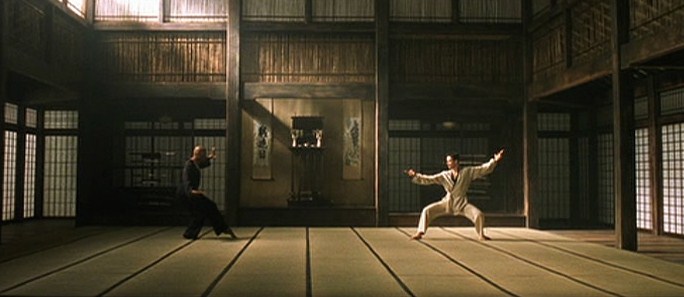
And now, despite still being referred to often as a “young man” by many a member of my church, I recognize that I am a full-fledged adult. And I have had to declare false the assumption I and so many other kids had throughout our childhoods that once we crossed that ill-defined developmental Rubicon into actual adulthood we would understand all those mysteries that so irked our younger selves. There is no instantaneous “I know Kung Fu” moment for us. Very little of the why’s and how’s in this life are received fully realized. We must learn them. And if we are to truly retain what we learn, we must practice them.

The world is our dojo.

The world is our dojo.

I was talking to a gentleman in a bookstore the other day who was telling me about teaching his thirteen-year-old son how to build a simple pair of shelves. He wanted his boy to learn some of the same skills that had been handed down to him from his own father. As they worked, the man asked his son if he agreed that it was important to learn skills like building shelves and basic construction. His son replied, “Isn’t that what Google is for?”

We are all moving so fast, faster than fifty years ago and faster even than fifty days ago. And rather than inventing things that might slow us back down even a little, instead we improve on tools that can keep pace with us. We microwave our food, order coffee from drive-thrus, and pay an annual fee to Amazon.com just so we can receive our purchases a couple of days sooner. We text more than we call, and we call more than we sit down together. We have multiple e-mail addresses, but haven’t sent a handwritten letter in decades. Why? Because we have little, if any, time to spare.

My dearest Helga, I would have thrilled to send you this humble correspondence, but you wouldn't believe how much stamps cost these days!

My dearest Helga, I would have thrilled to send you this humble correspondence, but you wouldn’t believe how much stamps cost these days!

In an age of convenience the likes of which we have never seen before, we are more rushed, more stressed, more frazzled, more impatient, and more inattentive than we have ever been.

Don’t get me wrong. I appreciate quite a few of these conveniences. I like that I can get an answer to a question from Google that used to be reserved for the reference section of my library. I’m embarrassed, though, that I cannot tell you what any section of my neighborhood library looks like. I appreciate that I don’t have to wait until 7 PM to find out the latest news of the world. I’m wearied, though, by how long I can stare at CNN despite knowing in thirty seconds they have no new information worth reporting. I love having thousands of movies and television shows available at the click of a button. I’m mortified that sometimes, when a somewhat long-winded person is talking to me, I feel an unmistakable desire to fast-forward, as if the conversation was stored in my cable’s DVR.

What does all this have to do with spending time with God?

Simply that, despite a million little conveniences designed to save us time, we usually find ourselves unable to offer God any of it. We’re sleeping less as a society, so waking up a little earlier has become a sacrifice too great for some. Lunch breaks are often taken at our desks rather than in an office atrium or the park across the street, and the average mealtime has dwindled from one hour to fifteen minutes. And what about the end of the day? I don’t know about you, but by the time I get my two preschoolers to bed in the evening, I feel as if I’m running on fumes. Even if I were to give God that hour or so before my own bedtime, would he really be getting the best of me?

"Do you have any devotional Bibles that are shaped like pillows?"

“Do you have any devotional Bibles that are shaped like pillows?”

Should it really be this difficult to cut an hour, or even thirty minutes, out of our daily schedules so we can spend it with God?

Realizing the difficulty of this leads me to a recognition of something else. According to Scripture, what God required of his people was not thirty minutes per day, or an hour here and there during the week. Smack dab in the Ten Commandments is a decree that God’s people would devote an entire day to him. They would honor him by putting aside every effort toward productivity, and instead be present. The Sabbath wasn’t something crammed into a daily planner; it was a sacred period of time, declared “holy” because it was set apart from the rest of a week so diligently focused on labor, development and output.

The Sabbath was a time to rest, and growing up I thought that meant the Israelites had built into their weeks a day to sleep-in and take a nap, like some sort of super-siesta at the end of each week. It wasn’t until later that I realized what the Sabbath was really about. I re-read Jesus’ statement, “The Sabbath was not made for man, but man was made for the Sabbath,” and it occurred to me that the “rest” referred to in the commandment was more about being present and being still than it was about catching up on sleep. The rest God desired for his people wasn’t so much about replenishing energy from all the work that had sapped their strength as it was about taking stock of the glory that lay behind the work itself. Just as God “rested” on the seventh day of Creation, surveying all he had made and declaring it good, so also he wanted his children to avoid getting so caught up in production that they failed to marvel at their God-given ability to produce anything at all.

How else would we be able to deal with all the messes that happen on day 8?

How else would we be able to deal with all the messes that happen on day 8?

I recognize this – a decree so important it was cooked into the center of the Torah’s Ten Commandments – and I shake my head at how meager a thing it is to scrape and strive to spend a full hour with God every day. I mean, hey, if that hour is life-giving for you, and you walk away feeling in deep communion with the Holy Spirit, then more power to you. But if you have been striving for years to commit an hour – or even a half-hour – to God only to feel more wearied by, or disappointed with, your quiet time, maybe your real problem isn’t how you’re spending that hour. Maybe the problem is how you’re spending the other twenty-three.

I haven’t been able to write on this blog in more than a month not because I’ve been too busy, but because writing on this blog has unwittingly tumbled down multiple notches on my priority list. Trying to reestablish a beloved and life-giving activity to the top of your priority list – even a time for communion with the Creator of the universe – can be as difficult a thing as Baylor trying to get the College Football Playoff committee to notice them after losing to West Virginia in October.

34 points? Is that all?

You beat Oklahoma by 34 points? Is that all?

The more we pack into our lives, the harder it becomes to manage, organize, and prioritize those things. Growing up, I was warned about all the dark, ungodly temptations that lay in wait for me out in the world. What I’ve found is most of the temptations I face are not ignoble vices, but noble endeavors. Most of the things we fill our time with are good things. There is nothing wrong with productivity. There is nothing wrong with success. There is certainly nothing wrong with hard work. But like the workers in the vineyard who become incensed at receiving only a standard daily wage for their day’s worth of labor, the majority of us have lost sight of the truth that what matters even more than being productive is the ability to be present and still and thankful before a holy and generous God – a God who wants much more than mere hours of our weeks.

After many years already, I have come to realize what this means for me. It means I have to scale back. I have to simplify. Not Thoreau, “I went to the woods because I wished to live deliberately” simple, but I need to at least be more mindful of my priorities, and faithful to maintaining that list. Maybe I’m not the kind of person who can wake up at 5 AM to spend quality time with my Creator. That means I mustn’t allow the rest of that day to be so chock full of tasks and duties and responsibilities that I am either exhausted or perpetually distracted, unable to live in the present. If I constantly find myself arriving somewhere with no time to spare, or several minutes late, I should consider what tasks (or distractions) force me to depart late. If it seems I am often anxious, or unprepared for meetings, I must reflect on how many other concerns I allowed to pull and tug at me during that day. The more I have to think about, the less I can think.

If every day you blame your tardiness on traffic, that's the same as saying, "I have no short-term memory."

If every day you blame your tardiness on traffic, that’s the same as saying, “I have no short-term memory.”

It is going to take sacrifice, and tenacious attention to the undercurrent of our lives. It is going to mean severing ties with some responsibilities that don’t measure up to a revitalized priority list. It is going to mean a lessened focus on being productive in a world that demands productivity above most everything else. Until we slow ourselves down, we will never truly experience the kind of joy God desired for his people. But, once we do, quiet times become simply a happy accident of being alive.

Our hard work, ambition, and efficiency are not the problems. But our “love” of them (i.e., enslavement to them) are. The good news is Christ came to set us free from a yoke of slavery. The shackles have been broken, and the cell door stands open. The choice to walk out into a free and open world is up to us.

Has Your Quiet Time Become a Burden?

As I close in on the end of this series about daily quiet times, I feel the need to address a particular concern.

I recognize that much of what I have written in the last few posts regarding traditional quiet time methods has been primarily cautionary and negative. I haven’t written much about the benefits of keeping daily quiet times, but focused almost exclusively on the pitfalls and problems of them. The last thing I want is for my readers (meaning you) to think I am advocating for the abolishment of personal quiet times.

Because I’m not.

I am, however, troubled by what I see as rampant naiveté in many Christians’ lives when it comes to the keeping of a personal “time with God.” As my previous posts have pointed out, we often go about these times all wrong. Either we force ourselves to keep certain disciplines that our personalities, thought-processes and specific backgrounds naturally oppose, or we treat our devotional exercises like corporate grunts dutifully paying our dues in order to attain a promotion.

"Well, Mr. Bowen, you seem like a hard-worker, but we find it discouraging that you only have 5 psalms memorized. You need at least 25 to be upper management material."

“Well, Mr. Bowen, you seem like a hard-worker, but we find it discouraging that you only have 5 psalms memorized. You need at least 25 to be upper management material.”

So, before I leave behind the negative aspects, let me offer one more note of caution. While any time spent with God comes with an element of sacrifice (because, c’mon, there’s always something vying for our attention besides God), the goal of a quiet time is not to fix us up into a more presentable version of what a Christian should be. The various exercises and disciplines inherent in a daily devotional time don’t fix us at all; what they do is open us up for the Holy Spirit to enter our hearts, minds, and souls and do his work, in his way, according to his timing. It’s like taking your car for regular tune-ups. Your main role is to hand your keys over to the mechanic – he doesn’t need you rolling under there with him and giving him advice on what needs to be done.

Maybe get some newer magazines in your waiting room if you don't want me bugging you!

Maybe get some newer magazines in your waiting room if you don’t want me bugging you!

The work of the Spirit is key to grasping the purpose of a quiet time with God. As I wrote in a previous post: “A quiet time is meant to undergird one’s relationship with the Lord. We don’t do it so God is obligated to transform us. We do it so that his Spirit might find our hearts and minds opened to his guidance and provision. It is an expression of loyalty and love, not a set of daily chores.”

And yes, I’m aware I just quoted myself there. I’m as disappointed as you.

But let’s face facts. Three-weeks-younger Bo was right. God knows us better than we know ourselves. Therefore, he knows what to transform in us – and how to go about that transformation – better than we do. This being the case, when it comes to quiet times, sometimes “less is more.”

Well, not THAT much less.

Well, not THAT much less.

There came a point in my own struggle with keeping a quiet time that I began to question not just the method itself, but the individual value of each element. As I’ve stated before, the method that was promoted to me growing up consisted of a time of prayer, Bible study, Scripture verse memorization, and journaling. Time and again, this structure was referred to as the most comprehensive and beneficial method a young Christian could adopt. For me, though, the problem wasn’t only that this arrangement of specific exercises clashed with my natural inclinations and preferences for communing with God. It was also that I couldn’t help corrupting each individual exercise until they became hollow, futile and self-centered pursuits.

When it came to prayer, I quickly progressed from not being sure what to pray, to praying for just about everything and then feeling guilty later when I remembered things I had neglected to pray for. Consequently, I began keeping an extensive list of prayer concerns – friends who didn’t follow Jesus, family members in the hospital, church members who were struggling with some problem or another, friends of friends who were in need, the church leadership, the local community, the country’s leaders, world events, third-world strife, unsaved people groups… The list grew and grew and grew, until it not only morphed into a rote list of problems I wanted God to solve, but also became a terrible drain on my time and energy. I began to dread my prayer times, because after I finally spoke my “Amen,” I did not feel refreshed. I felt exhausted, empty.

"Seriously, these are natural. If you don't believe me, take a look at my prayer list."

“Seriously, these are natural. If you don’t believe me, take a look at my prayer list.”

As for Bible study, I did the best any young person unfamiliar with commentaries and Bible dictionaries could do, trying my best to understand what I was reading. Sometimes it was Psalms, Acts, or Philippians, and this was not so difficult. Other times, though, I’d try to get my mind around a passage in Ezekiel, Daniel, Hebrews or Revelation, only to end up shamefully shrugging my shoulders and assuming that I’d eventually break through to a deeper understanding that would accommodate such perplexing writing.

Besides, my goal wasn’t contextual comprehension, but rather the drawing of modern-day applications from the text. My focus was, What can this passage mean for meNo one ever told me I should concern myself with the historical context, the nuances of the language, or the original purpose of a story. There’s nothing wrong with looking into Scripture for personal direction, but if the entirety of your Bible study – both individual and in a group – is focused on personal application, you’re missing an incredibly intricate and rich tradition that carries a far greater purpose than helping you manage stress or know what kind of girl you should date.

"You're so Proverbs 31 and you don't even know it!"

“You’re so Proverbs 31 and you don’t even know it!”

And as my Bible study became more about me, so did my selection of Bible verses to memorize. I chose the ones that resonated with me, treating particular sentences with hardly more respect than fortune cookie aphorisms. To this day, I still use the little Bible I had when I was in high school, and every day I see verses highlighted in yellow – the ones I attempted to memorize a decade and a half ago. I’m not sure what motivated me to commit some of those sentences to memory. However, what bothers me more than my adolescent selectivity is that many of those verses were abducted from healthy contextual homes meant to provide sound interpretation.

For example, one of those verses I carried around with me, like a trimmed photograph inside a locket, was the second half of 2nd Corinthians 10:5, “…and we take captive every thought to make it obedient to Christ.” I remember quoting that one often, always regarding the importance to think before I spoke – lest I utter a swear and “hurt my Christian witness” – or felt an urge toward angry or lustful daydreaming. Unfortunately, while that probably is good advice, it wasn’t Paul’s intention when he wrote those words. He was referring to how we deal with heresy – that we examine all spiritual teaching in light of Christ, which was something the Corinthians were failing to do with the false teachers in their midst.

"Dear Corinthians, I'll give you something to memorize..."

“Dear Corinthians, I’ll give you something to memorize…”

And I shan’t forget how efficiently I corrupted the exercise of journaling. If drawing personal applications from my Bible study bordered on self-centeredness, what found its way onto the pages of my journals was downright narcissism. Writing down thoughts doesn’t always provide perspective and guidance like we might expect. Sometimes all we end up doing is indulging in either self-pity (Why am I so incapable of __________?) or self-advancement (Realizing _________ shows how awesomely God is blessing me.) Sure, there are certain journal entries I can look back on today as documentation of major life decisions and important new shifts in understanding, but they are hidden within a sea of pages full of overwrought self-reflection, all of which serves as evidence that I refused to heed one verse in particular: “Cast all your anxiety on him because he cares for you” (1 Peter 5:7).

There’s nothing wrong with journaling, setting down all your thoughts and fears on the page, as long as you have first relinquished control of those things to the Savior who reminds us that following him requires the denial of self, not the promotion of it.

"Blessed are those who keep diaries, for their sparkly pink pens shall never run dry."

“Blessed are those who keep diaries, for their sparkly pink pens shall never run dry.”

So, what’s the point of all this?

Simply that there exists no magic combination of exercises or disciplines that will make you into the kind of Christian you hope to be. There is no specific pattern or method that works perfectly for everyone. As we grow, learn, and mature, our personalities and interests and abilities shift in subtle yet profound ways. The way we interact with God has to grow and shift with that.

The good news is that the God with whom we seek to commune is abundantly merciful and infinitely patient. He doesn’t keep a short list of only three or four ways to connect with and inspire us. He is always with us – his Spirit indwells us, going where we go, whispering his truth throughout our days, whether we have our Bibles open and our highlighters uncapped, or we’re waiting in line at Chick-Fil-A.

Where real Christians go to love God and waste gas.

Where real Christians go to love God and waste gas.

I still have one more thing to say about personal quiet times – specifically about an actual biblical mandate for how to spend time with God – but I’ll save that for next week, and the final installment in this series. In the meantime, I encourage you to examine the things you do to commune with God and grow in his truth. Does it keep you grounded in his will and his sovereignty, or have you made it all about you? Don’t be afraid to change things up, because God’s fervent desire for a relationship with you never changes.

Is Your Quiet Time Turning You into a Pharisee?

This is the third post in a five-part series on the problems with keeping a personal, daily “quiet time.” Click here and here to read the first two installments.

Have you ever prayed to become a better Christian?

ManPraying

“Shh! If you say it out loud, it won’t come true.”

Well, stop it.

There’s no such thing.

Some believers are under the impression that a relationship with Jesus is meant to be an ever-increasing advancement – that the Christian life contains higher levels of capability and competence, like promotions within a corporation, and if we would just show up early, put in the work, and leave late, eventually we will climb the spiritual ladder. The worst part of this misconception is that a lot of new believers think that Christians who have attained these alleged higher levels don’t have to deal with the temptations and struggles that rage down in the mailrooms and custodial closets of faith. Up in the corner offices of Christianity are those who sit above all that stuff.

Sometimes we have to deal with this guy, though.

Though sometimes we have to deal with these weirdos.

While it is certainly true that we are meant to mature in our faith – to grow more trusting and find deeper reservoirs of strength – a relationship with Jesus is not about promotion. There is no such thing as “a better Christian.”

There are days when you may feel like you’re sitting high in that corner office of unchallenged commitment, but watch out, because before you know it, you may find yourself back down in the basement aimlessly sorting mail.

The misconception in Christianity that we can attain higher levels of faith is born out of a fear of failure. We don’t like to back-slide, to spurn our commitments and indulge in selfishness. So, we convince ourselves that there is some Rubicon within the Christian life – a point of no return that, if we can live obediently enough to reach it and cross it, we will never have to return to the laborious, unpredictable days of unripe belief.

"Actually, the crossing of the Rubicon signaled the start of conflict, not the end of it." - the Metaphor Police

“Actually, the crossing of the Rubicon signaled the start of conflict, not the end of it.” – the Metaphor Police

Of course, this belief drags several problems along with it. The first is that we can end up lying to ourselves about our spiritual health. If I believe in higher levels of the Christian life where fledgling struggles and beginner’s temptations no longer affect me, when those trials inevitably rear their heads, I may feel I need to pretend I’m not influenced by them. And, if I don’t end up lying to myself, then another problem I may encounter is self-devaluation. I will take my inevitable missteps and failures as proof that I’m incapable of attaining the higher levels, and will begin to hate myself (rather than hating only my sinful nature). Christians who continually deprecate themselves in their prayers and testimonies will find it very hard to accept the unconditional love of God.

But sometimes the biggest problem for people who believe faith is like a corporate ladder is that they can develop a sense of entitlement. If I am disciplined and obedient (to whatever predetermined extent), I deserve ______ from God. Some will fill that blank with recognition. Others, with particular blessings. Whatever it is, they unwittingly make God’s provision obligatory.

Several years ago, I found myself caught up in the throes of this third problem. So certain was I in the foolproof formula of a traditional quiet time that I truly believed my keeping it would rocket me upward into the stratospheres and ionospheres of faith. Maybe not right away – rocket boosters have to burn for a few moments before you see movement – but once I got going, “Houston, we have liftoff.”

"Corporations, the Rubicon, space travel! C’mon, Bo, pick a metaphor and stick with it!"

“Corporations, the Rubicon, space travel! C’mon, Bo, pick a metaphor and stick with it!”

But that feeling of incompetence continued, and after weeks and even months of seeing little difference in my attitudes and actions, I began to get angry. Angry at myself, but also angry at God. Couldn’t he see that I was trying? Didn’t he realize I was attempting to discipline myself? Why was he still standing far off? I was the lost son returning home – why wasn’t he running out to embrace me? Where was the party? Where was the fatted calf?

The only thing I knew to do, and was counseled to do by various church leaders, was to keep at it. God would show up, eventually. Read those Psalms, they told me; those folks had to wait on God, too, and they kept right on praying and praising.

The über-faithful could also rock a harp.

The über-faithful could also rock a harp.

And so, for years, I believed that strict adherence to a specific quiet time method would eventually result in some kind of breakthrough. I would wake up one day and my prayers would flow like a mountain river, the words of 1st Chronicles would suddenly become life-giving, and every sentence I wrote in my journal would be more profound than the last. Life itself would reverberate with meaning. Things would finally be easier. I would have reached that corner office, and all my present struggles and feelings of discontent would seem so small, so very, very far away. But that breakthrough never came.

Why?

Because my daily quiet time had morphed into devotion to a system rather than devotion to a Savior.

Without meaning to, I had become a Pharisee.

I really should grow a beard.

I really should grow a beard.

The if-you-will-do-this-then-God-will-do-that system of thought comes up time and again in Scripture, and time and again people get it wrong – the most famous example being the Pharisees of first-century Judaism. These people were the most influential sect of teachers, scribes and lawyers, and the ones who seemed to clash most often with Jesus. We often criticize the Pharisees for being legalistic and close-minded, and yet they appear to be the closest comparison to Christians in America today. In reality, among the people of the first-century, Pharisees were the most faithful students of the Scriptures. They were devoted to prayer and theological reflection, and they were adamant about the importance of an obedient lifestyle. Some of the most famous and gifted rabbis ever to arise in early Judaism were Pharisees.

The Pharisees believed strongly in the if/then promises of the Torah, and were careful to faithfully keep the “ifs” so that God might follow through with the “thens.” Several times, Jesus pointed out the main problem with this. The Pharisees had lost sight of the goodness of God, particularly the fact that he was even willing to offer promises to human beings at all. In so doing, Jesus informed them that they had fallen out of a real relationship with the God they so desired to please.

The irony was that the Scriptures – which they knew better than anyone due to such rigid devotional methods – are replete with reminders that what God is after is not a process, but a posture. In Psalm 51, David prays, “For you will not delight in sacrifice, or I would give it; you will not be pleased with a burnt offering. The sacrifices of God are a broken spirit; a broken and contrite heart, O God, you will not despise.” Long before Jesus came on the scene, the prophet Hosea bore witness to a sacrificial/devotional system that had lost all meaning, stating the people’s worship was “like the morning mist, like the early dew that disappears,” to which God responds, “I desire mercy, not sacrifice, and acknowledgment of God rather than burnt offerings.” In Matthew 9, Jesus tells the Pharisees they ought to take another look at Hosea, because no matter how ironclad the process might be, transformation is impossible without the right posture.

"Did that guy just give us a homework assignment?"

“Did that guy just give us a homework assignment?”

The Pharisees believed that God owed them something – that their status as God’s chosen people was not only based in history, but also sustained by their faithful keeping of the Torah. They believed their rigid loyalty to the Law of Moses had caused them to attain the higher levels. And so, they lived as if they resided in those corner offices of the faith. Jesus was disgusted with this sense of entitlement, as well as the fact that the Pharisees so often made life difficult for the mailroom clerks and custodians just trying to make ends meet spiritually. Those who had seemingly mastered obedience made no effort to help others with it.

There is no such thing as becoming “a better Christian.” And when it comes to quiet times, the most dangerous thing you can do is become a slave to a formula, believing dogged tenacity will accomplish the kind of spiritual growth you’re hoping for.

I will continue this series next week with an argument for why the traditional formula itself is faulty. However, may we be mindful of our motivations when we seek communion with God. In the same spirit as the Teacher’s advice regarding worship in Ecclesiastes 5, may we “draw near to listen rather than to offer the sacrifice of fools.”

Are You Doing Someone Else’s Quiet Time?

This is the second post in a five-part series on the problems with keeping a personal, daily “quiet time.”

We started doing something at my church recently that I think is incredibly important.

No, not that.

No, not that.

We enhanced our process for new members, not by adding more prerequisites to being one, but by inviting them to a carefully designed gathering in which we encourage them to recognize how their individuality should influence where and how they get involved in the church.

Some people know how to say no. But many others do not, and when ministers and lay leaders start getting desperate to fill spots in their volunteer base, we’re rarely concerned with whether or not someone is particularly gifted for those jobs.

"It's okay if you can't sing. We usually just move our lips while the tech guys play something from Hillsong."

“It’s okay if you can’t sing. We usually just move our lips while the tech guys play something from Hillsong.”

Unfortunately, that’s no way to find fulfillment as a church member. To be a disciple of Jesus means to surrender our lives in worship and service of our Savior. But it does not mean we are supposed to conform to one particular way of living out our devotion. God designed you in a unique way, with a compilation of emotions, inclinations, abilities, and interests that are all your own. Why would he want you to neglect this design plan in your relationship with him? If you want to be unhappy in your church, serve on a committee or in a ministry that does not utilize your gifts or jive with your personality.

The same is true for your method of quiet time with God.

When people come to me for advice because they feel dissatisfied or frustrated with their walk with Christ, the first question I ask is, “Are you attempting anything that isn’t you?”

"Well, Jim, for starters, it says here this translation is in the Transylvanian Saxon dialect of Romania, and you've never even traveled outside of Indiana."

“Well, Jim, for starters, it says here this translation is in the Transylvanian Saxon dialect of Romania, and you’ve never even traveled outside of Indiana.”

It took a long time for me to accept this as truth, but after years of discontent with the traditional quiet time formula handed down to me by my Sunday School teachers and youth camp counselors, I finally realized that what bothered me most was that the method didn’t stimulate my heart and mind according to the unique way God made me.

We’re all wired in a one-of-a-kind way. Sure, there are common practices and activities that the majority of us enjoy, and there are also common disciplines every Christian is expected to engage, but God is well aware that no two people are exactly alike. He designed us that way. We have differing personalities, our minds develop differently and at a variety of paces and speeds, and some things that interest you will never fascinate me. Moreover, we also grasp concepts in diverse ways, according to different stimuli, and a particular truth might not resonate with me at the same time or in the same way that it does with you, based on the variety of emotions, passions, and experiences we bring to the table.

Now, let’s take the truth about individuality to its logical conclusion. If it is true that God uniquely creates each person, then it is also true that every relationship between two people is also unique.

Checkmate.

Checkmate.

Anybody who has read a book on relationships can tell you that while some advice might have been helpful to his or her own relationship, not everything in the book was applicable. That’s because there is no perfect formula to a successful relationship. A relationship is not a binding contract; it’s a decision of intimacy between two individuals who, whether they are aware of it or not, bring their own ideas, ambitions, ideals and temptations into play. A healthy, successful relationship is an intentional and careful commitment to interact with each other’s idiosyncrasies, rather than denying their influence.

For example, my wife and I have a relationship that is unique to us. One of the things we’re still learning but know is important is not to force one another to speak or act in a way that is contrary to our designs. This doesn’t mean we don’t strive to connect with one another, nor does it mean I don’t adopt certain behaviors that support my wife and give her pleasure. However, pretending to be someone I am not is no good for Leigh, and vice versa.

How many times do I have to tell her that doing the dishes isn't my spiritual gift?

How many times do I have to tell her that doing the dishes isn’t my spiritual gift?

Now, if a quiet time is what a Christian does in order to experience a vibrant, intimate, and healthy relationship with God, then it stands to reason that conforming to a certain way of thinking, reading, and praying might not be the most beneficial way to deepen or strengthen that relationship. Just because God is a constant in the equation doesn’t mean each Christian must commune with him the exact same way. One of the most well-known statements of the late Brennan Manning’s is, “God loves you as you are, not as you should be, for no one is as they should be.” If I believe this, then the last thing I would want to do is pretend to be someone I am not in my relationship with God.

I love the looks on people’s faces when I suggest that, given their individual passions and interests, they might consider a solitary hike in the woods to be their quiet time, or gardening, writing poetry, even preparing a meal. Sure, the reading of Scripture is important and should not be neglected, but God is able to move in a million more ways than the standard methods so many of us so often conform to. Rather than slog through a formula that squelches your individuality, why not seek out the methods that stimulate your own peculiar composition?

As we continue in this series, I will cover the biggest dangers of conforming to a formula rather than creating one that works with a person’s God-given uniqueness. Above all, we should always remember that a quiet time should awake one’s soul, not burden it.

Is There Something Wrong with Your Quiet Time?

In a post dated August 5th, I promised to expound on the misconceptions of “quiet times.” This follow-up grew so lengthy that I feared it would put off even the most dogged of blog readers. I decided to break it down into five smaller posts, each detailing a major problem with keeping a traditional, daily quiet time. Here is the first installment of this series. 

young man reading small bible

A daily “quiet time” isn’t biblical.

Please don’t get me wrong – spending time with God is totally biblical. The Bible is filled to the brim with examples of people who intentionally spent time in prayer and individual worship, not to mention reflection influenced by the scriptures. However, at no point in the Old or New Testaments is there a clearly described plan for what we in the Church today refer to as a “daily devotion” or “quiet time.”

Though this is totally on the level! (he said with heavy sarcasm).

Though this is totally on the level! (he said with heavy sarcasm).

Now, when I refer to keeping a personal Bible study and prayer time, I am referring to a genuine desire to spend time with the Creator and invite his Spirit to transform your life, bit by bit, inch by inch. If, however, you are the kind of person who keeps a quiet time out of obligation and cold compliance, it is safe to say you’ve already got the whole endeavor backwards. (More on that in a later post…)

So, how dare I insinuate that a daily quiet time isn’t biblical?

It’s not to argue against the value of a quiet time, but rather to dispel the myth that keeping one is an explicit command found in Scripture.

"Commandment 11: Thou shalt give Oswald Chambers's MY UTMOST FOR HIS HIGHEST to every graduating high school senior..."

“Commandment 11: Thou shalt give Oswald Chambers’s MY UTMOST FOR HIS HIGHEST to every graduating high school senior…”

First of all, let’s look at the individual parts of a standard quiet time. (I am going off of the allegedly tried-and-true formula passed down to me by many a Sunday School teacher and youth camp leader when I was growing up).

  • Bible study – Let’s ignore the fact that the closest thing ancient and first-century Jews had to devotional books was Rabbinic midrash; it would have been nearly impossible for common folk living in either testament’s time to engage in personal Bible study as we know it today. While we have evidence that portions of the Oral Tradition was written down as early as the second millennia B.C., it wasn’t like these writings were available to common folk. Thus, the Jewish people are reminded many times in the Pentateuch that Scripture (specifically the words and acts of God to his people) was not something to be studied over time, but intrinsically remembered. Which brings us to the second component…
  • Scripture memorization – This discipline was actually quite prolific. As Judaism developed its educational system, the core curriculum was the memorization of the Torah, and for those who progressed into higher levels of training, it expanded to rote learning of the entire Hebrew Bible. This is one of many aspects of Jesus that is so fascinating. While he showed a phenomenal, interpretative grasp of the scriptures and taught with a level of authority that suggested deep advancement within rabbinical training, he is also derided as a country bumpkin and the son of a blue-collar worker. Given the importance of scripture memorization to the general public back then, my own struggle to commit to memory two measly verses from Ephesians seems pathetic by comparison.
Is that the best you can do, Jimmy Gourd?

Is that the best you can do, Jimmy Gourd?

  • Prayer – The question isn’t whether the people of the Bible prayed, but how many of them compartmentalized their prayer lives into one specific time of day. Not many. For one thing, it was Jewish custom to pray at multiple times during the day, publicly or privately as circumstances dictated. Secondly, we are reminded several times by NT writers that one’s prayer life should be unceasing – that we pray continually throughout the day, rather than in one pre-determined time. This wasn’t a radical new teaching, but simply a return to the kind of faithfulness implied in the Law, the goal of which was deep communion with God.
  • Journaling – Most of us are aware that very, very few biblical heroes had access to writing materials with which they might accomplish this part. A chisel and stone, maybe, but papyrus was pretty hard to come by. Sure, the Jews had been writing things down for centuries, and Peter, Paul and the apostles were able to write letters. But always having a Mead notebook at the ready has been a luxury reserved only for the last century’s worth of Christians. Perhaps this is why Jesus wrote in the dirt – it was readily available.
Rich boy.

Rich boy.

To sum things up, what we find in the Bible is that the children of Israel – and, later, early Christians – are commanded to remember the laws and stories, and to pass them on to future generations. Scripture, therefore, was not just a self-improvement tool, but a living, definitive history that enveloped the nation. Even before it was written down for a select few to access, there was a deeply communal aspect to the receiving of Scripture. This is something I never considered when I used to sit alone in my room trying to come up with modern-day applications from 2nd Chronicles.

So, how does this reality shed light on why and how we engage in a quiet time? Simply that what Scripture encourages is a regularity and an intentionality to a person’s Bible study and prayers. It does not insist on a set pattern. Sure, the ancient Israelites had a very strict set of regulations for temple sacrifice and worship, but those constraints didn’t carry over to the disciplines of prayer and reflection. These balls were left in the court of the worshipper, to not neglect but go about in a humble, authentic manner. This is why we can read the Psalms today and recognize a great variety of expressions to and about God. Because no one was requiring one particular method of devotional articulation.

"You call that a psalm, son?! I only count three metaphors! What would your Uncle Asaph think?"

“You call that a psalm, son?! I only count three metaphors! What would your Uncle Asaph think?”

If you feel your quiet time has lost genuineness – if it has become more about doing something for God rather than being with God – I encourage you to take a lesson from the very scriptures through which you’ve been slogging. When it comes to righteousness, what counts “is faith expressing itself through love” (Gal 5:6). A quiet time is meant to undergird one’s relationship with the Lord. We don’t do it so God is obligated to transform us. We do it so that his Spirit might find our hearts and minds opened to his guidance and provision. It is an expression of loyalty and love, not a set of daily chores.

Having opened this series with what quiet times shouldn’t look like, in my next post I will do my best to consider how they should look. There’s certainly more that needs saying. However, may these words from Frederick Buechner be a point of reflection in the meantime:

Be importunate, Jesus says – not, one assumes, because you have to beat a path to God’s door before he’ll open it, but because until you beat the path maybe there’s no way of getting to your door… because the one thing you can be sure of is that down the path you beat with even your most half-cocked and halting prayer the God you call upon will finally come, and even if he does not bring you the answer you want, he will bring you himself.