Are You Doing Someone Else’s Quiet Time?

This is the second post in a five-part series on the problems with keeping a personal, daily “quiet time.”

We started doing something at my church recently that I think is incredibly important.

No, not that.

No, not that.

We enhanced our process for new members, not by adding more prerequisites to being one, but by inviting them to a carefully designed gathering in which we encourage them to recognize how their individuality should influence where and how they get involved in the church.

Some people know how to say no. But many others do not, and when ministers and lay leaders start getting desperate to fill spots in their volunteer base, we’re rarely concerned with whether or not someone is particularly gifted for those jobs.

"It's okay if you can't sing. We usually just move our lips while the tech guys play something from Hillsong."

“It’s okay if you can’t sing. We usually just move our lips while the tech guys play something from Hillsong.”

Unfortunately, that’s no way to find fulfillment as a church member. To be a disciple of Jesus means to surrender our lives in worship and service of our Savior. But it does not mean we are supposed to conform to one particular way of living out our devotion. God designed you in a unique way, with a compilation of emotions, inclinations, abilities, and interests that are all your own. Why would he want you to neglect this design plan in your relationship with him? If you want to be unhappy in your church, serve on a committee or in a ministry that does not utilize your gifts or jive with your personality.

The same is true for your method of quiet time with God.

When people come to me for advice because they feel dissatisfied or frustrated with their walk with Christ, the first question I ask is, “Are you attempting anything that isn’t you?”
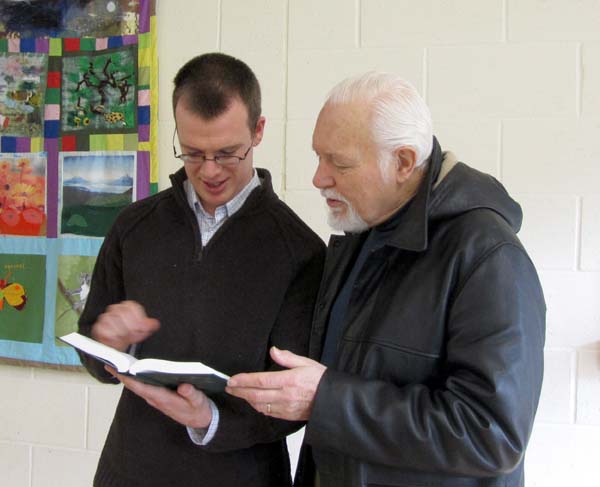
"Well, Jim, for starters, it says here this translation is in the Transylvanian Saxon dialect of Romania, and you've never even traveled outside of Indiana."

“Well, Jim, for starters, it says here this translation is in the Transylvanian Saxon dialect of Romania, and you’ve never even traveled outside of Indiana.”

It took a long time for me to accept this as truth, but after years of discontent with the traditional quiet time formula handed down to me by my Sunday School teachers and youth camp counselors, I finally realized that what bothered me most was that the method didn’t stimulate my heart and mind according to the unique way God made me.

We’re all wired in a one-of-a-kind way. Sure, there are common practices and activities that the majority of us enjoy, and there are also common disciplines every Christian is expected to engage, but God is well aware that no two people are exactly alike. He designed us that way. We have differing personalities, our minds develop differently and at a variety of paces and speeds, and some things that interest you will never fascinate me. Moreover, we also grasp concepts in diverse ways, according to different stimuli, and a particular truth might not resonate with me at the same time or in the same way that it does with you, based on the variety of emotions, passions, and experiences we bring to the table.

Now, let’s take the truth about individuality to its logical conclusion. If it is true that God uniquely creates each person, then it is also true that every relationship between two people is also unique.

Checkmate.

Checkmate.

Anybody who has read a book on relationships can tell you that while some advice might have been helpful to his or her own relationship, not everything in the book was applicable. That’s because there is no perfect formula to a successful relationship. A relationship is not a binding contract; it’s a decision of intimacy between two individuals who, whether they are aware of it or not, bring their own ideas, ambitions, ideals and temptations into play. A healthy, successful relationship is an intentional and careful commitment to interact with each other’s idiosyncrasies, rather than denying their influence.

For example, my wife and I have a relationship that is unique to us. One of the things we’re still learning but know is important is not to force one another to speak or act in a way that is contrary to our designs. This doesn’t mean we don’t strive to connect with one another, nor does it mean I don’t adopt certain behaviors that support my wife and give her pleasure. However, pretending to be someone I am not is no good for Leigh, and vice versa.

How many times do I have to tell her that doing the dishes isn't my spiritual gift?

How many times do I have to tell her that doing the dishes isn’t my spiritual gift?

Now, if a quiet time is what a Christian does in order to experience a vibrant, intimate, and healthy relationship with God, then it stands to reason that conforming to a certain way of thinking, reading, and praying might not be the most beneficial way to deepen or strengthen that relationship. Just because God is a constant in the equation doesn’t mean each Christian must commune with him the exact same way. One of the most well-known statements of the late Brennan Manning’s is, “God loves you as you are, not as you should be, for no one is as they should be.” If I believe this, then the last thing I would want to do is pretend to be someone I am not in my relationship with God.

I love the looks on people’s faces when I suggest that, given their individual passions and interests, they might consider a solitary hike in the woods to be their quiet time, or gardening, writing poetry, even preparing a meal. Sure, the reading of Scripture is important and should not be neglected, but God is able to move in a million more ways than the standard methods so many of us so often conform to. Rather than slog through a formula that squelches your individuality, why not seek out the methods that stimulate your own peculiar composition?

As we continue in this series, I will cover the biggest dangers of conforming to a formula rather than creating one that works with a person’s God-given uniqueness. Above all, we should always remember that a quiet time should awake one’s soul, not burden it.

Is There Something Wrong with Your Quiet Time?

In a post dated August 5th, I promised to expound on the misconceptions of “quiet times.” This follow-up grew so lengthy that I feared it would put off even the most dogged of blog readers. I decided to break it down into five smaller posts, each detailing a major problem with keeping a traditional, daily quiet time. Here is the first installment of this series. 

young man reading small bible

A daily “quiet time” isn’t biblical.

Please don’t get me wrong – spending time with God is totally biblical. The Bible is filled to the brim with examples of people who intentionally spent time in prayer and individual worship, not to mention reflection influenced by the scriptures. However, at no point in the Old or New Testaments is there a clearly described plan for what we in the Church today refer to as a “daily devotion” or “quiet time.”

Though this is totally on the level! (he said with heavy sarcasm).

Though this is totally on the level! (he said with heavy sarcasm).

Now, when I refer to keeping a personal Bible study and prayer time, I am referring to a genuine desire to spend time with the Creator and invite his Spirit to transform your life, bit by bit, inch by inch. If, however, you are the kind of person who keeps a quiet time out of obligation and cold compliance, it is safe to say you’ve already got the whole endeavor backwards. (More on that in a later post…)

So, how dare I insinuate that a daily quiet time isn’t biblical?

It’s not to argue against the value of a quiet time, but rather to dispel the myth that keeping one is an explicit command found in Scripture.

"Commandment 11: Thou shalt give Oswald Chambers's MY UTMOST FOR HIS HIGHEST to every graduating high school senior..."

“Commandment 11: Thou shalt give Oswald Chambers’s MY UTMOST FOR HIS HIGHEST to every graduating high school senior…”

First of all, let’s look at the individual parts of a standard quiet time. (I am going off of the allegedly tried-and-true formula passed down to me by many a Sunday School teacher and youth camp leader when I was growing up).

  • Bible study – Let’s ignore the fact that the closest thing ancient and first-century Jews had to devotional books was Rabbinic midrash; it would have been nearly impossible for common folk living in either testament’s time to engage in personal Bible study as we know it today. While we have evidence that portions of the Oral Tradition was written down as early as the second millennia B.C., it wasn’t like these writings were available to common folk. Thus, the Jewish people are reminded many times in the Pentateuch that Scripture (specifically the words and acts of God to his people) was not something to be studied over time, but intrinsically remembered. Which brings us to the second component…
  • Scripture memorization – This discipline was actually quite prolific. As Judaism developed its educational system, the core curriculum was the memorization of the Torah, and for those who progressed into higher levels of training, it expanded to rote learning of the entire Hebrew Bible. This is one of many aspects of Jesus that is so fascinating. While he showed a phenomenal, interpretative grasp of the scriptures and taught with a level of authority that suggested deep advancement within rabbinical training, he is also derided as a country bumpkin and the son of a blue-collar worker. Given the importance of scripture memorization to the general public back then, my own struggle to commit to memory two measly verses from Ephesians seems pathetic by comparison.
Is that the best you can do, Jimmy Gourd?

Is that the best you can do, Jimmy Gourd?

  • Prayer – The question isn’t whether the people of the Bible prayed, but how many of them compartmentalized their prayer lives into one specific time of day. Not many. For one thing, it was Jewish custom to pray at multiple times during the day, publicly or privately as circumstances dictated. Secondly, we are reminded several times by NT writers that one’s prayer life should be unceasing – that we pray continually throughout the day, rather than in one pre-determined time. This wasn’t a radical new teaching, but simply a return to the kind of faithfulness implied in the Law, the goal of which was deep communion with God.
  • Journaling – Most of us are aware that very, very few biblical heroes had access to writing materials with which they might accomplish this part. A chisel and stone, maybe, but papyrus was pretty hard to come by. Sure, the Jews had been writing things down for centuries, and Peter, Paul and the apostles were able to write letters. But always having a Mead notebook at the ready has been a luxury reserved only for the last century’s worth of Christians. Perhaps this is why Jesus wrote in the dirt – it was readily available.
Rich boy.

Rich boy.

To sum things up, what we find in the Bible is that the children of Israel – and, later, early Christians – are commanded to remember the laws and stories, and to pass them on to future generations. Scripture, therefore, was not just a self-improvement tool, but a living, definitive history that enveloped the nation. Even before it was written down for a select few to access, there was a deeply communal aspect to the receiving of Scripture. This is something I never considered when I used to sit alone in my room trying to come up with modern-day applications from 2nd Chronicles.

So, how does this reality shed light on why and how we engage in a quiet time? Simply that what Scripture encourages is a regularity and an intentionality to a person’s Bible study and prayers. It does not insist on a set pattern. Sure, the ancient Israelites had a very strict set of regulations for temple sacrifice and worship, but those constraints didn’t carry over to the disciplines of prayer and reflection. These balls were left in the court of the worshipper, to not neglect but go about in a humble, authentic manner. This is why we can read the Psalms today and recognize a great variety of expressions to and about God. Because no one was requiring one particular method of devotional articulation.

"You call that a psalm, son?! I only count three metaphors! What would your Uncle Asaph think?"

“You call that a psalm, son?! I only count three metaphors! What would your Uncle Asaph think?”

If you feel your quiet time has lost genuineness – if it has become more about doing something for God rather than being with God – I encourage you to take a lesson from the very scriptures through which you’ve been slogging. When it comes to righteousness, what counts “is faith expressing itself through love” (Gal 5:6). A quiet time is meant to undergird one’s relationship with the Lord. We don’t do it so God is obligated to transform us. We do it so that his Spirit might find our hearts and minds opened to his guidance and provision. It is an expression of loyalty and love, not a set of daily chores.

Having opened this series with what quiet times shouldn’t look like, in my next post I will do my best to consider how they should look. There’s certainly more that needs saying. However, may these words from Frederick Buechner be a point of reflection in the meantime:

Be importunate, Jesus says – not, one assumes, because you have to beat a path to God’s door before he’ll open it, but because until you beat the path maybe there’s no way of getting to your door… because the one thing you can be sure of is that down the path you beat with even your most half-cocked and halting prayer the God you call upon will finally come, and even if he does not bring you the answer you want, he will bring you himself.

Better Words

For The Ink Well Creative Community

Word: Substitute
Parameters: Write for 15 minutes without stopping

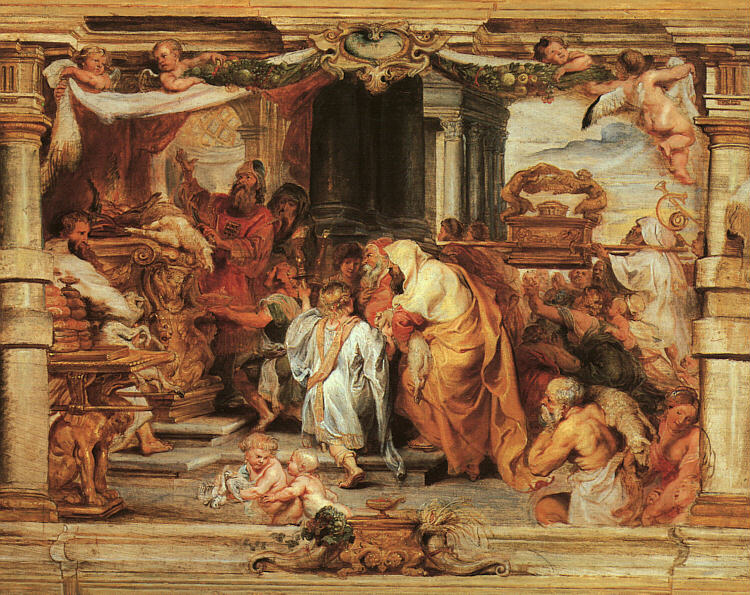
Sacrifice_of_the_Old_Covenant_Rubens

the blood of bulls and goats cry out
from the ground, a ferment flowing
was death for naught, o chosen ones?
the left hand cuts; the right hand grasps
for pleasures to fill the clean slate
perpetual slaughter provides
the fire burns, never dies away
in your place we stand, knife to throat
will you remember us at all?

Substitute for sin, once for all
if this is what they need then why
were we called to give for so long
and why, when they finally see,
do they debate the hows and whys?
Ransom, Penal Satisfaction,
Christus Victor, Exemplary,
Universal or Limited
what power is there in a name?

is not power found in the blood?
does it not ferment even now?
does it not flow for you each day
you chosen ones, you wanderers?
the left hand pierces flesh with nails
the right hand gambles on garments
and the eyes behold death and say
surely this was a God unknown
will I remember him at all?

for those who faced death every day
so you might have a way to peace
the blood you spilt speaks better words
than those you use to describe this
in sight of death, theories shudder
and hang their heads, speechless, silent
and hope in this redemption too
let these words reign, for what we were
He is, forevermore, Amen.

Within You

For The Ink Well Creative Community

“You wander from room to room
Hunting for the diamond necklace
That is already around your neck.”
-Rumi

Prompt: Write something in response to the quote.
Parameters: 15 minutes

billboard

They choose a billboard.

Though there is still thirteen years to go, they follow the instructions of their pastor. They put down a deposit and find someone to design the look of it. After this, one of the crews that changes out the facades takes that design, renders it according to the necessary materials, and a few days later the date is displayed for every northbound motorist to see – an intentional eyesore, gaudy in its size and color.

Beneath the date, in smaller letters, they offer a cryptic subject line and provide their website.

And now they wait.

In thirteen years they will fly to Israel. They will bring along suitcases packed solely out of practicality: what do you wear to a Second Coming?

They will do a little sight-seeing first. Who wouldn’t? It’s the Holy Land, after all, and they don’t expect to ever lay eyes on it again. At least not on the way it looks now, all corrupted by non-believers and heretics.

And then, on the determined day announced by the pastor who, in his adamancy, has satiated their hopes for an escape from this corrupt world, they will climb Mount Olivet (as they prefer to call it), pick a nice spot facing the once holy Holy City, and fix their eyes on the vista. They will wait to see it change. To see the clouds do something out of the ordinary. To see Someone split the sky.

And take them home.

And then, once the day ends and that which they have waited thirteen years to see does not unfold, they will look at one another, confused, heartbroken, disillusioned. Some will make concessions, suggesting an innocent glitch in their pastor’s figuring due to time zones or hemispheres. The one who endlessly quotes the Old Testament will suggest that the day the sun stood still, as recorded in the Book of Joshua, could be a reason, and they should stay put one more day to be sure. A few others will feel their hopes – both in deliverance and in the man they have called their pastor – dissolve. The pastor himself will say nothing. Not yet, anyway. Not until he can figure out how to explain himself without losing the bulk of his flock.

They will return to their home country. The deposit will expire. The billboard will revert to the company that owns it, and an advertisement for a truck stop or a local university, or perhaps just one of those “Does Advertising Work? Just Did.” signs will replace their announcement.

And one of them – at least one of them – will turn to her well-worn Bible out of despondency, to the Scriptures she has memorized and manipulated but never respected. On one sunny morning, not long after her return from the Mount, she will sit at her kitchen table, a mug of steaming coffee to her right and a journal and pen to her left, and she will read the words before her with no predetermined agenda. And for the first time in longer than she can remember, the sound of the Savior’s voice will not sound to her like the voice of the old pastor with his curmudgeonly sermons and dire predictions.

Tears will well up, because for the first time in so very long, Jesus will not sound angry or disappointed. He will sound kind. He will sound patient. He will sound like love.

In that moment at the kitchen table with the steaming mug of coffee and the morning light filling the room, he will gently remind her that hoping in his return has nothing to do with predictions and signs and best-laid plans. The escapists and code-breakers and treasure hunters go after such things. “Here it is,” they cry, though they have found nothing at all.

She will pick up the pen and write only seven words in her journal, the shortest entry it has ever received.

“The kingdom of God is within me.”

Are We Up for This?

I wonder if most believers are really interested in the salvation Jesus offers people.

Let me clarify that statement. In my last post, I wrote about the alleged difficulty of defining the term “spiritual formation.” My argument was that the difficulty only comes when we lose sight of what those two words really mean. When you look at their roots, it’s not difficult to see what we’re describing when we’re saying someone is being spiritually formed. The Spirit is at work in that person, forming him or her into something different. Something new.

But for those who think that sounds perfectly agreeable, Jim Smith, executive director of The Apprentice Institute, reminds us, “Formation involves every single aspect of our lives: our thoughts, our emotions, our bodies, our experiences, our relationships, our resources, our time management, our loved ones, our health, our sexuality, etc. … There is no area of our lives that is not a part of our formation process. It is not, as I used to think, a separation of sacred and secular, of spiritual and physical, but a holistic, unified endeavor.”

I’m not sure many of us are up for that kind of formation.

But that’s the kind of conversion Jesus wants to bring to us. It is a far-reaching formation – a wholesale wholeness.

feature6

By and large, though, people have stopped seeing Christianity this way, as a comprehensive transformation of body, mind and soul. Instead, we’ve portrayed a faith that is concerned only with moral behavior, or “traditional” values, or what comes after death. Christians have ceased seeing the all-inclusiveness of God’s transformative power.

I’m a Spiritual Person

I’m a fan of modernity. As a former teacher of American literature, I didn’t think the curriculum became fun until we hit the 20th century. However, with the modernization of the West came the tendency to relegate “spirituality” to one facet of what we began to think of as a multifaceted existence. Those who wanted to maintain belief in the supernatural – in that Something beyond ourselves – nonetheless compartmentalized that perspective in such a way that “the things of the Spirit” gradually began to lose influence over the other aspects of our lives. As modernism permeated the culture, our identities began to look like a region full of autonomous city-states. The social/relational sphere of our lives won its independence from all the others, as did the vocational/financial sphere, the familial sphere, the emotional sphere, the physical sphere, and so on. Sure, there has always been interaction between all of these various parts of our identity, but people are quick to guard the self-sovereignty of each one.

Pictured: Our identities.

Pictured: Our identities.

A perfect example of this is the all-too-common referral to being “a spiritual person” (many professing Christians included). Rarely are these people referring to a tangible, active presence – or Spirit – at work in their lives. Rather, what they are describing is a more self-seeking posture that feeds off of feelings we can’t easily name but still enjoy. Modern spirituality has become an amorphous pursuit – a hobby easily tailored according to each person’s preferences. Because of this, it is not uncommon to encounter a person who claims to be very “spiritual” but whose other spheres of life seem mostly unaffected by that spirituality.

This was not the kind of spiritual formation Jesus was referring to when, in Gethsemane, he promised the disciples that the Holy Spirit was coming.

All the Fullness of God

Likewise, there’s a moment in the middle of St. Paul’s letter to the Ephesians when he expresses what his prayers are for them, a church he so dearly loves. Having challenged them to recognize that the mysteries of God have finally been revealed in Jesus, and that this revelation changes everything, he writes the following:

“I pray that out of his glorious riches he may strengthen you with power through his Spirit in your inner being, so that Christ may dwell in your hearts through faith. And I pray that you, being rooted and established in love, may have power, together with all the saints, to grasp how wide and long and high and deep is the love of Christ, and to know this love that surpasses knowledge – that you may be filled to the measure of all the fullness of God” (Eph. 3:16-19).

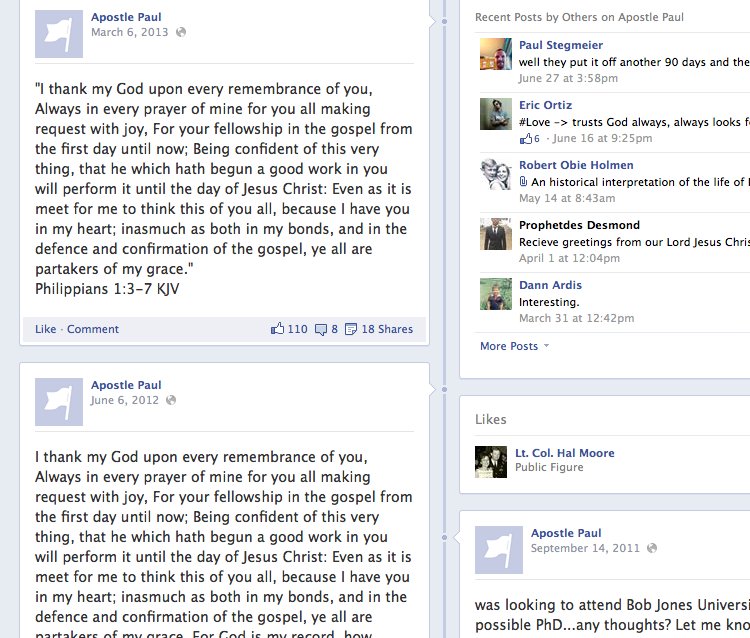
If Facebook were around in the first century, Paul would have been that annoying friend who always posts longwinded prayers in his status updates.

If Facebook were around in the first century, Paul would have been that annoying friend who always posts longwinded prayers in his status updates.

Paul was referring to a transformation that affected every aspect of a person’s existence. So was Jesus, when he said he came that we “may have life, and have it in abundance” (John 10:10).

Thus, the salvation offered by Jesus is not found in laying down only one sphere of my identity, but when I relinquish them all. Jesus is not the Lord of only the spiritual parts of my life. He is the Master of it all – my social interactions, my job and finances, my family, my emotions, my physical health, and so on. Jesus understood that just as we are not created in part but in whole, our recreation must happen the same way. Salvation is all or nothing.

Amen, Yoda. Amen.

Amen, Yoda. Amen.

Sure, there will be times when our rationalism causes us to doubt even a good and beautiful God, and we feel a need to hold something back. But this is why Paul’s prayer included a plea “to know this love that surpasses knowledge” – that our doubts would not lead to self-reliance, and our minds would be transformed alongside everything else. That by surrendering, we would learn surrender.

Simple, Not Easy

Like I said, I’m not sure we’re interested in that kind of salvation.

The Gospel is simple, but that doesn’t make it easy. We understand that by our own efforts we cannot save ourselves. Our healing and wholeness requires an act of God, and that act was Jesus. Believing this is simple enough. But responding to it is not so easy.

The problem for those who stop at mere belief is that salvation requires belief and response. What kind of response? Oh, just the relinquishing of every element of control you enjoy over your existence. Just the surrender of every sphere of your life into the hands of Another.

Amen, Neo. Amen.

Amen, Neo. Amen.

Simple? Yes.

Easy? Definitely not.

Maybe this is why so many of the most powerful stories of transformation we hear – the ones that stick in our minds long after we’ve listened to their telling – are the ones in which people surrendered their lives to Jesus after their lives became a complete wreck. They were at the end of their rope, the candle was flickering, the water was almost over their heads, there was nothing left to live for … and that’s when Jesus changed everything.

Perhaps too many of us still feel like we have something worth living for – a sphere of life we’ve arranged too much to our liking. Even if its not perfect, we’d rather keep things as they are than risk what might change if it were devoted to God.

I wonder why that is.

I’ve heard a lot of ministers complain that people are just too lazy to really seek after formation. But what if laziness isn’t our core problem?  What if our problem is bad theology? I mean, do we or do we not believe that God is good? That he is generous and trustworthy? That he desires the best for us, and that he has promised to daily care for us?

Because, if we really believe those things, what on earth has prevented us from responding?

The Answer in the Question

I’m two months into a new position at a new church. That position is Minister of Spiritual Formation. Apparently, the title isn’t self-explanatory, because upon introducing myself to church members, I am often asked to explain what exactly I do at the church.

Now, the puffed-up, self-centered part of me wants to balk at such questions, and the cynic in me wants to scoff and say, “What do you mean? Do you ask the music minister or the youth minister to explain what it is they do?” But, at the same time, the realist in me just gets anxious.

"Whatever happened to a simple "'preciate ya'" and a handshake?"

“Whatever happened to a simple “‘preciate ya'” and a handshake?”

Here’s why. Several years ago, I remember sitting in an interview with a church’s search team and being asked essentially the same question. The woman who asked it had done her homework on me; from where I sat across the conference table, I could see her detailed notes written into the margins of my resume, a legal pad replete with questions she considered asking me, and underneath that a black, three-ring binder containing photocopies of several posts from my blog. Perusing these for a few seconds, she looked back up at me and said, “You write a lot in your blog about ‘spiritual formation.’ It seems like that term comes up a lot. I was just wondering, what is spiritual formation?”

I remember feeling simultaneously excited and apprehensive by her question.

Excited, because this was one of the first interview questions that had to do with my personal convictions and interests in ministry (as opposed to programs I had started and events I had planned), and it would be refreshing to speak to a deeper level of what it means to be a minister.

Apprehensive, because I was hardly prepared to give a succinct and comprehensive answer to her question.

"Uhhhh... no comment?"

“Uhhhh… no comment?”

You see, at the time “spiritual formation” was still somewhat of a nebulous concept to me, despite however many times the term found its way onto my blog or into my lessons. It was something I was profoundly interested in, of course, but also something that intimidated me as much as it inspired me. I was convinced I wanted to focus on it in my ministry, both in philosophy and practical direction, but despite collecting several books on the subject, I was still unsure how to work with, in, and toward spiritual formation.

Still, it is not like me to forego offering my opinion on anything. So when this woman asked her question, I let very little silence fall before I opened my mouth to speak. However, another person on the search committee beat me to answering. He said quickly and dismissively, “It’s just another word for ‘discipleship.'”

His answer threw me off, and I slowly closed my mouth. It’s tricky enough to respond to the open-ended question, “What is spiritual formation?” Explaining the error in confusing it with discipleship, especially in the context of a job interview, is a whole other level of difficulty.

"Which brings me back to why you are all completely wrong and have no choice but to hire me to save you from your wrongness."

“Which brings me back to why you are all completely wrong and have no choice but to hire me to save you from your wrongness.”

The Hunt for a Good Definition

I learned two things in that interview. The first was that it is not uncommon to encounter long-time, active church members who have little idea what spiritual formation is. The second was that I was one of them.

Defining spiritual formation is not necessarily a hard thing to do. People have been offering their elucidations on the term for quite some time. (Jim Smith just wrote a great series of posts covering it from every angle.) However, because every person whom the Spirit forms is a unique individual woven together by an elaborate and distinctive collection of characteristics, attributes and idiosyncrasies, sometimes the only definition that seems to truly fit is the one you craft yourself.

How pompous can you be, Merriam-Webster?

You don’t know everything, Merriam-Webster.

After the interview, I at least knew where not to start. I knew spiritual formation was not simply another term for discipleship. The two are intimately related, for sure, but even my limited understanding cried out against belittling either term by calling it a mere synonym of the other.

I decided to start with defining discipleship, something that did not intimidate me as much. Oddly enough, it was this endeavor that led me to an answer for the other.

Defining discipleship seemed easy enough; I just looked more closely at its root word: disciple. Once I cleared away the cobwebs of antiquated Christianese words that were part of my small town Baptist church upbringing – words like “discipleship training” and “church discipline” and “Disciple Now Weekend” – I was able to return to the original meaning of the word. From the Greek mathetes, meaning learner, pupil or apprentice, it was often used to describe the students of a rabbi, and in the case of the Gospels, this means Jesus. Rabbinic disciples were meant to learn from their teacher, to emulate them in every way possible, and, eventually, to carry on that rabbi’s teachings – also known as their rabbi’s “yoke” – as a formative part of their own.

If this is not the very example provided us by the likes of Peter, James and John, I don’t know what is.

The Mount of Transfiguration. Also known as the original Disciple Now Weekend.

The Mount of Transfiguration. Also known as the original Disciple Now Weekend.

So, if discipleship is the commitment to being a disciple, and being a disciple means emulating one’s teacher, then Christian discipleship simply means, as one of his disciples wrote, “walking as Jesus did,” and another added, “fixing our eyes on Jesus, the author and perfecter of our faith.” Jesus is both the example and the focal point for our thoughts, words and actions.

And wouldn’t you know it, this was all right there in the word itself. It wasn’t complicated.

The Title Is Self-Explanatory

Naturally, this led me to reconsider the term “spiritual formation,” taking again the root word – or, in this case, the root words. “Spirit” and “forms.” I was struck by the fact that these two words alone was almost a workable sentence in itself. Spirit forms. What is more, it sounded as much like a declaration as it did a reminder. In John 16, Jesus declares that it is the Spirit who leads us into all truth. And every time I try to arrange and organize and methodize my life so that I might feel like a more effective person, my inevitable shortcomings bring God’s reminder: “No, Bo. The Spirit forms. Not you.”

This, then, must be the first step toward any measure of spiritual formation. There must be the element of surrender. I’ve heard some people describe the concept as a “pursuit of God,” but spiritual formation is not about us chasing after God. Rather, we are the ones who lay down our arms – the dependencies and life structures that rival his promised provision – and wave the white flag. It is not us creeping closer to God’s territory, but rather God invading our once guarded spaces. If it is a pursuit, it is a pursuit of man by the Holy Spirit.

I could do a whole predator-becomes-prey illustration thing, but not everyone sees the deep theological implications of this movie.

I could do a whole predator-becomes-prey illustration thing, but not everyone sees the deep theological implications of this movie.

This is similar to discipleship. Jesus said that if anyone wanted to be his disciple, that person had to deny himself. This doesn’t mean that discipleship and spiritual formation are the same, but it doesn’t reveal that an essential element of the Christian life is the relinquishing of control over our abilities and circumstances.

The difference between the two is that discipleship is the commitment we make to follow Jesus according to his call. Spiritual formation is what takes place once that following begins, when the Spirit begins its transformative work in our hearts and minds.

So, what exactly does a Minister of Spiritual Formation do?

If I’m shepherding a person effectively, then I am helping him understand the principle common to both experiences – that it isn’t all about him. A minister attends to the needs of others, so I’m reminding him that he doesn’t need the worship service to conform to his preferences. That his Bible study doesn’t need to utilize his favorite curriculum. That fellow church members don’t need to think and act the way he feels they should.

"Again with the rattlesnakes?! I really think he should use more copperheads! They much more aesthetically pleasing."

“Again with the rattlesnakes?! Copperheads are much more aesthetically pleasing, Pastor.”

I tell him that what is truly needed is something only God can give. And, if I do this well, he learns to accept that the community of God is something larger and grander than his own imagination’s limits. He comes to see it is infused by a very big and very beautiful God who has a purpose and an agenda so much greater than any one mind can grasp.

A Minister of Spiritual Formation provides opportunities upon opportunities that challenge people to experience the grandeur of God. I’m pointing them to ministries and programs and events and studies not simply because that’s what going to church is all about, but because these things hold the potential to reveal how, as Hopkins wrote, “Christ plays in ten thousand places / Lovely in limbs and lovely in eyes not his / To the Father through the features of men’s faces.”

It’s not always the easiest thing to explain, but not everything has to be easy to explain. When people hear my job title and ask me what I do, I’ve stopped sweating the question. Instead, I smile and tell them, “I make sure people aren’t so focused on their own lives that they forget they’re a part of something much, much greater.”

It may not be the answer they are expecting, or the one that clarifies things the way they were hoping when they asked the question. I’ve only been here two months, so I’ve still got a lot of work to do when it comes to helping people live into their own definitions.

But when it comes to explaining spiritual formation to someone, I’ve decided that is as much the Spirit’s job as it is mine.

Bedtime Prayers

I became a Christian because I was afraid of hell. I was afraid I would die before I woke. I was afraid of where I might end up if I didn’t pray a special prayer that assured my protection.

As a kid who already struggled with a plethora of nocturnal fears – of monsters and ghouls and all manner of wicked-faced, sharp-toothed frights – the last thing I needed to fixate on at eight years of age was the dreadful image of an eternal, fiery torment. I had enough trouble falling asleep as it was. So, one night, moved as much by an overactive imagination as by the Spirit, I prayed a patchwork sinner’s prayer – penitent phrases I had gleaned from church services and Vacation Bible Schools and stitched together by my hushed lips mumbling the words into my pillow.

Beside my bed, a Voltron nightlight projected the blazing image of a robot protector on the ceiling of my bedroom. In hindsight, I realize that the image wasn’t a far cry from my theology at that time – that God was an all-powerful being who watched over the weak. Something invincible that could vanquish the terrors that slithered out from a dark realm. But, as I understood it, if you had not acknowledged his all-powerful-ness and verbally professed your belief in his invincibility, you were bound for that dark realm, where you would suffer forever and ever. And so, I prayed.

It’s been twenty-six years since I lay in my childhood twin bed and whispered a desperate prayer for, among other things, peace of mind at bedtime. I’ve grown quite a bit since then, in every form of the word. I’ve learned quite a bit about God and Jesus and salvation and faith and grace, not to mention about sin and hell. I’ve been baptized. I’ve led Bible studies and taught Sunday School classes. I’ve obtained a seminary degree. I’ve been ordained into full-time church ministry. I’ve worked in many different churches and organizations in which all of the above beliefs and experiences have been well utilized.

And yet…

There are those nights lying in bed, waiting for sleep to usher me away, when I feel surrounded by fears as irrational but as palpable as the ones that tormented me when I was eight.

I don’t fear the darkness of hell anymore, but I do fear the very real possibility of separation – of loss and abandonment. I don’t fear the agony of the fire, but I do dread physical ailments and illnesses and the cruel what-if’s they cast before my mind’s eye like a fishermen’s lures. I don’t fear the prospect of an eternity apart from God, but in the quiet of my bedroom I stress over the realization that I have not lived my life as closely to his truth as one should.

My theology has developed in countless ways over the past twenty-six years. My God is bigger than he has ever been, and he only continues to increase, emerging from the shadows cast by my limited understanding in ways that remind me he is not – he cannot be – a figment of my imagination.

But the darkness at the end of the day remains a place where doubt resides, where fear thrives. So, with the same mixture of hope and terror that I possessed when I was eight, I still speak words into my pillow. Words of trust and rattled optimism. I ask for protection. I ask to be saved.

And I am convinced that, just as it was when I was eight, there is something greater going on. Something wider and deeper is taking place – something invincible and yet as connected to me as these doubts and fears that never fail to show their threatening faces and gnash their vicious teeth when I turn out the lights. This Something is that which fulfills the words of the Apostle John, that “perfect love casts out fear.”

It is in this Something that I must trust as much at thirty-four years of age as at eight. And when sleep does usher me away, it is this Something that I still believe watches over me while I sleep, like a light on the ceiling.

I am never alone.

The Problem with First World Problems

“First world problems.”

It was a funny categorization at first, but that phrase has begun to wear thin, don’t you think? It’s one thing to recognize that my problems aren’t as significant as other points of suffering in the world. Rarely, though, was this sobering realization followed up by action on behalf of those who are suffering with greater significance.

After all, few of us appreciate suffering. We don’t want to experience it, we get uncomfortable when we witness others go through it, and more often than not it is our guilt and our pity, rather than our compassion, that is aroused when we hear of global atrocities near and far. And, save for a bold few, it would seem that over time Christians in the West have lost their stomach for suffering.

Which is odd.

Because suffering is intimately connected to what Christians are taught to look to as the source and the power of our faith.

Pictured: suffering.

Pictured: suffering.

The ultimate activity of following Christ is to be made like him. It is the journey of sanctification – by the movement of the Spirit within us, we are slowly, day after day, made holy.

Our culture, however, encourages us to have our desires, needs, and aspirations met as quickly as possible. This selfishness is found in a slick-suit preacher who says, “Come to Jesus and he will make your life one joy after another.” While it is true that Jesus promised abundant life to those who would follow him, as the pioneer of that life, he set his “face like flint” (Isaiah 50:7) and walked faithfully on into a violent, fallen world.

Thus the question comes, what is more tragic: the poor and needy who have experienced suffering, or the proud and naïve who have no stomach for it?

If we are to become like Christ, suffering is necessary, and faithful perseverance is the goal. In his influential work, The Orthodox Way, Bishop Kallistos Ware writes, “The Son of God suffered ‘unto death’ not that we might be exempt from suffering, but that our suffering might be like his. Christ offers us, not a way round suffering, but a way through it; not substitution, but saving companionship.”

When we pray for God to reveal to us his glory, we should remember this. It was only after the visibly heartbroken Jesus washed his betrayer’s feet, broke bread for him, and bid him leave to fulfill his treachery that he was able to proclaim, “Now the Son of Man has been glorified, and God has been glorified in him.”

To identify something as a “first world problem” may be to communicate perspective on hardship, but may we never forget that suffering is not something to always be on our guard against. May we be open to whatever comes our way, trusting in the provision and the compassion of a God who truly has seen it all.